Jeff, Oli
Earlier, while trying to relock, we were seeing locklosses preceded by a 0.6 Hz oscillation seen in the PRG. Back in October we had a time where the estimator filters were installed incorrectly and caused a 0.6 Hz lock-stopping oscillation (87689). Even though we haven't made any changes to the estimators in over a month now, I decided to try turning them all off (PR3 L/P/Y, SR3 L/P/Y). During the next lock attempt, there were no 0.6 Hz oscillations seen. I checked the filters and settings and everything looks normal, so I'm not sure why this was happening.
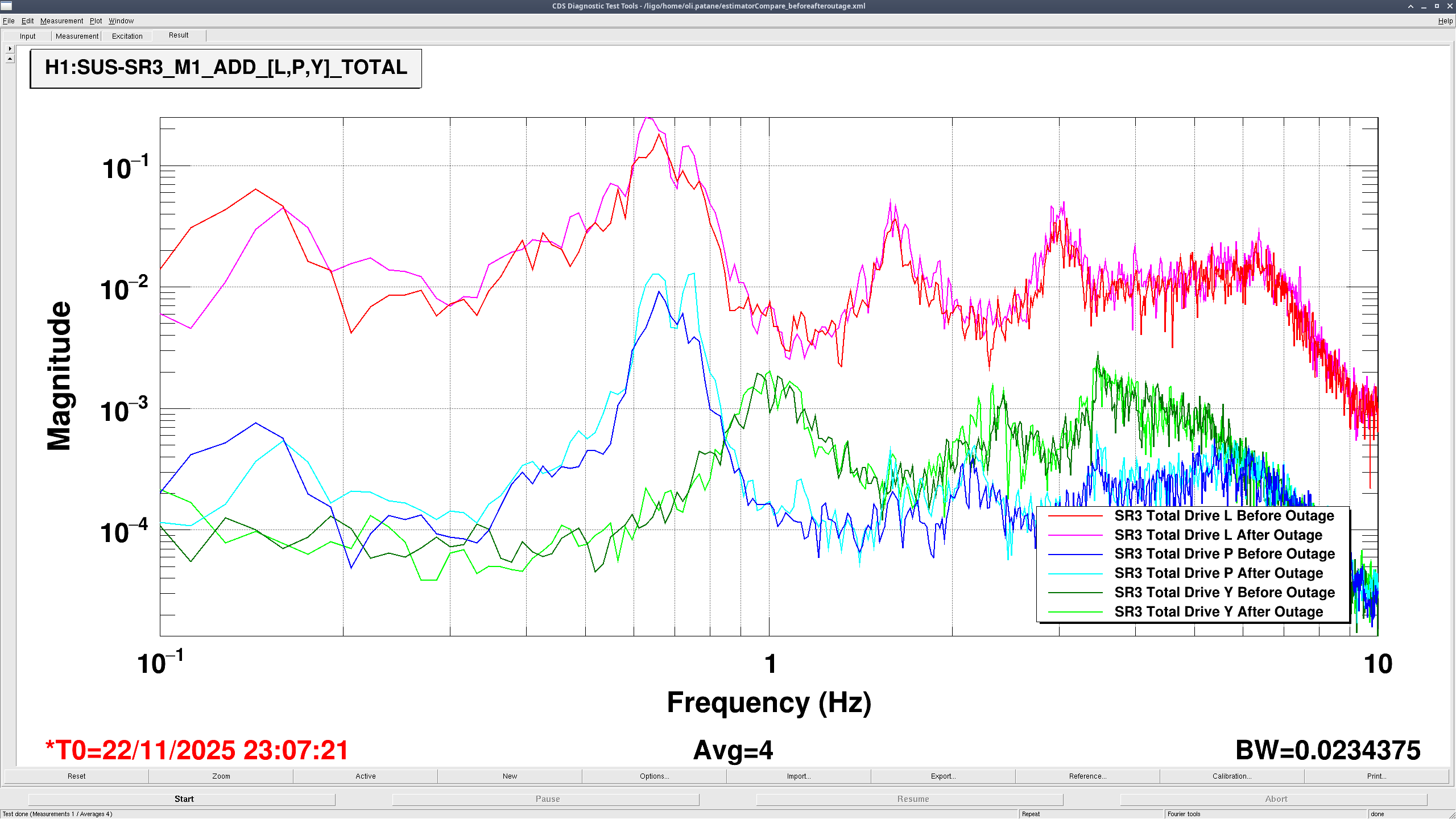
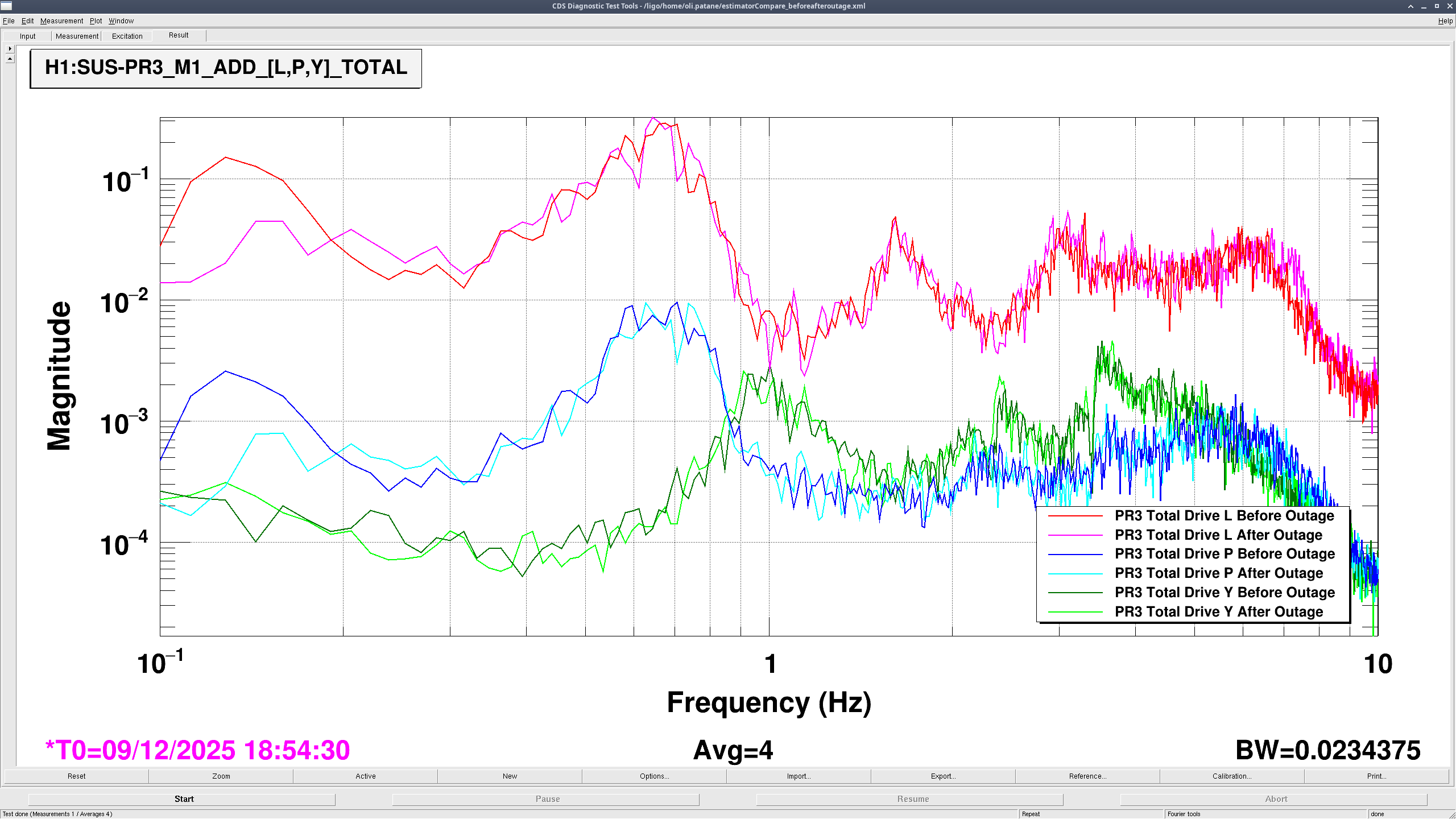
I took spectra of the H1:SUS-{PR3,SR3}_M1_ADD_{L,P,Y}_TOTAL_MON_DQ channels for each suspension and each DOF during two similar times before and after the power outage. I wanted the After time to be while we were in MICROSEISM, since it maybe seems like maybe the ifo isn't liking the normal WINDY SEI_ENV right now, so I wanted both the Before and After times to be in a SEI_ENV of MICROSEISM and the same ISC_LOCK states. I chose the After time to be 2025/12/09 18:54:30 UTC, when we were in an initial alignment, and then found a Before time of 2025/11/22 23:07:21 UTC.
Here are the sprectra for PR3 and SR3 for those times. PR3 looks fine for all DOF, and SR3 P looks to be a bit elevated between 0.6 - 0.75 Hz, but it doesn't look like it should be enough of a difference to cause oscillations.

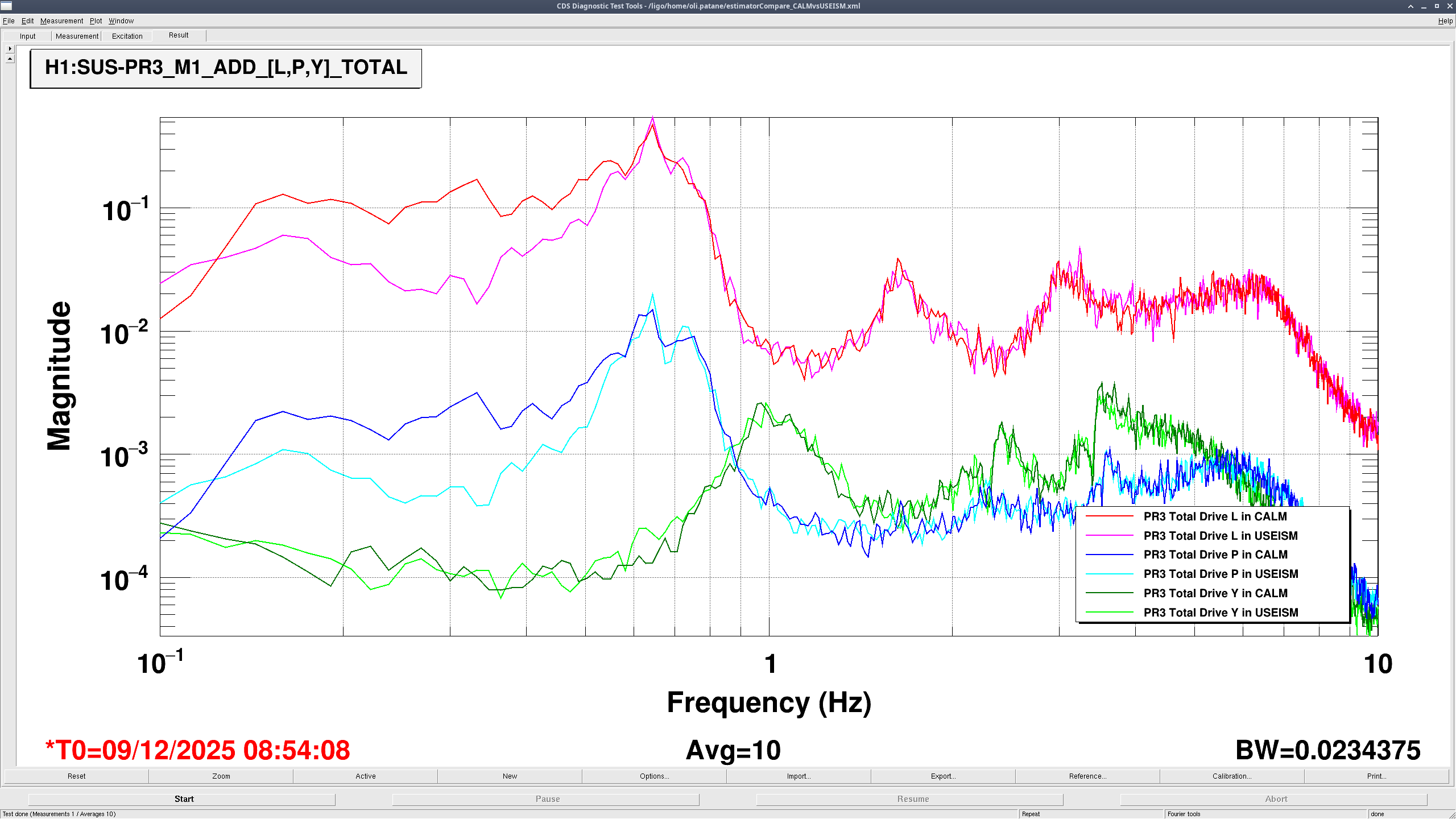
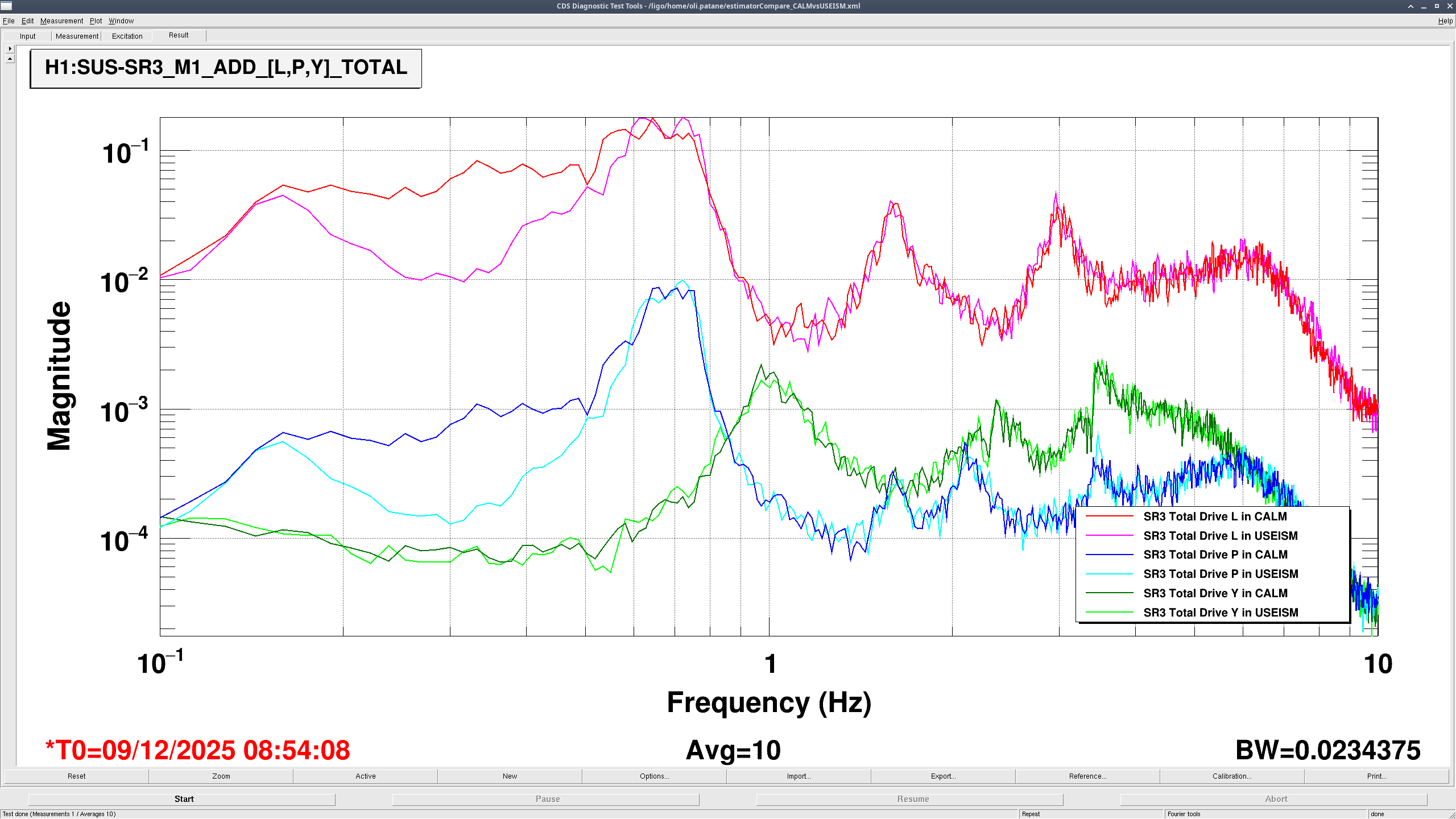
Then, while talking to Jeff, we discovered the difference in overall noise in the total damping for L and P changed depending on the seismic state we were in, so I made a comparison between MICROSEISM and CALM SEI_ENV states (PR3, SR3). USEISM time was 2025/12/09 12:45:26 UTC and CALM was 2025/12/09 08:54:08 UTC with a BW of 0.02. The only difference in the total drive is seen in L and P, where it's higher below 0.6 Hz when we are in CALM.
So during those 0.6 Hz locklosses earlier today, we were in USEISM. Is it possible that the combination of the estimators in the USEISM state create an unstable combination?
This is possibly true. The estimator filters are designed/measured using a particular SEI environment, so it is expected that they would underperform when we change the SEI loops/blends.
Additionally, we use the GS13 signal for the ISI-->SUS transfer function .It might be the case that the different amount of in-loop/out-of-loop ness of the GS13 might do something to the transfer functions. I don't have any math conclusions from it yet, but Brian and I will think about it.
I'm pretty confident that the estimators aren't a problem, or at least a red herring.

Just clarifying the language here -- "oscillation" is an overloaded term. And remember, we're in "recovery" mode from Last Thursday's power outage -- so literally *everything* is suspect and wild guesses are are being thrown on around like flour in a bakery, and we only get brief, but separated by 10s of minutes time, unrepeatable, evidence that something's wrong.

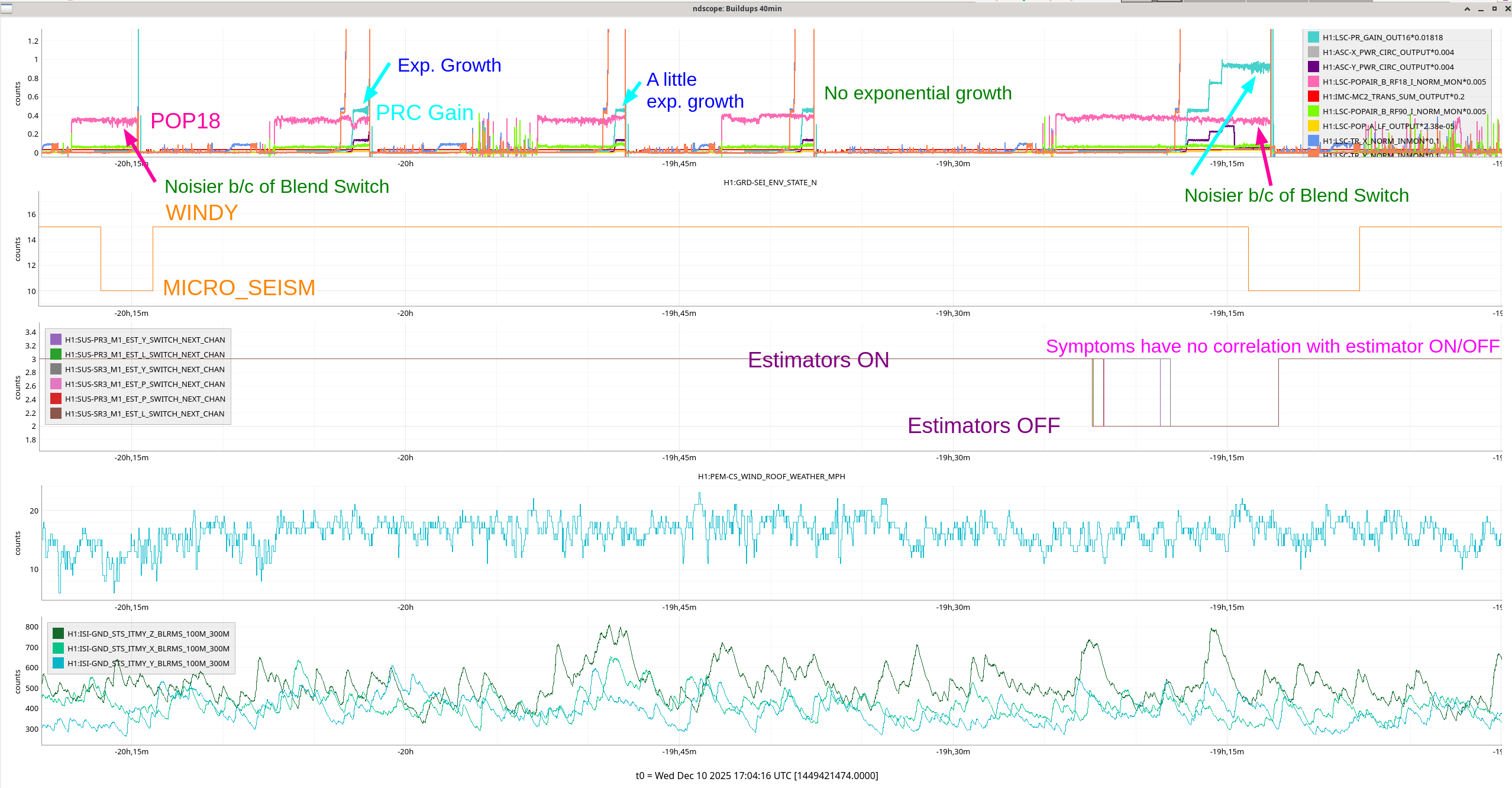
The symptom was "we're trying 6 different things at once to get the IFO going. Huh -- the ndscope time-series IFO build ups as we're locking one time looked to exponentially grow to lock-loss in one lock stretch and in another it just got noisier halfway through this lock stretch. What happened? Looks like something at 0.6 Hz."

We're getting to "that point" in the lock acquisition sequence maybe once every 10 minutes.
There's an entire rack's worth of analog electronics that go dark in the middle of this, as one leg of its DC power failed. (LHO:88446)
The microseism is higher than usual and we're between wind storms, so we're trying different ISI blend configurations (LHO:88444)
We're changing around global alignment because we thing suspensions moved again during the "big" HAM2 ISI trip at the power outage (LHO:88450)
There's a IFO-wide CDS crash after a while that requires all front-ends to be rebooted; with the suspicion that our settings configuration file track system might have been bad . (LHO:88448)...

Everyone in the room thinks "the problem" *could* be the thing they're an expert in, when it's likely a convolution of many things.

Hence, Oli trying to turn OFF the estimators.
An near that time, we switch the configuration of the sensor correct / blend filters of all the ISIs (switching the blends from WINDY to MICROSEISM -- see LHO:88444).

So -- there was
    - only one, *maybe* two where an "oscillation" is seen, in the sense of "positive feedback" or "exponential growth of control signal."
    - only one "oscillation" where it's "excess noise in the frequency region around 0.6 Hz," but they check if it actually *is* 0.6 Hz again isn't rigorous.

That happens to be frequency of the lowest L and P modes of the HLTSs, PR3 and SR3.
BUT -- Oli shows in their plots that:
    - Before vs. after the power outage, when looking at times when the ISI platforms are in the same blend state PR3 and SR3 control is the same.
    - The comparing the control request when the ISI platforms are in microseims vs. in windy show the expected change in control authority from ISI input, as the change in shape of the ASD of PR3 and SR3 between ~0.1 and ~0.5 Hz matches the change in shape of the blends.

Attached is an ndscope of all the relevant signals -- our at least the signals in question, for verbal discussion later.