[Jennie, Jason, Rahul, Betsy, Masayuki]
Betsy monitored the particle count throughout the work, and it remained below 20 at all times.
Summary:
The input periscope was installed and aligned. Minor First Contact issues on the top mirror required a mirror swap with the output periscope, after which installation proceeded smoothly. The periscope height and rotation were adjusted to center the beam on both mirrors and meet the 90° ± 5° rotation requirement with sufficient margin. JM1 was subsequently installed using target irises.
Work Details
-
Aligned the beam to the HAM1 irises. The bottom mirror of the periscope was used to align the first iris, and the top mirror was used for the second iris. Initially, the beam was hitting the left edge of the iris; after several iterations of beam walking, both irises were well aligned.
-
During removal of the first First Contact (FC) on the top mirror of the periscope, we found a small piece of FC residue remaining on the mirror surface. We attempted to remove it by scrubbing, but it could not be removed. Therefore, we decided to reapply FC to this mirror. The periscope was removed from the chamber and placed on a clean tray. Jennie and Betsy applied FC to the HR surface of the top mirror. The second FC attempt was also unsuccessful, so to continue the work without waiting for FC drying, we decided to swap this mirror with the top mirror from the output periscope, which will be installed later. The mirror taken from the output periscope was successfully cleaned, and the FC peeled off properly.
-
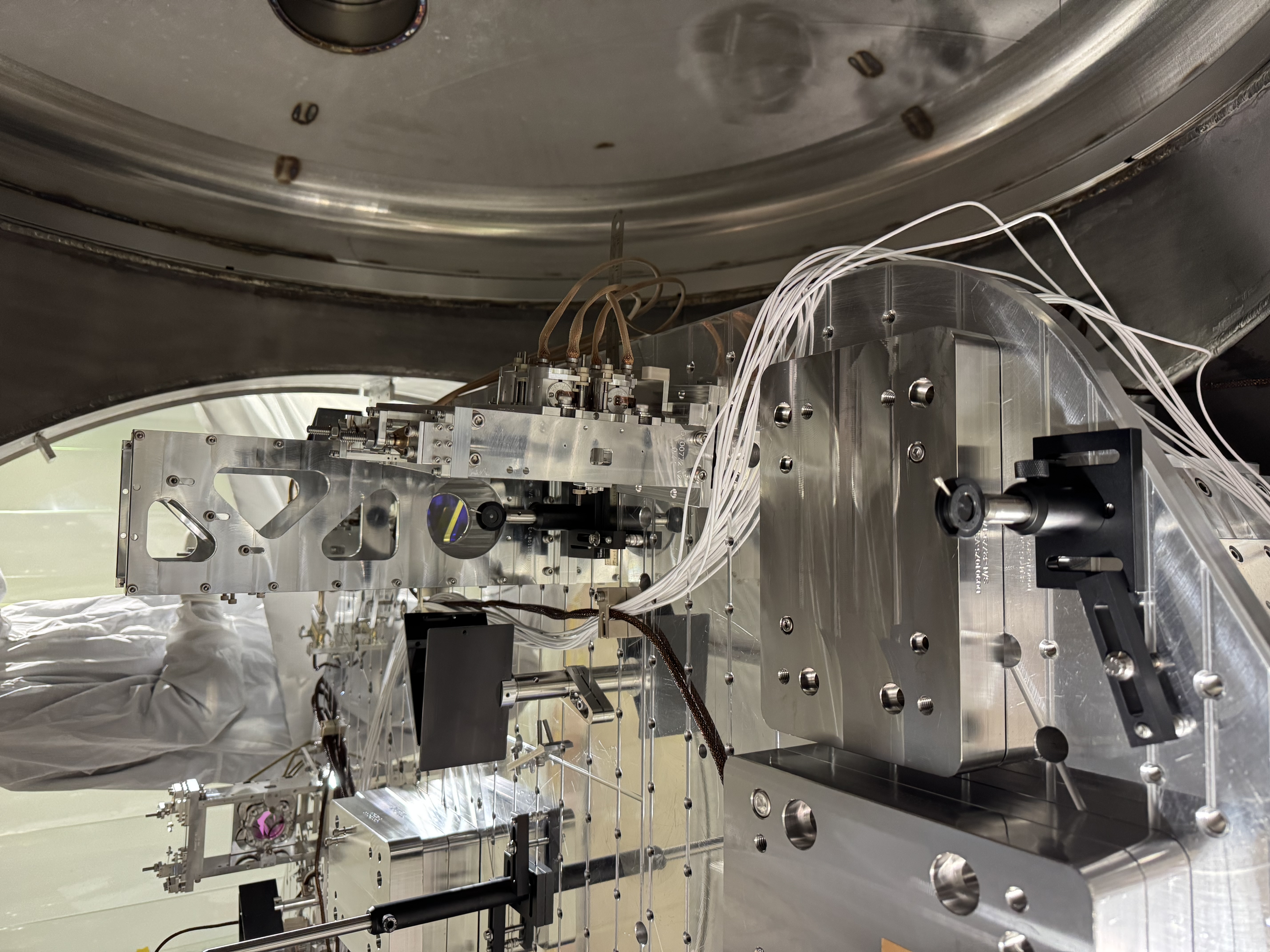
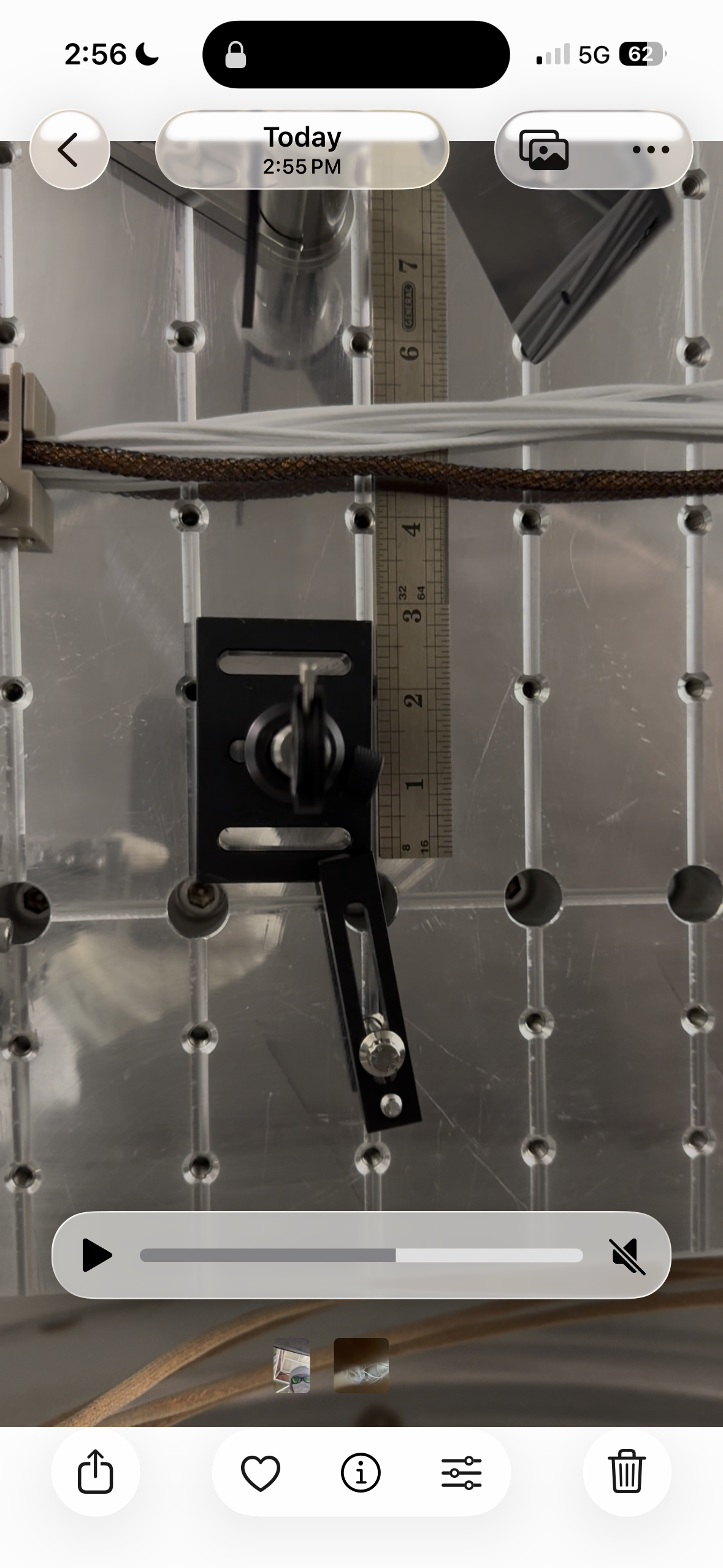
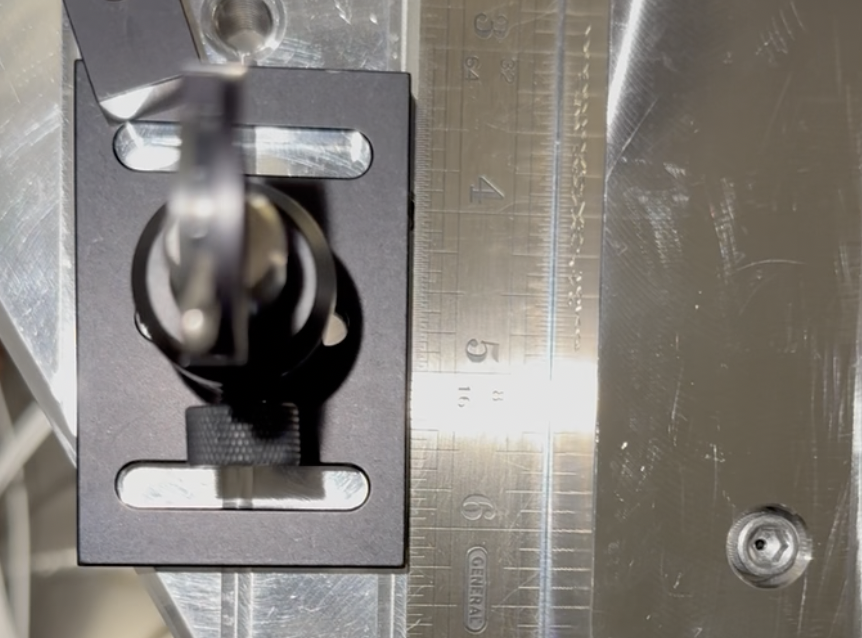
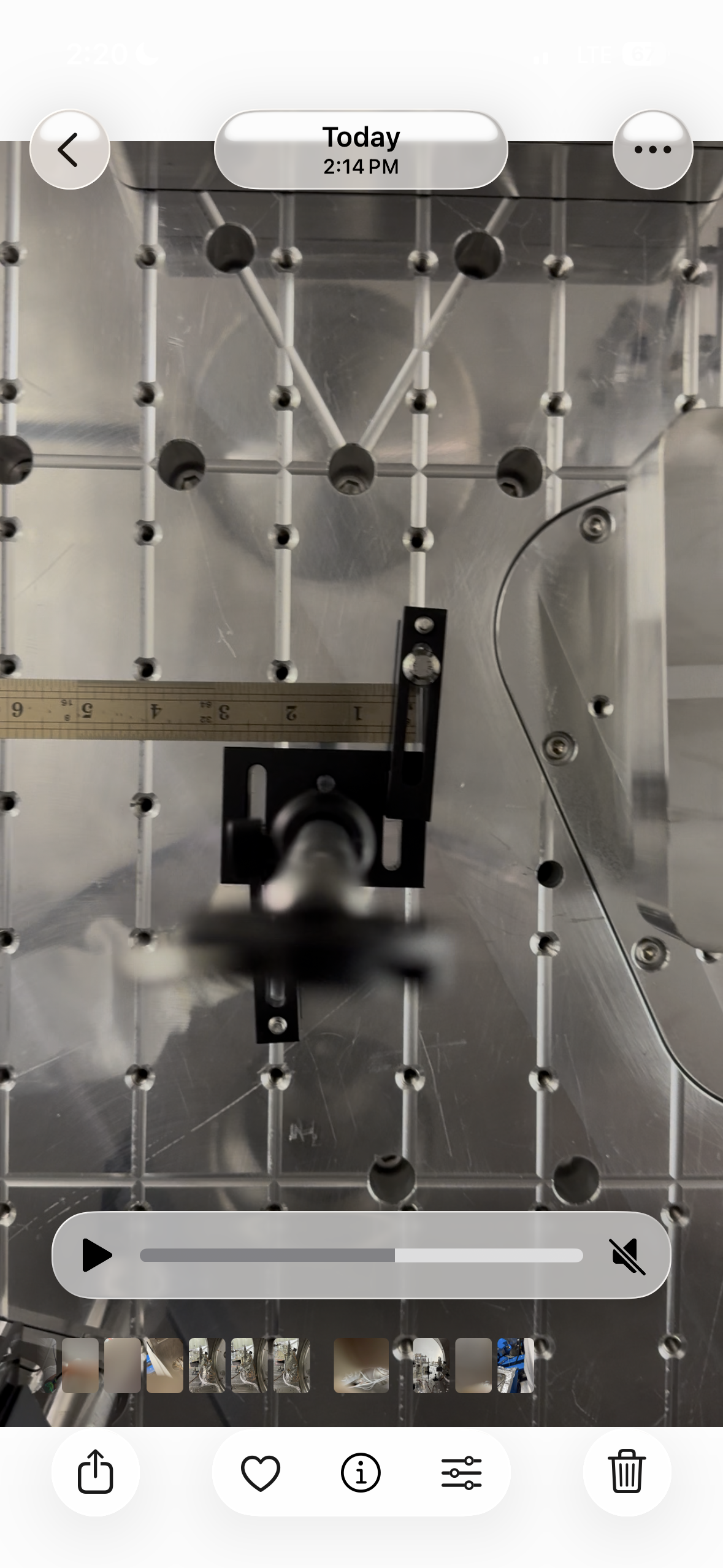
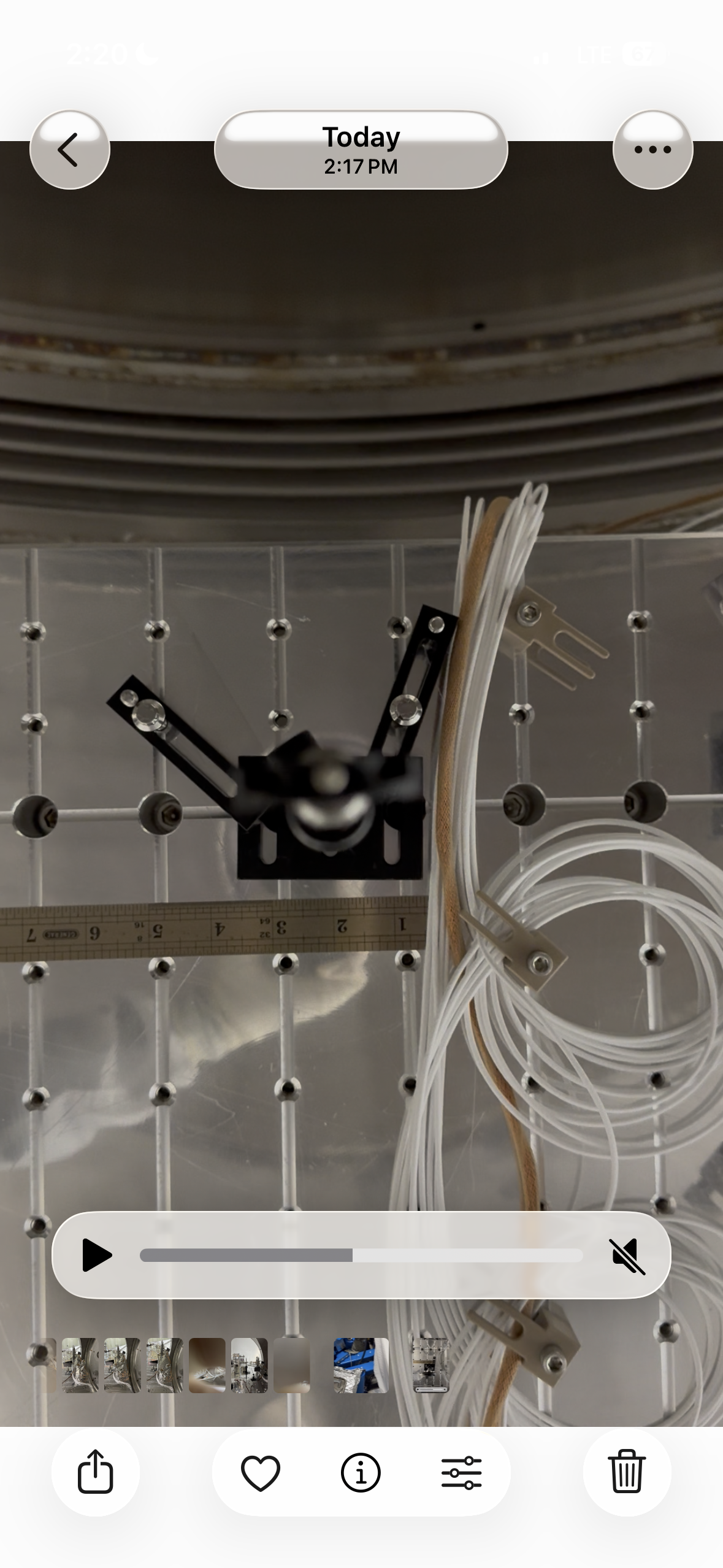
At the time of the first FC attempt, the target irises for periscope alignment were placed. The first picture shows the two target irises. Each iris was aligned to the corresponding hole line. I measured the distance from the hole line as shown in the second and third pictures. The iris was placed approximately three-quarters of the way from the hole line. (In one of the pictures, the hole is difficult to see, but it is located beneath the 4-inch tick mark on the ruler.) Before placing these irises in the HAM1, the height was also adjsuted with rulere to 4".
-
After positioning the periscope at its nominal designed location, we found that adjustment of the top mirror height was required. The periscope includes a vertical slot to accommodate different beam heights from the PSL at the two sites. The top mirror was moved to the highest position within the slot, which provided the best alignment for the beam to hit the center of both mirrors.
-
The output beam from the periscope was aligned by translating and rotating the periscope body itself. The rotation angle needed to be 90 degrees within a tolerance of ±5 degrees. As discussed below, this requirement was satisfied with margin.
-
The top mirror of the output periscope was also hung in the same manner as the input periscope, providing an appropriate output beam height.
-
After completing the periscope installation, JM1 was installed. Target irises were again used for alignment, and JM1 was positioned using these references. Details of this installation will be reported separately by Rahul.
Rotation angle discussion
-
The beam line from the PSL was projected onto the ISI table by measuring the iris positions that were placed at the beginning of this installation period (see earlier alog). The first iris (closer to the PSL) was positioned 1-3/8″ from the −Y hole line, while the second iris was 1-5/16″ from the same reference. The two irises are separated by approximately 48″, indicating that the beam has an angle toward the −Y direction of (1/16) / 48 = 0.0013 rad.
-
The beam from the periscope was aligned using two irises separated by 20″. Assuming the irises are parallel to the hole line and that the alignment accuracy is limited by the iris aperture size (~1 mm), the beam is parallel to the hole line within 1mm / 20″ = 0.0019 rad
-
Combining these effects, the total error of the rotation angle of the beam about the z-axis is less than 5 mrad even in the worst-case scenario. The requirement for this rotation angle is 90 degrees ± 5 degrees (±87 mrad), so the alignment meets the requirement with a safety margin of approximately a factor of 10.
Tagging for EPO.
More photos.


