jeffrey.kissel@LIGO.ORG - posted 13:36, Wednesday 04 February 2026 (89029)
SPi Optomechanics: Optical Fiber Feedthru, Path Cable, and Spool Assembly
J. Kissel
- D2500175 :: S3228003
   . D2100573
   . E2300345
- D2400281

I'm finally back in the optics lab, taking the next steps towards assembling the SPI.

Specific to this entry -- I'm assembling the Class A clean components of the fiber-coupled seed laser light. In other words, I'm integrating
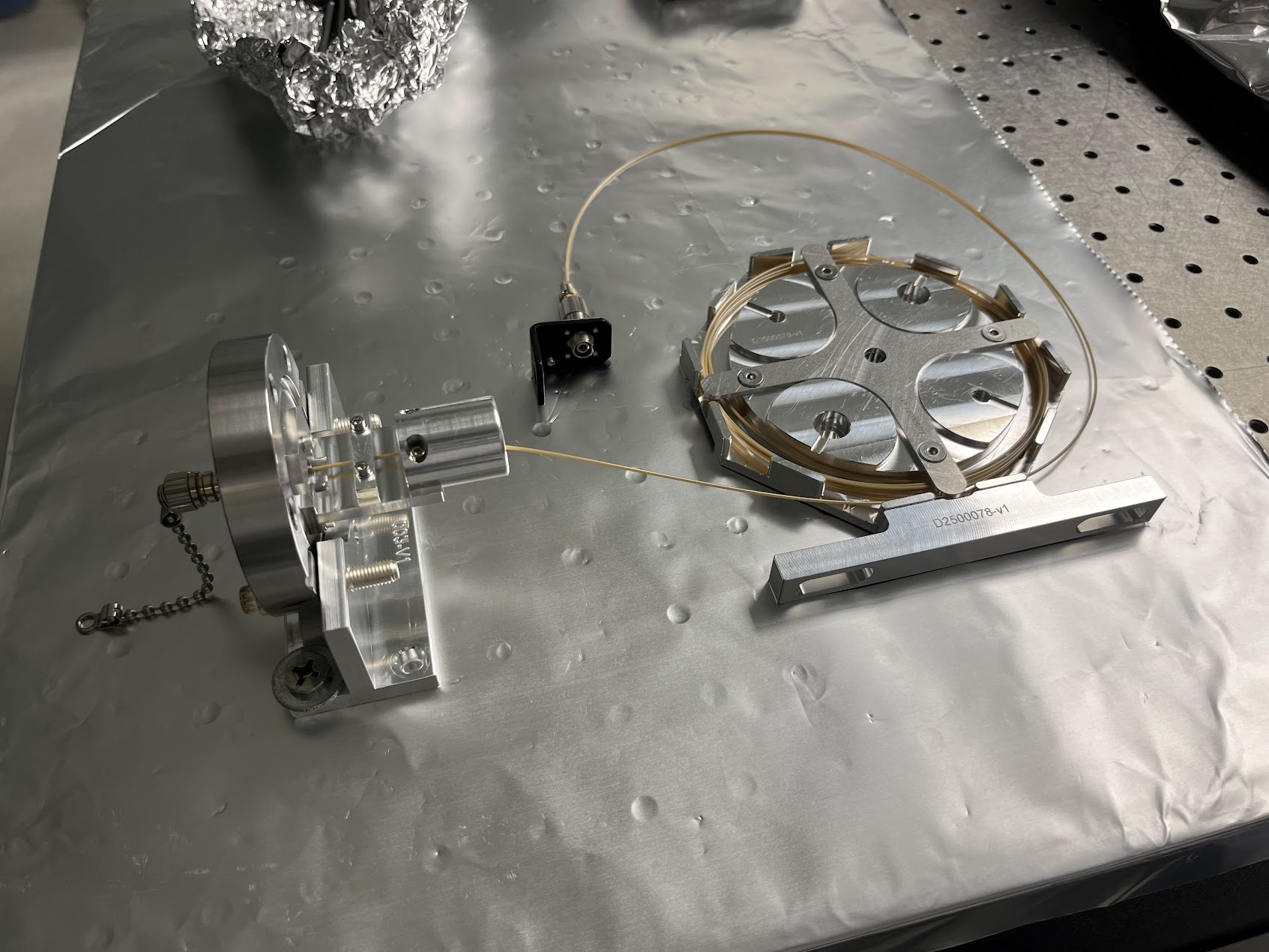
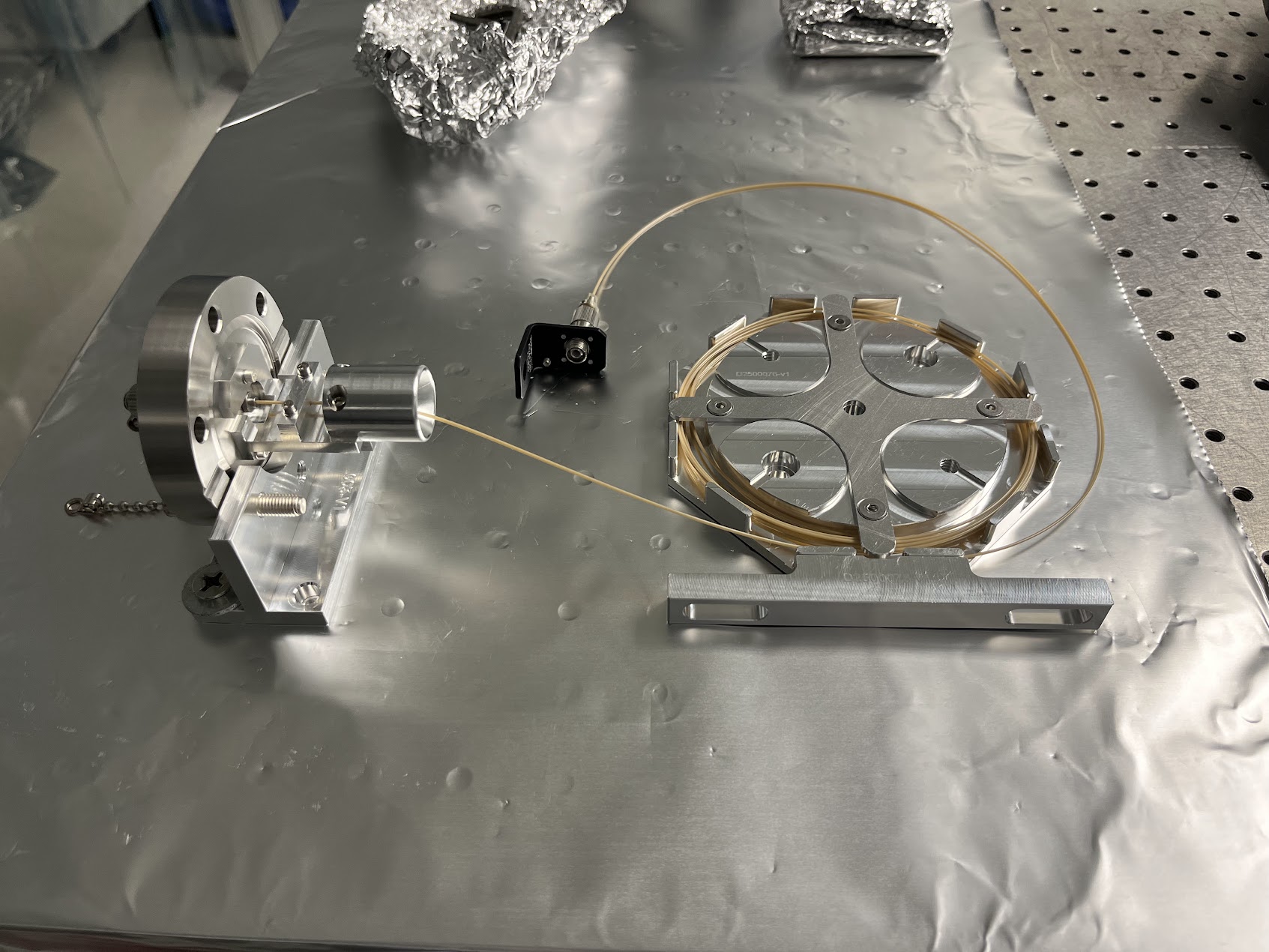
    (1) S3228003*** -- One of the 4.5" (inch) 1064nm V-FT Optical Fiber Feedthrough (Feedthru) Conflat Flange (DIAMOND) (D2500175) -- which includes the "off the shelf" (OTS) feedthru and integrated 3 [m] patch cord (the industry jargon for fiber optic cable), and its MIT-designed strain relief assembly D2100573 -- all delivered to LHO after class-A cleaning and assembly at Caltech per E2400159.
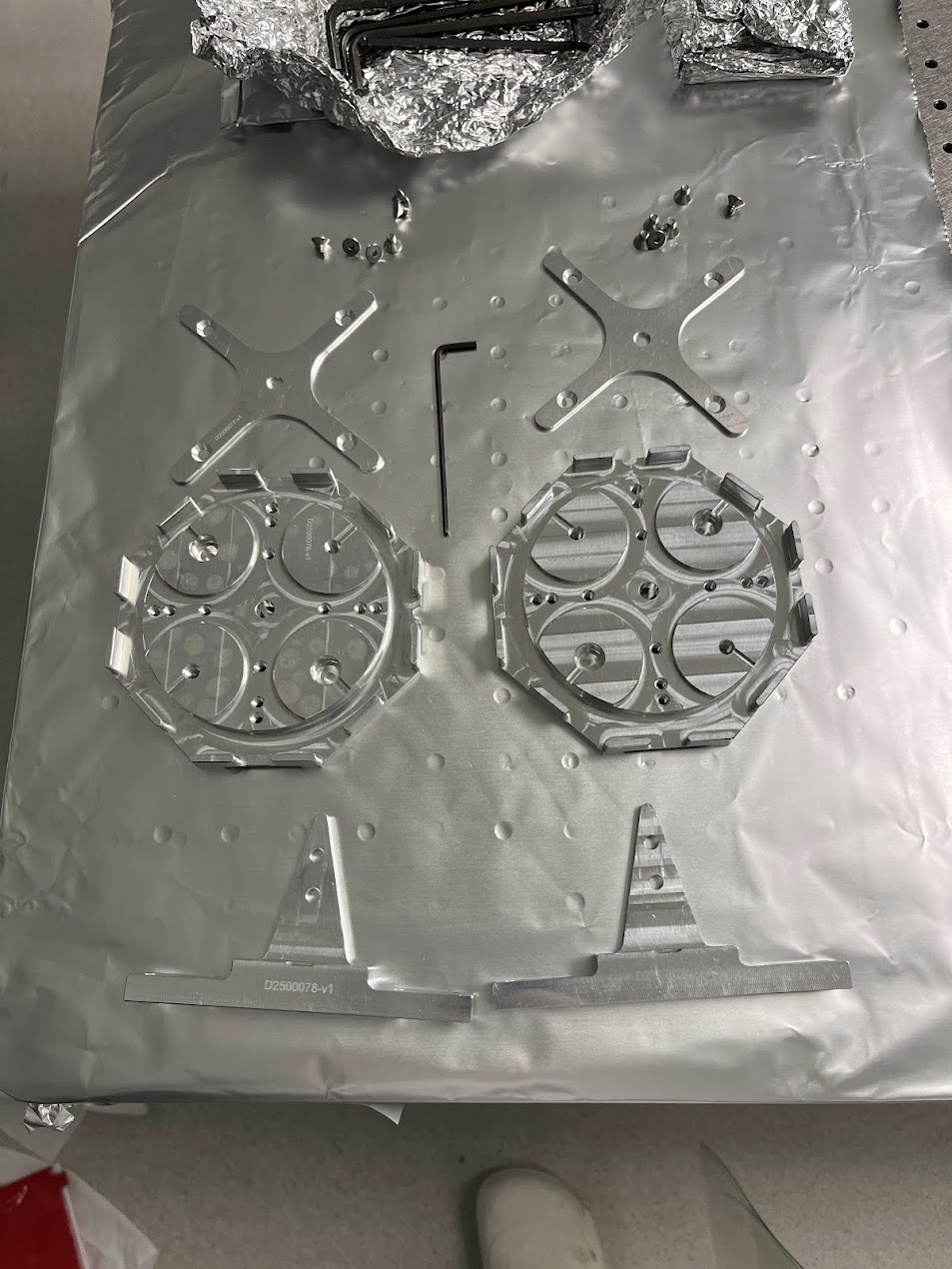
    (2) the ANU-designed Fiber Storage Spool assembly, D2400281, of which we have two.

Sina characterized the power transmission of all three of the feedthrus at Stanford before the clean-n-bake process, and identified that S3228003 had 100% transmission, so I've chosen that to be assigned to the MEAS path, where we need the most input power (as it's distributed through the most number of beam splitters). I plan to further integrate the patch cord into the SuK fiber collimator S0272503 for no better reason that to "pair the S[...]03 feedthru with the S[...]03 fiber collimator."

***The serial numbers for the OTS feedthrus (D2500175) are of the alpha-numeric form 2153228V00n, where n = 1, 2, 3. That full version of the serial number is indicated in their ICS record, but in order to conform to the mold of the DCC S-numbers, I truncated the format to be numeric, S322800n, i.e. removing the identical leading 215 and misleading/unnecessary V character in the middle.

Pictured here is
    - The pre-assembly components of the fiber storage spool (First)
    - The completed assembly of the spool with S3228003's patch cord wound up within it (Second and Third)

The feedthru's patch cord still has a Thor Lab Narrow-Key Mating sleeve (but NOT polarization maintaining) ADAFCB3 that is not intended to be a part of the final assembly, just there for fiber storage during shipment. I'd yet to detach it in these pictures.

Commentary:
     - Coiling the fiber within the spool was nerve racking. It feels like you're trying to coerce dry spaghetti into a curve without it snapping. If you let it go, it "sproings" into a wild relatively straight mess. In the end, holding it all mid-air with both hands, I used the weight of the mating sleeve to slowly pull the coil tighter as I rotated the coil nudging the rest of the coil into the newer smaller circle, until I met the radius of the storage spool. I had the goal of coiling it with one end "on top" and the other "on the bottom" of the stack, but I gave up on that. Once to the desired radius and no smaller, I used the securing cross, resting loosely across only 1/4 of the spool to hold the bulk of the coil of fiber in place while I tucked the rest of the length into the guiding channel. This is doable with a chair and patience in the open space of the optics lab, but I'm not looking forward to ding this in chamber.
     - Thinking through the install, my current plan is as follows :: WHAM3 D5 is currently a 12 inch blank with no 4.5 inch flange adapters. So it *needs* to be replaced by a 12 inch to 3x 4.5 inch flange adapter. So let's create the full 12 inch flange assembly with the 2x, MEAS and REF, fiber feedthroughs and 1x 4.5 blank -- and spool the fibers -- in the optics lab. Then we bring and install the whole 12 inch assembly on to HAM3 as a whole.
Images attached to this report


