I redid the measurement of the SPI QPD A that I did in LHO alog #92050. I had been comparing ASC-AS_C_NSUM_OUT_DQ which is calibrated in W at the anit-symmetric port with the individual sum channel of SPI-OL_H23_QPD_A_SUM_OUT_DQ which is in V/V as it is normlaised by the sum of the four segments.
As this measurement is using data from the 22nd, the only DQ'd channels I could compare between the two QPDs are the PIT_OUT_DQ and YAW_OUT_DQ, which are all in V/V.
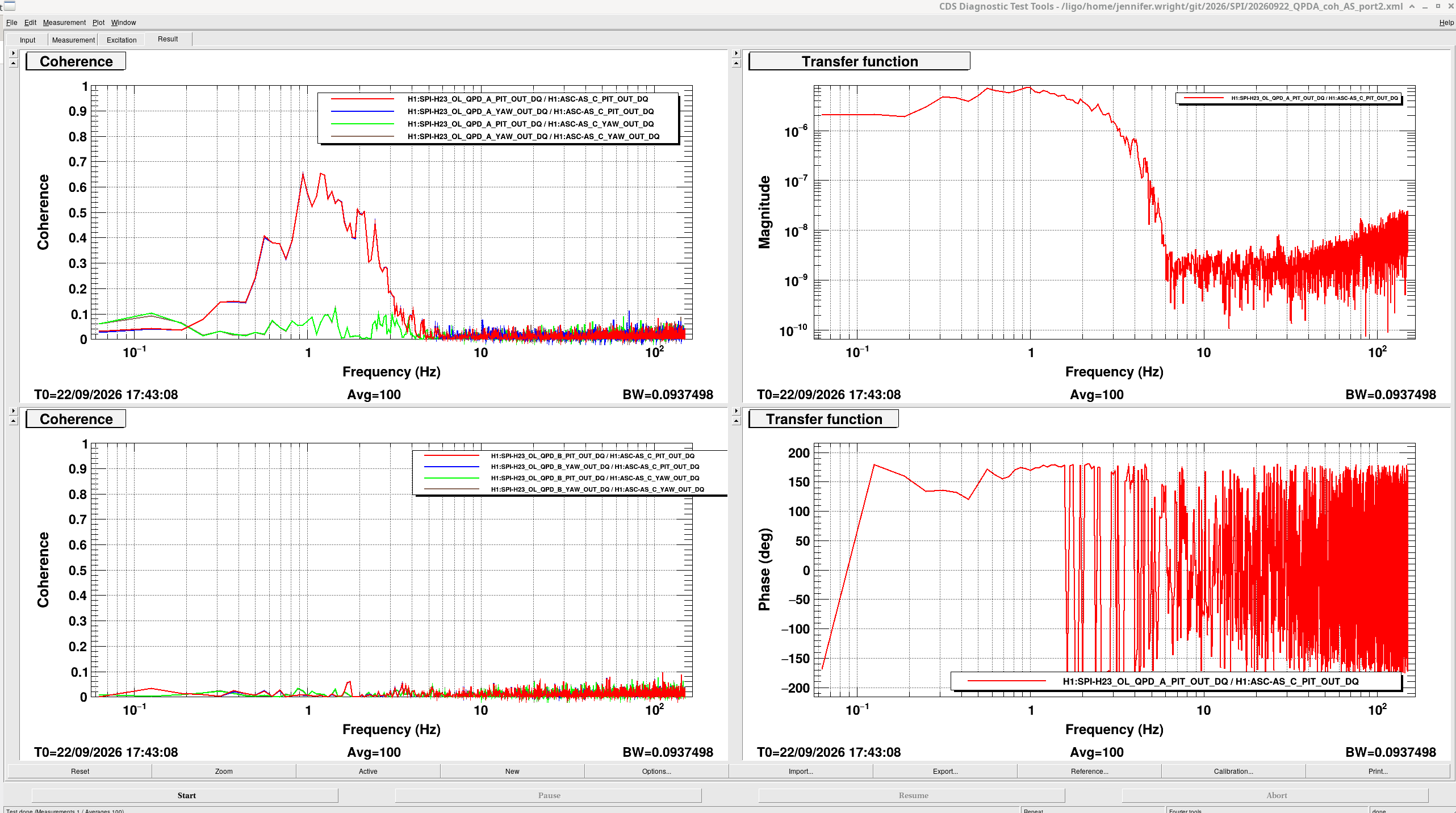
The measurement shows there is ony coherence between the pitch at the ASC-AS_C QPD and the pitch of SPI QPD A.
The coherence level is 0.6 at 1Hz and drops to near 0 below 0.2 Hz this and above 4Hz.
The transfer function from anti-symmetric port to QPD A has a level of ~7e-6 V/V and a phase of 170 degrees at 1Hz.
This will hopefully have a very small effect on the QPDA and so might not be as much of a problem as I had thought from my previous entry.
Here's the original time-series that made us realize that the main IFO light was scattering into the SPI's QPDA on HAM2. From that we asked "is it coherent?" and hence all these studies of coherence, and showing the ASDs (less informative). The hope would be that, if coherent, then we could get a linear transfer function to get the *magnitude* of the TF where coherent to have a good estimate of how much power is getting into the SPI.

It's 30 seconds of the raw channels in question on 2026-09-22 from 18:00 to 18:05 UTC while the main IFO had corner Michelson aligned and we see exactly the same fringing in QPDA as we do at the IFO AS port.

Note that while the coupling is coherent, the time-series on the sum is a +/- 0.001 [V] on a sum of ~35 [V]. While yes, we've shown that even that amount of light can spoil the QPD signal, it may be peanuts amount of light... 35 [V] on QPD A = 28 [mW] of power on QPD A per LHO:92079, so if we calibrate the +/- 0.001 [V] with 28/35 [mW/V] , that's +/0.0008 [mW] = 0.8 [uW]...

I also attach the evidence that no PD on HAM3 sees it.


