arnaud.pele@LIGO.ORG - posted 11:24, Friday 02 October 2026 (92156)
CRS work summary from this week
The CRS laser is now on its final hardware, with TEC and power control running through CDS and a new guardian. Damping works, but still needs some attention. Readout noise is now x2-3 times lower thanks to the new TIA.
- Cabling and interface chassis (92108, 92097): We pulled two new DB25 cables (CRS LASER 4/5) from TCS-R2 to SEI-C1 and installed the final interface chassis, D2400073. Wiring redlines were posted at D2600186. The higher TIA gain from the new chassis (15.8k vs 4.99k V/A) improves the tilt readout noise by about 2-3 accross the spectrum (light green) compared to our best reference (dark green).
- Model changes (92153): We added a LASER subsystem to CRSPROC with laser monitors, a frontend TEC loop, and a DRIVE bank for laser power, plus a VEL filter module. Channels are H1:ISI-HAM3_CRSRY_LASER_*, and documented in E2600265-v2. Moving forward, I would also like to propose adding an ADC and a DAC to the ham23 IO, dedicated to CRS/SPI. Even though the current scheme works, having the CRS LASER running in HAM16 is not optimal, and increases fault probabilty.
- Damping (92116): All cap plates actuate. The damping loop works with its -2e9 gain now built into dampBP, so it engages with a gain of +1. One HEPI AI channel (dac0 chan 14, U26) is weak, so we're holding off on the Q measurement until that chassis is replaced.
- Laser driver and TEC (92137): We installed the final laser driver, D1500207, and commissioned the CDS TEC loop. Power and noise are unchanged, and the Thorlabs TEC is now unplugged from the AC mains (left in the LVEA for now).
- Guardian (92152): The new CRS_LASER guardian (LASER_ON/LASER_OFF) makes sure the TEC is engaged before the laser turns on, and there's a new laser MEDM screen. Details are in T2600470.
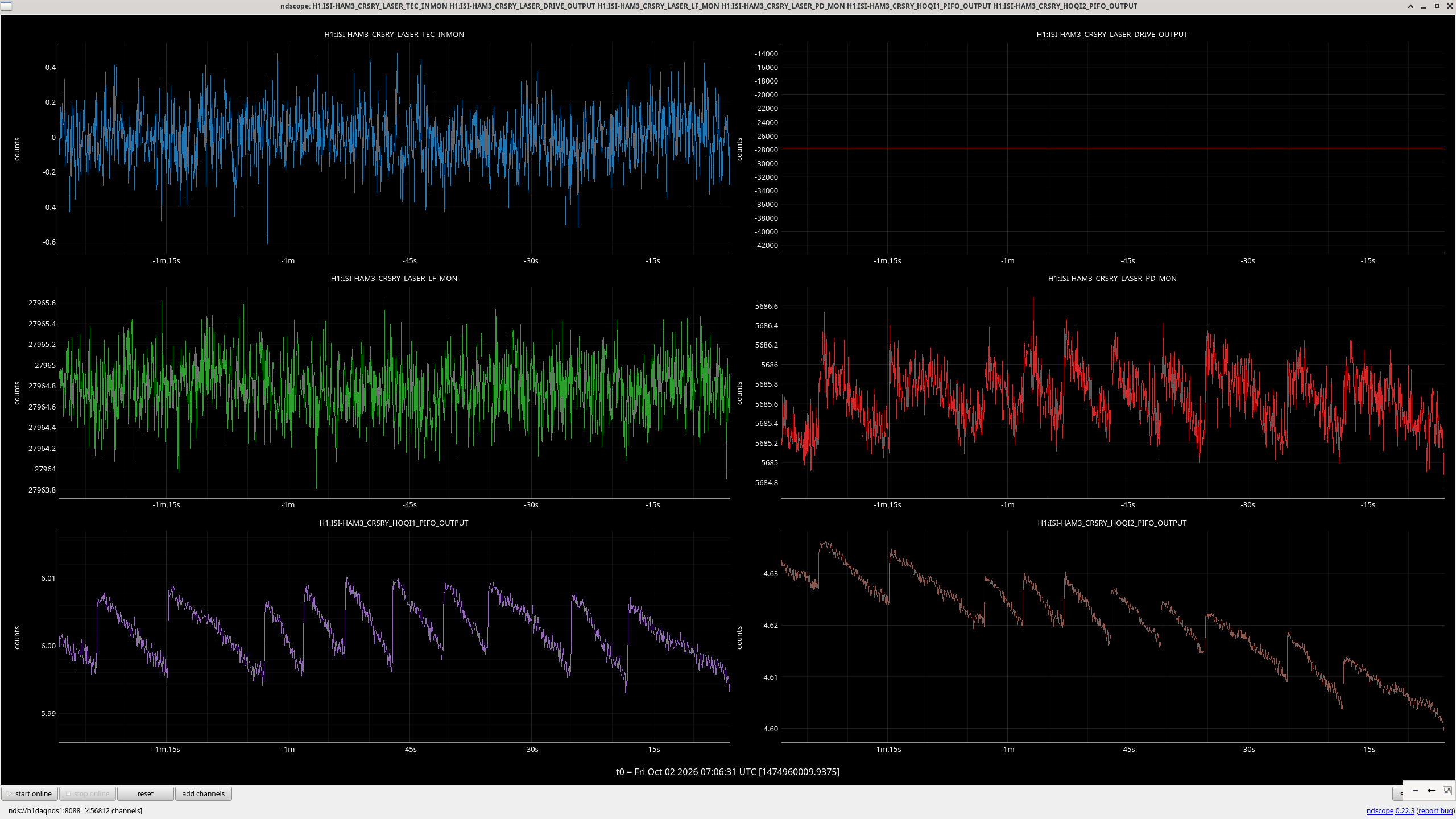
- Power transients : With the new monitor channels (HOQI power and Laser power), we observe what looks like mode hoping (also observed here by Shoshana), see attached screenshot. The power transients happen at the same time on both hoqis, and are also measured by the PD in the laser. Once the thermal state of the laser is stabilized, we can try to move the TEC setpoint around to try park the laser away from a mode hoping region, like Shoshana did. We can also try to add an optical isolator inline, in case it comes from some backreflection in the fiber. Touching the fiber also creates transients in the power channels. It seems that this mode hoping makes the readout noise spectrum breathe, so reducing it might improve the noise even more.
Left to do: replace the AI chassis and measure the ring down Q, update the SOP (M2600128), finish Technical note T2600471, create the CRS_STAT guardian, monitor the TEC stability (+ try to find a mode hop free region), record new chassis serial numbers and post photos.
Images attached to this report

Non-image files attached to this report