jeffrey.kissel@LIGO.ORG - posted 12:26, Friday 02 October 2026 (92169)
ISI Fundamentals: We should increase the data storage rate for the CPS, or fix the DAQ downsampling filter.
J. Kissel

As I'm building up my understanding the ISI system -- in order to eventually understand how to compare it to the SPI signals -- I found one thing I didn't like.
When looking at the ISI data offline, we're typically looking at DQ channels -- i.e. those versions of test points that are stored in the frames -- so that we don't have to wait so long to gather data down to 1 [mHz].

Fine.

The native rate of the ISI front-end models is 4096 [Hz], so storing every interesting channel at the full data rate would be too much. As such, we down-sample some channels before storage.
Fine.

Of course, down-sampling requires a digital anti-aliasing filter, often referred to as the "DAQ down-sampling filter."
These are defined in T1600059 and the front-end in terms of "factor-of-reduction from native sampling frequency," e.g. if the native rate of the model is 4096 [Hz] and you chose to store the channel at 2048 [Hz], then you apply the "2x" filter.

We store the inertial sensors, input to the blends e.g. H1:ISI-HAM2_BLND_GS13X_IN1_DQ at 4096 [Hz] so there's no downsampling filter involved.
Long ago, we decided that down-sampling the CPS to 512 [Hz] is good.
4096 / 512 = 8x.

But there's something very wrong with the 8x down sampling filter in the ISI system.
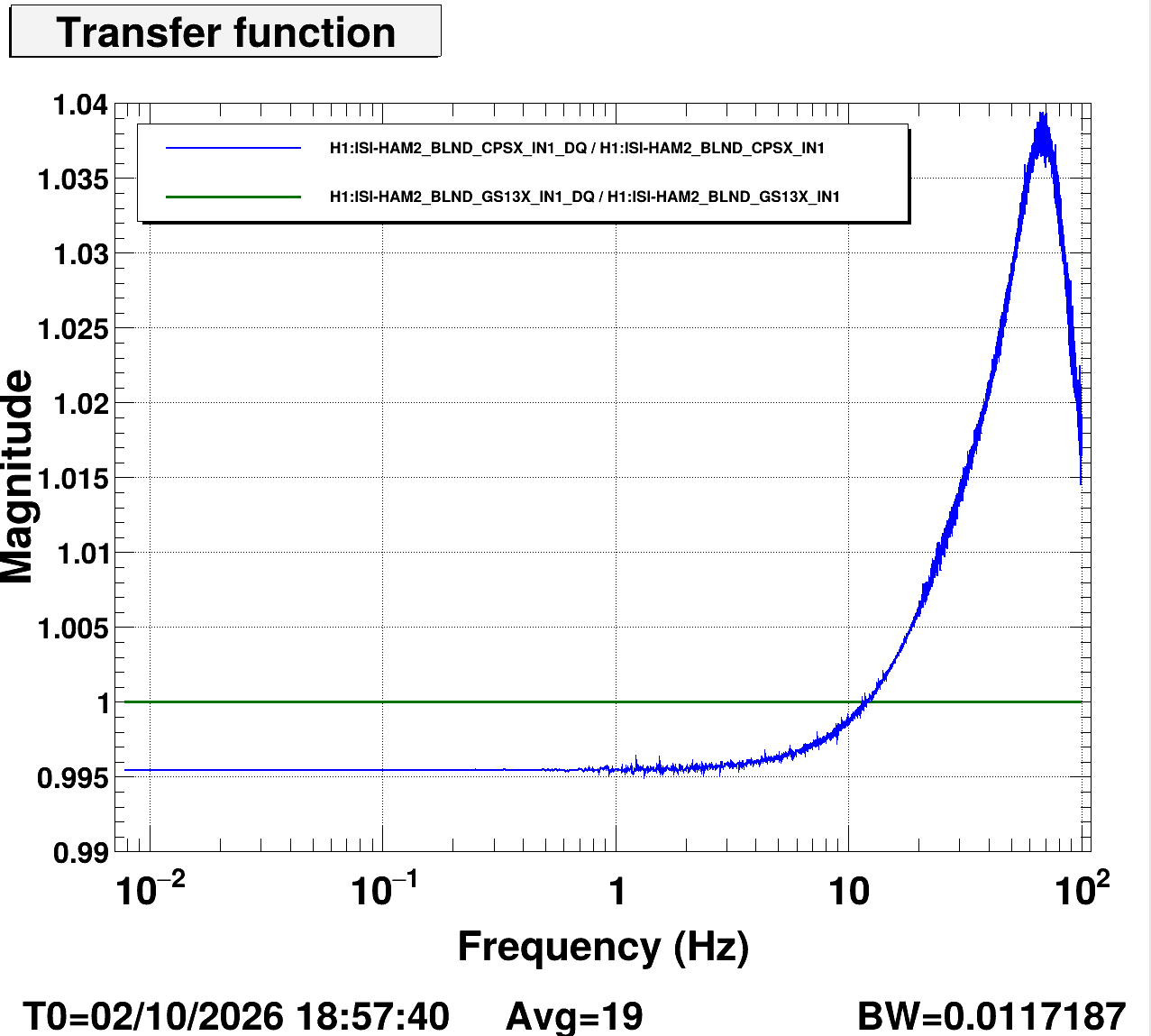
    (a) The DC magnitude of the transfer function between raw and DQ channel is 0.9954; i.e. a 0.5% gain loss.
    (b) The filter's ripple peaks at ~70 Hz with a magnitude of 1.0386.
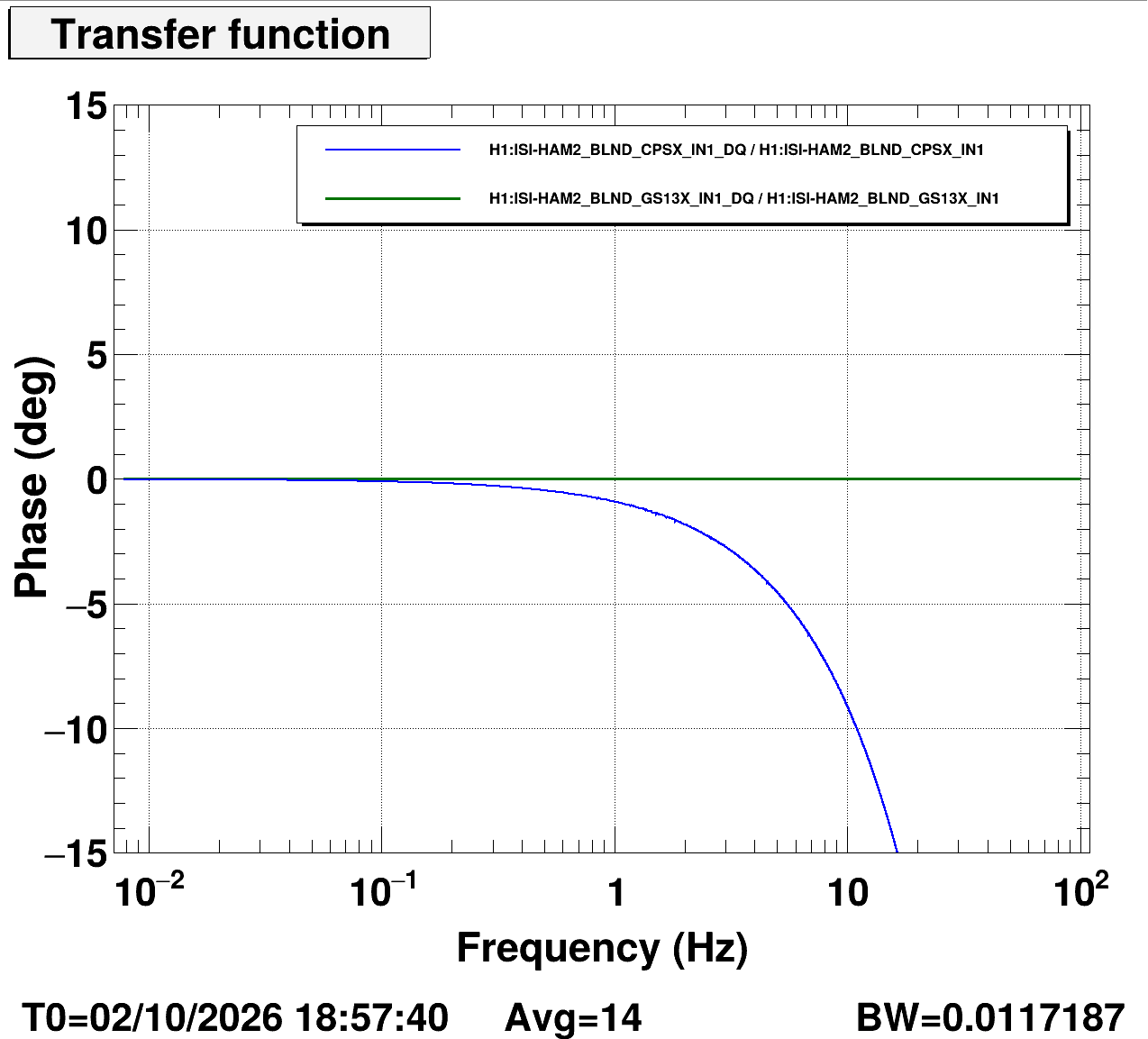
    (c) The phase loss at 10 Hz is -9.1 [deg].

It's difficult to tell from the plots in T1600059 what the magnitude is doing, but I thought that these filters were normalized such that *either* the DC magnitude was 1.0, or the peak of the ripple is 1.0. Neither is true.
But, far worse -- the 8x filter phase in the design doc says its only losing -0.5 [deg] of phase at 10 [Hz].

We should fix the issue with the filter, and/or use a higher down-sampling rate.

If there's confusing stuff like this happening at such a base level, it makes it that much harder to interpret / compare the already confusing sensor signals.
Images attached to this report