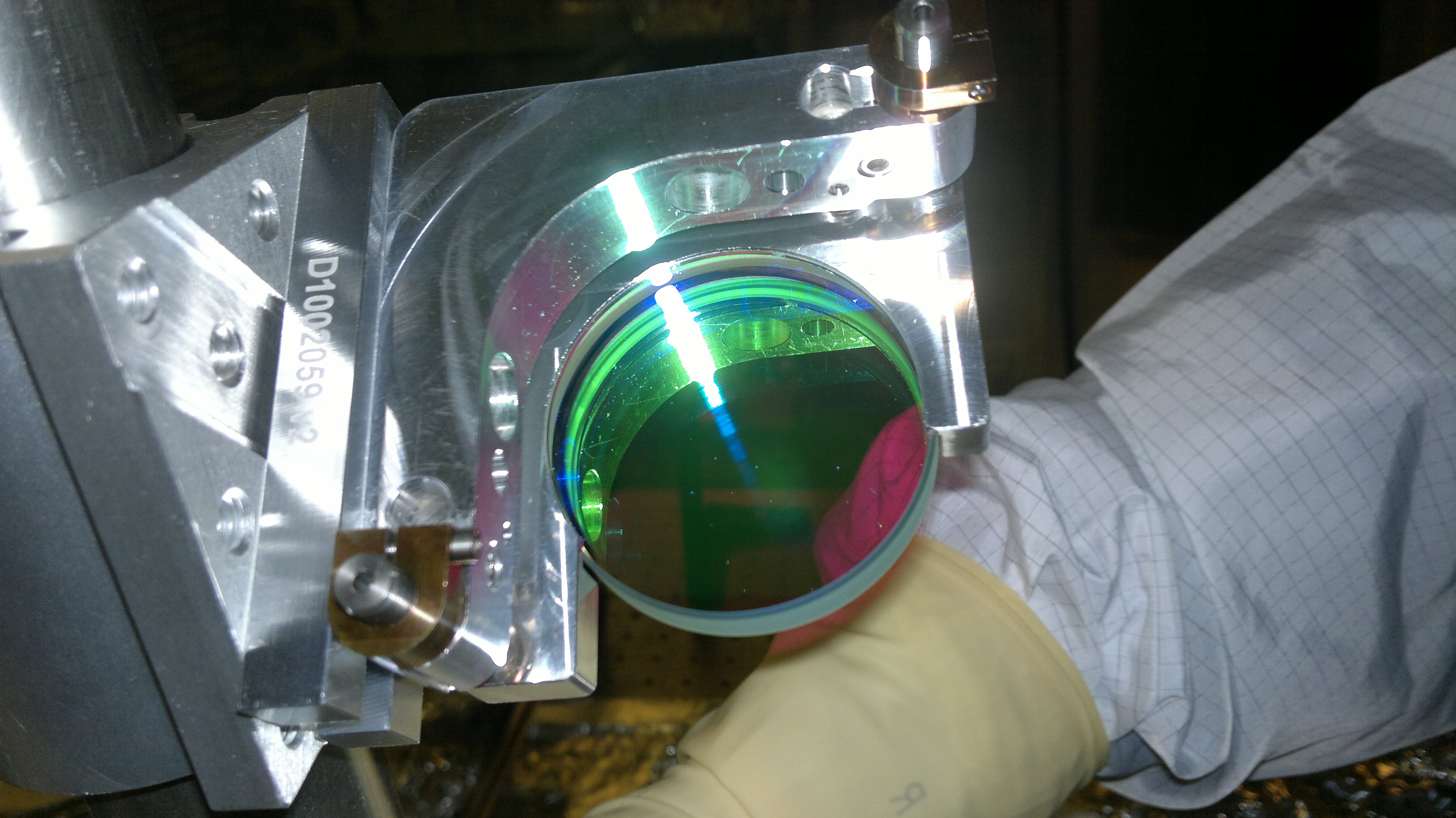
Hugh, Jim, Hugo,
We measured the level of stage 1 this morning. Results are attached. Stage1 appeared tilted by ~170 µrad. This result is beyond the 100 µrad of the acceptance criteria used during the assembly-validation phase.
We recently changed the shim thickness on locker D. In order to make sure that it is not the cause of the mis-levelling, we measured the level on stage1, just above the locker D when the ISI is locked, and compared it to the same measurement when only the locker D is unlocked. The shift in level is less than 1mil. Hence, the adjustement we made on locker D is not the cause of the mis-levelling we observed.
Changing the shim of locker D is the only serious mechanical modification we made on HAM3-ISI after the suspensions (MC2 and PR2) were approved. We then conclude that the suspensions were tested under the current configuration without being affected by it in a noticeable manner.
We measured the level of stage 0 around the lockers. We did not detect such a mis-levelling there (see attachement).
The assembly validation testing is performed with a ~600lbs pounds on top of the ISI. The mass distribution is very different now that the ISI is loaded with suspensions, optics, and 10kg masses. We currently suppose the new mass repartition would have affected the flatness of the optical table, and thus the level measurement which is performed along its edges.
Jeff B & G2 We released the Intermediate Mass EQ stops on MC2 and PR2, so Seismic can continue testing the HAM-3. All masses on both suspensions are now free.
And with that HAM2 is ready for HEPI Actuator Attachment. After the Dial Indicator installation, the HEPI was unlocked, very little motion was measured with the DIs. I did Caging Brace/F-Clamp adjustments and will commence actual Actuator attachment tomorrow. HAM1 HEPI was locked before ISC installs Thursday and remains locked. Please be mindful of the DIs on the HAM2 Support Tube Ends.
Mitchell & I completed the loading of the Optical Table with the Trim Mass & Damping Assemblies D1003161 as per D1001989. I believe that puts that 'Cartridge' back in SUS/IAS hands.
Restarted the h2nds1 computer. The computer could be pinged but could not log in remotely or at the console, and the nds process was not responding. h2nds0 also died over the weekend but was restarted.
Cheryl, Rodica
Last Friday we finished the isolation measurements for powers up to 133 W. As we increased the power, we optimized for isolation ratio at 450 mW, 4.70 W and 20 W from the half waveplate and adjusting the pitch/yaw of DKDP, and for powers higher than 20 W we only finetuned from the waveplate's picomotor screw. We measured incident and REFL (using the same water-cooled high power power meter Ophir L250W-SH-ROHS), transmitted (Ophir L300W-LP), forward rejected and isolation beams.
The results are:
| P-inc (W) | Fwd Extinction (dB) | Isolation Ratio (dB) | One way losses (%) |
| 0.45 | 31.35 | 55.85 | 4.55* |
| (*big uncert in PM readings) | |||
| 4.70 | 30.06 | 51.21 | 1.83 |
| 20.90 | 36.07 | 47.73 | 2.13 |
| 54.40 | 34.19 | 37.92 | 1.76 |
| 93.50 | 29.40 | 32.94 | 1.73 |
| 133.30 | 26.45 | 30.11 | 1.55 |
At maximum power we readjusted the orientation of DKDP, returned to 20 W and reoptimized for isolation, and repeated the measurements increasing again to 133 W. Thermal depolarization was higher, but the isolation kept within same levels.
| P-inc (W) | Fwd Extinction (dB) | Isolation Ratio (dB) | One way losses (%) |
| 22.28 | 26.1 | 47.7 | 2.5 |
| 22.28 | 26.2 | 47.6 | 2.5 |
| 55.6 | 27.2 | 41.2 | 2.0 |
| 55.6 | 27.4 | 41.1 | 2.0 |
| 98.7 | 28.4 | 36.1 | 1.8 |
| 98.7 | 28.1 | 35.9 | 1.7 |
| 133.5 | 29.0 | 33.3 | 1.1 |
| 133.5 | 28.9 | 33.4 | 1.3 |
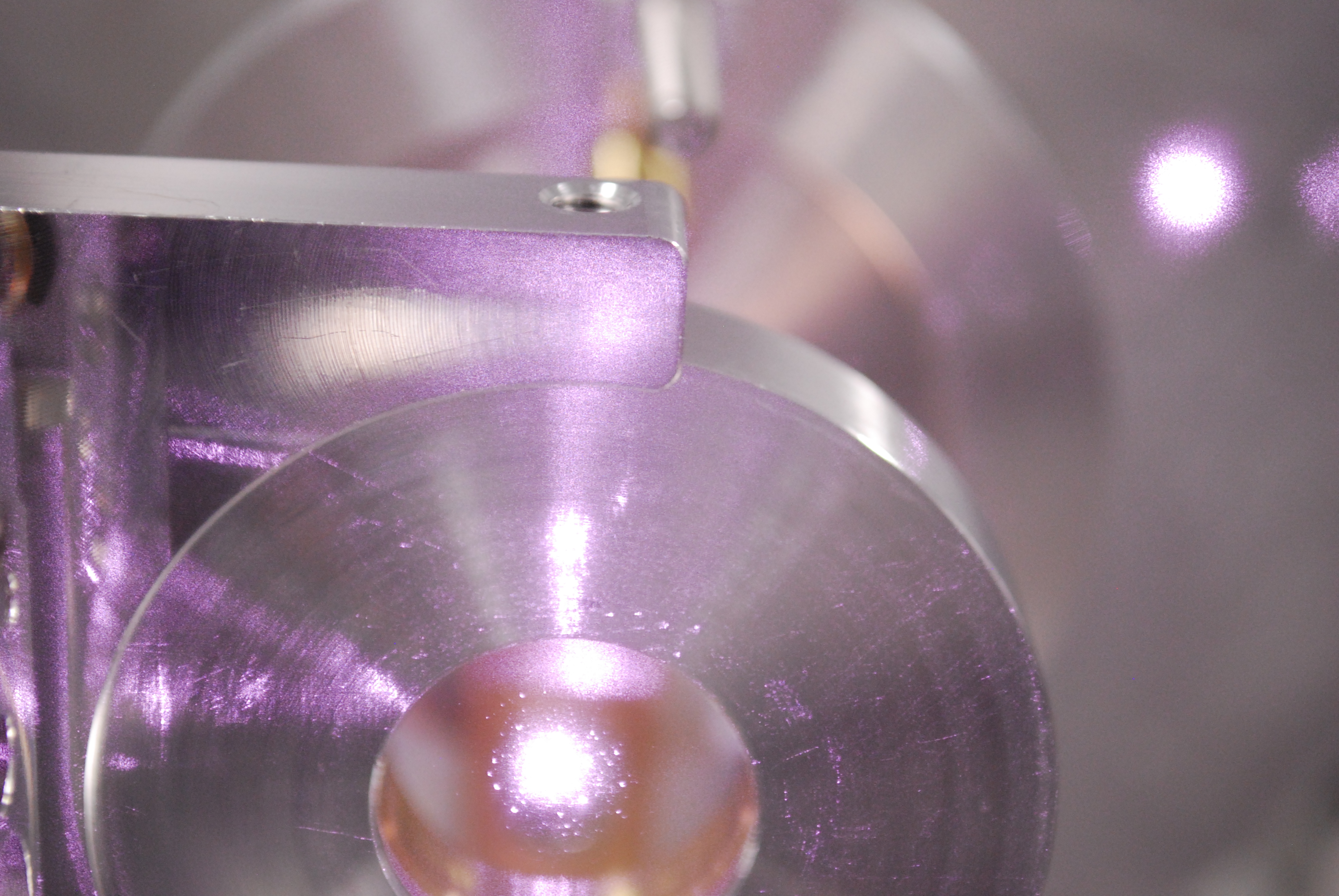
Cheryl took pictures of the DKDP under 140 W incident power with the IR camera, and shows serious scatter on the defects observed predominantly on one side. We will be installing the Faraday with this DKDP piece, but new ones are being purchased to installed at a later date. Picture attached.
We lost chiller 2 at Y end station today, because of an electrical problem. I have started chiller 1 and the temps are returning to normal. Richard and John have been notified
Following up on the earlier post 4327 concerning H2 OAT line studies, I am attaching additional slides containing plots and tables that compare the OAT spectrum from August 28 (focus of last report) with spectra on Sept 7 (generally quieter with fewer combs) and on Sept 13 when the aLIGO PSL was being used for the ALS reference. The spectrum on Sept 13 has a higher noise floor, more lines and stronger lines in many cases. In addition, a number of combs observed on August 28 moved slightly in fundamental frequency by Sept 7 and moved again by Sept 14. See slides for details.
Looked at MC1 (Bottom stage) UL channel, which showed low counts ~9000 compared to the expected 24,000 counts. Traced problem to IO Chassis (h1sush2a). Replaced ADC card SN110201-04 with SN110203-20. Problem still persisted, replaced ADC Adapter Board (D0902006 SN S1102390) and cabling inside IO chassis with a spare (no SN number). Have requested a replacement from CIT. Will replace sometime next week, but SUS is able to continue transfer functions on MC3. Filiberto Clara
Mark reports that the TFs taken Friday, looked noisy. The situation with MC3 deteriorates. Picking up where Filiberto/Jeff left off last week, I find that indeed no EXC is getting through to the MC3 tops, hence the lack of coherence in Friday's measurements. Because this is possibly related to what Fil did on Friday with respect to switching out some boards (alog above), he is now looking again at the boards.
While I was in the cleanroom, I chased a moth and finally caught it as it was perched on the MC1/MC3 shared in-vacuum quadra-puss. Ugh - now I have to switch that cable out as well.
-SEI Ham1 waiting on hardware. -SEI HAM3 Float ISI -Craning doors To HAM1 AND GARBING STAGING ROOMS. -Ski to change out valves at X-End. -Cheryl and Rodica working on the PSL doing isolation measurements on the Faraday -Vincent and Robert reboot NDS0 Doors locked at 16:17:00 PT
Andres R. & Jeff B. We released the EQ stops on the MC2 & PR2 Bottom Masses for the weekend. Both Intermediate Masses are still in light stops.
JimW, MitchR, HugoP,
The horizontal position of the lockers was adjusted.
The 0 of the horizontal CPS was set on the new locked position.
The shift on the CPS between the locked and unlocked configurations is within +/-600cts on each sensor.
Since this preparatory work just ended, we did not have the time to run a full-range transfer function measurement while attending it. Hence, no actuation will be performed over the weekend.
The ISI was left locked so JeffB could get in and release the optics of MC2 and PR2 before the weekend, as he requested.
We will look at the level of the ISI on Monday.
Mark B and Jeff B. After today's electronics and computer issues, we restored settings on MC3 and started running Matlab TFs at around 13:20 PDT. We started with damping on and will repeat with damping off this evening.
Mark B. Undamped TFs started at 01:50 (am, Saturday).
Mark B. TFs confirmed finished at (by) 7:40, damping restored.
Restarted h1seih23, h1sush2a, h1sush2b, and h1sush34 models, due to glitching the dolphin network while troubleshooting a bad ADC channel on h1sush2a. DID NOT DO ANY BURT RESTORE, other than what's done automatically.
Silenced these alarms at 7:35 AM -- H2CDS_IOP_ETMY_WATCHDOG, H2SUSITMBS, H1:PSL-MIS_FLOW_OK
Cheryl, Rodica
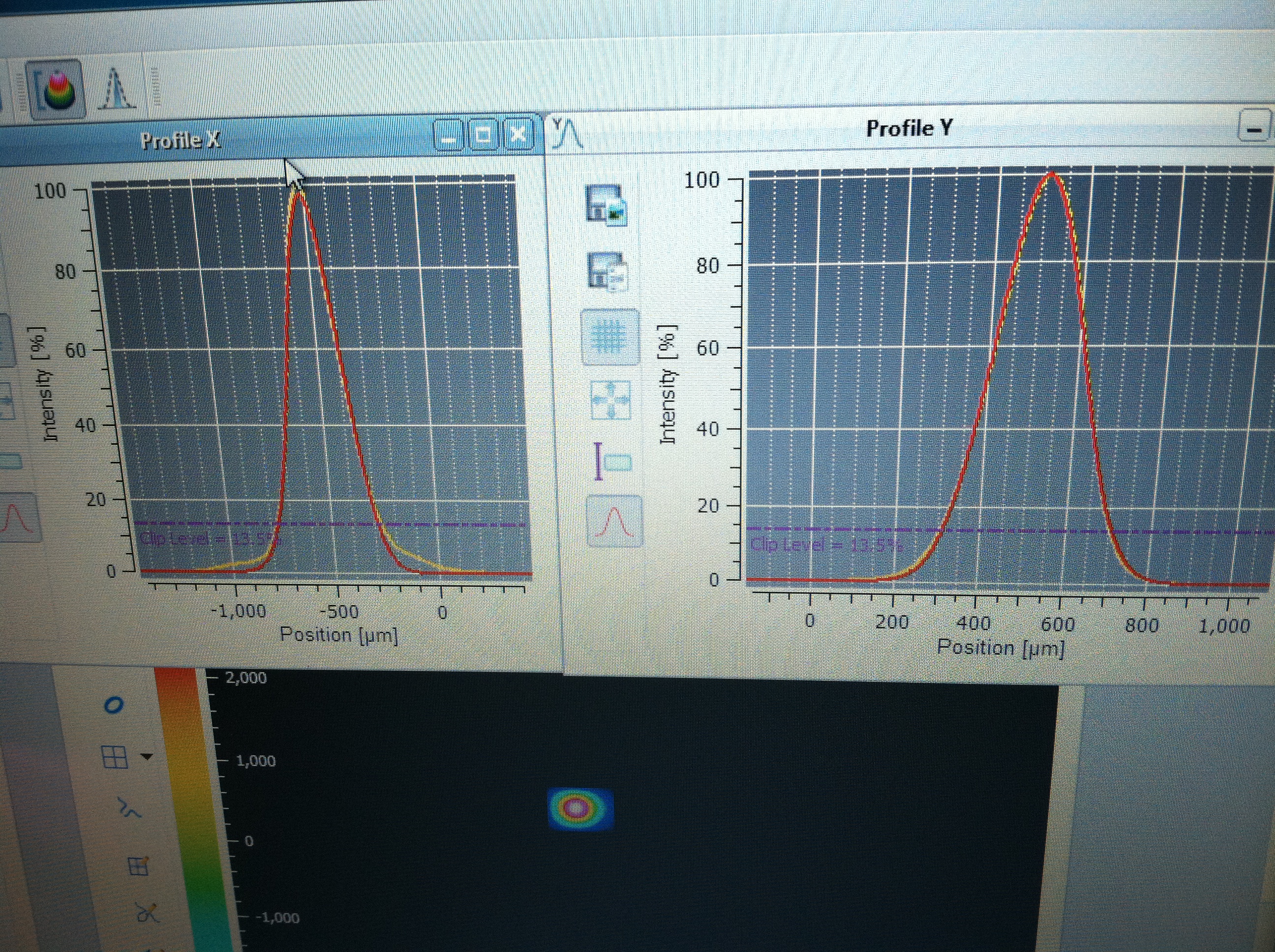
Today we concluded our thermal lens measurements of the H1 Faraday isolator for optical powers up to 140 W. In an attempt to correct for distortions in the beam shape observed with the beam scan, we repeated the measurements for several alignments and DKDP orientations. No significant diffence was found. Similar beam distortion could also be seen before the Faraday isolator, indicating vertical clipping after the EOM (possibly caused by a slightly eliptical beam coming out of the PMC?). More investigation needs to be done on the IO beam path to clarify this. For the thermal lens analysis only the data from the least distorted axis was used.
We also measured the thermal lensing of the Faraday with the eLIGO 3 mm thick DKDP piece, which has the same thickness as the aLIGO crystal, and it is considered as spare for Advanced LIGO.
The measured focal length of the FI with the aLIGO DKDP is +26 m, and with the eLIGO DKDP is +32m, the Faraday isolator being slightly undercompensated in both cases. This translates into a mode matching of 95% with the aLIGO DKDP, and 97% with the eLIGO one. Both values meet the IO requirements. M2 data and fit results are attached.
We changed the setup for isolation measurements and will do this tomorrow.
Attached are plots of dust counts > .3 microns and > .5 microns in particles per cubic foot. The data was taken from approximately 6 AM to 7 PM.
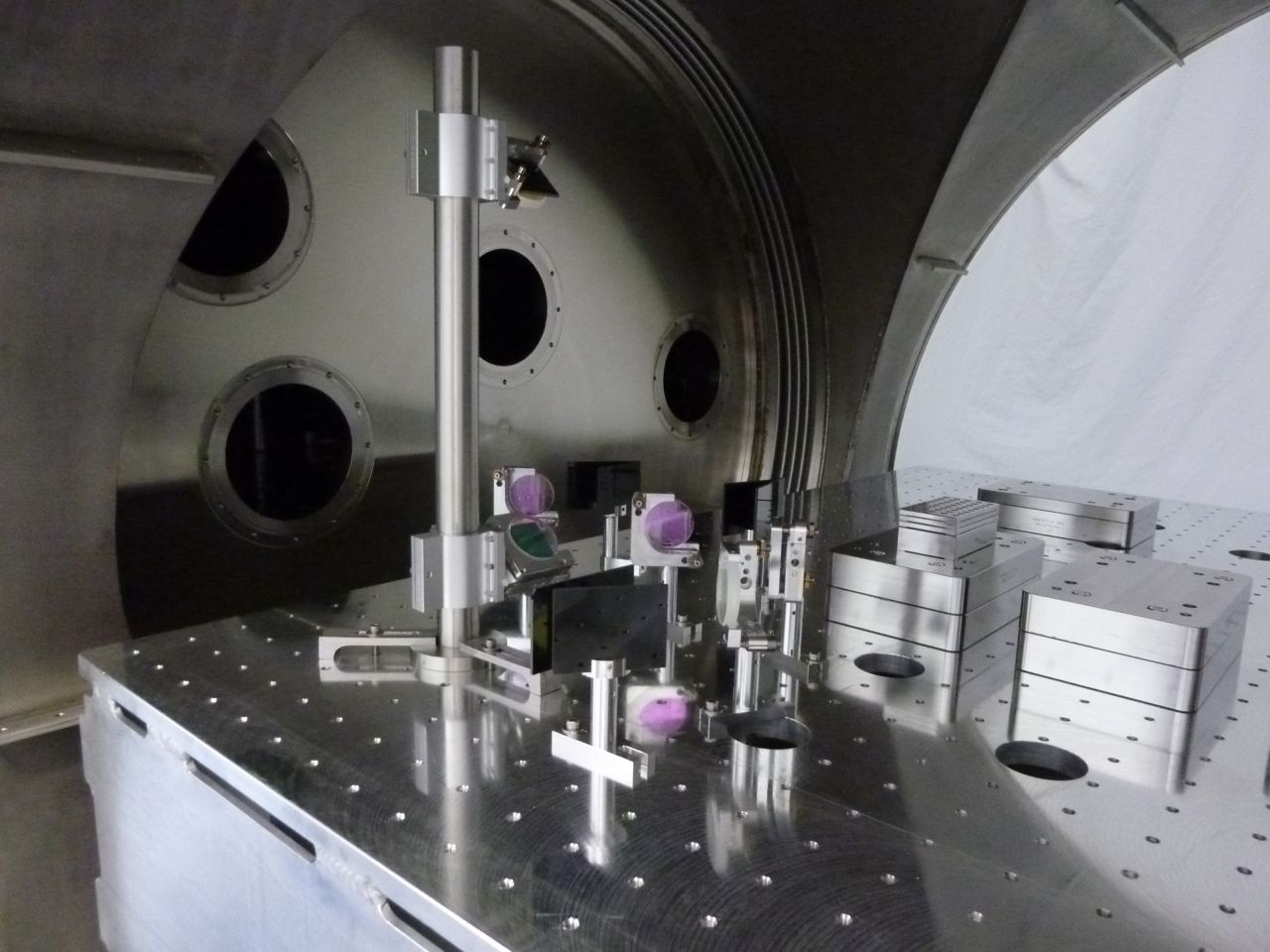
We've installed a minimum set of optics that are absolutely necessary for HIFO in HAM1. The list of installed optics will be alog-ed by Lisa.
We haven't payed any attention whatsoever to align them, as we don't have any beam for now. Things are just put in place, and we'll need to go back when the beam will be available.
Nothing could have been as smooth and as quick as this. One professor did all in-vac placement and bolt tightening. Don't know if these two things are correlated.
If we have time, we might install other stuff that are not necessary for HIFO in HAM1.
More than the professorial experience, I claim that the great success was due to this incredibly clear document: D1201390 in which all the relevant details (which optic, where, etc) are summarized. So far, we installed only the optics which are strictly necessary to route the PSL, ALS and REFL beams to the ISCT1 table. The REFL path to the sled and the POP path to ISCT1 and the in-vac LSC diode have been blocked by a V-shaped beam dump (grey blocks in the drawing).
Broken black glass story
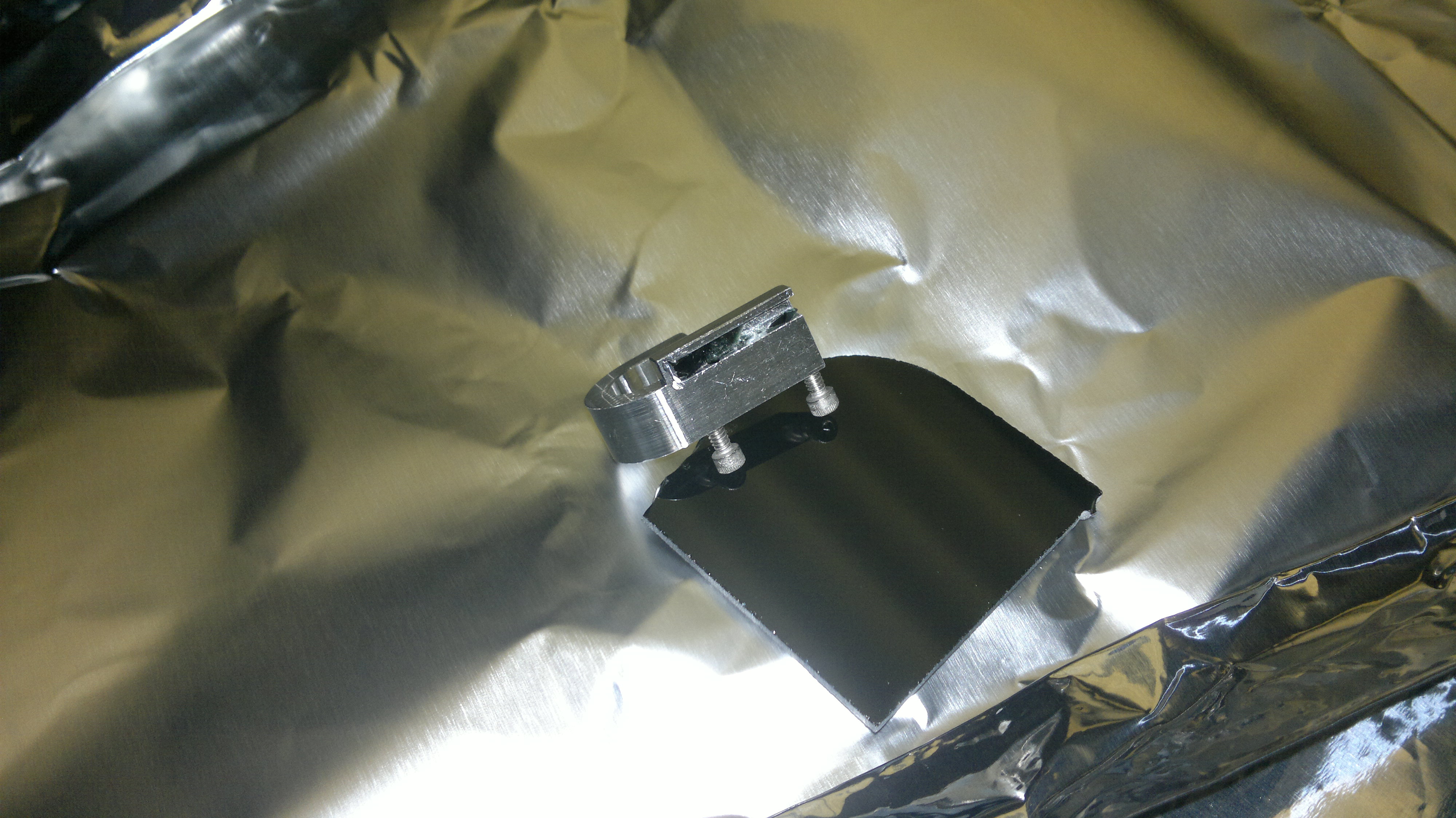
Before moving periscope assembly to HAM1, we've noticed that the black glass behind the top periscope mirror was getting loose. On a closer inspection, it turned out that actually the glass was completely broken and the larger piece was held in place just by a friction. The first picture shows the J-clamp with the broken shards of black glasses in the slot. We also observed a LOT of glass powder on the mirror, but fortunately this was all in the back (second picture). Lisa recleaned the mirror, we put another black glass, and everything was fine.
There could be more than one cause for this. Matt and Lisa noticed yesterday that the metal screw to hold the black glass was grinding and making some glass powder, so maybe we need to use PEEK.
Another thing is that, when tightening the J-clamp setscrew for attaching the J-clamp to the mirror holder (as opposed to tightening the screws for the glass), J-clamp moves in such a way that the black glass moves laterally towards or away from the mirror. If the tip of the black glass is already touching the mirror mount, which is hard to avoid unless you pay some attention, the J-clamp motion puts some torque to the black glass. So we need to make sure that the black glass doesn't touch the mirror mount.
And the slot in J-clamp for the black glass is too narrow anyway, sometimes you need to press it in really hard, sometimes it doesn't fit at all, and that doesn't help things. We need to make these grooves wider.