Displaying reports 82741-82760 of 86348.Go to page Start 4134 4135 4136 4137 4138 4139 4140 4141 4142 End
Reports until 16:44, Thursday 02 August 2012
LHO VE
kyle.ryan@LIGO.ORG - posted 16:44, Thursday 02 August 2012 (3707)
More leak testing at Vertex output MC
Kyle 

With the leak detector configuration as left yesterday, i.e. backing the Vertex MTP (100% of the turbo exhaust) the helium background had decreased from 1.3 x 10⁻⁸ torr*L/sec (as left yesterday) to 6.2 x 10⁻⁹ torr*L/sec today -> I vented the HAM5 and HAM6 annulus volume and decoupled the HAM5 aux. pump components leaving the pump port connection open to the room.  Then I let the HAM6 aux. cart diaphram backing pump pump air through the annulus, i.e. room air enters HAM5 pump port and routes through annulus volume and exits HAM6 pump port.  This was another attempt to expedite removal of any helium permeated in the annulus O-rings -> No help, too slow.  Next I calibrated our 2nd leak detector and swapped it in place of the initial leak detector -> No change.  It measured and behaved within 10% of the first.  This was done to rule out any instrument-specific inability the initial leak detector might have had in resolving helium ions from non-helium ions in the spec. tube (as the leak detector inlet pressure is relatively "high" baking the MTP).  This concludes my attempt to get the helium background to the nominal <2 x 10⁻⁹ torr*L/sec value.  

Moving on, I reconnected the initial leak detector and began testing CF joints on the output MC tube with a background of 6.2 x 10⁻⁹ torr*L/sec.  Two of the first three flanges I tested were 10-6 range leakers!! Ouch!!  Will have to continue tomorrow after this pumps away.  
LHO General
corey.gray@LIGO.ORG - posted 16:10, Thursday 02 August 2012 (3647)
Day Shift Ops Summary

Day's Activities:

Since there was not OAT activities during the day, this allowed for noisy activities in the LVEA/EY.

H2 SEI
vincent.lhuillier@LIGO.ORG - posted 15:44, Thursday 02 August 2012 (3706)
HEPI model modifications - BSC6 - BSC8

This morning, the HEPI master model was updated, corrected and committed. The two HEPI models (BSC6 and BSC8) were recompiled, re-installed, restarted and restored. The safe burt snapshots were updated. Bram was able to lock the cavity with the new configuration.
Note that the Yaw offset is now introduced in the DC_BIAS and the ISCMON filter output signals are not going through the isolation filters.
Now, ISC signals can be read by the HEPI models using the reflective memory.

H1 SUS
betsy.weaver@LIGO.ORG - posted 14:20, Thursday 02 August 2012 (3705)
H1 PR2 work

After the false start with damping measurements earlier, I went in and center the M2/M3 lower stage AOSEMs.  Unfortunately, we broke a magnet off of the temporary lowest mass during transport/rehanging, so LR AOSEM is not "seeing" anything.  We'll skip repairing it since we are about to move on to installing the real glass mass shortly.  I just turned damping on again now.

LHO General
robert.schofield@LIGO.ORG - posted 13:38, Thursday 02 August 2012 (3704)
Attempts to explain S5 H1-H2 coherence

I would not normally put this here, but the stochastic log was unavailable.

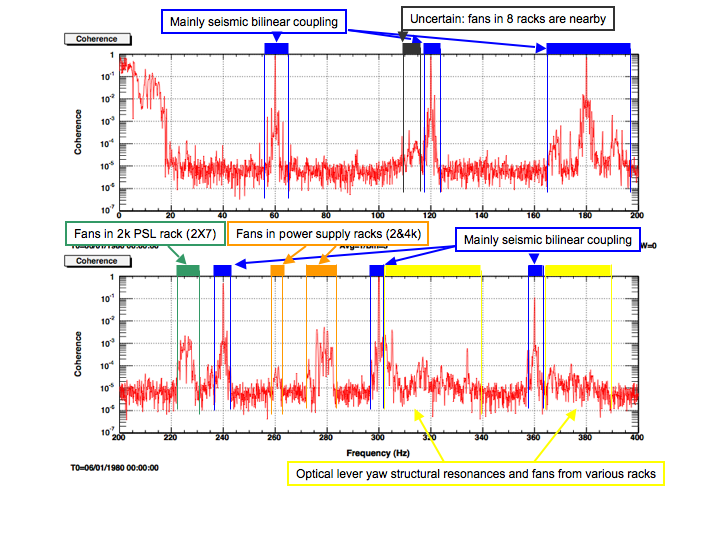
To build our confidence in our understanding of instrumental H1-H2 correlations, we are attempting to identify the features in the H1-H2 coherence. I did this for part of the S5 data back during S5 (here), when I was able to trace many of the features to particular sets of fans, or to low frequency (0-15 Hz) BSC and HAM resonances in the bilinear coupling regions around 60 Hz peaks; the summary from 2006 is repeated here as Figure 1.

Here we check these earlier results with full-S5 data, making sure that the rest of the run is consistent with the earlier partial results by comparing the full-run and partial-run features in coherence and by comparing the full-run PEM spectra to the full-run coherence.

A comparison of Figure 1 and Figure 2 indicates that the clusters of peaks from certain fans and the bilinear coupling features are present in both the partial run and the full run, suggesting that the specific partial-run identifications could be extended to the full run.

We expect that peaks in the H1-H2 coherence are associated with peaks in important PEM channels (sensors at coupling sites or half way between H1 and H2 coupling sites). The full-run PEM spectra of important channels show peaks that correspond with the coherence features, except for the peak at 114 Hz. The 114 Hz peak in Figure 1 is the only peak labeled “uncertain” – there were fans in this frequency band, but the shape of the peak did not quite match the shape in the partial-run spectra. This is again true for the full-run spectra, so I am not confident that we understand the source of the 114 Hz peak in coherence.

We are currently looking into the possibility that a sudden change in coupling when I floated ISCT4 to reduce H1 H2 coupling might be responsible for the inconsistency in coherence and ASDs. 

Images attached to this report
Non-image files attached to this report
H1 SUS
betsy.weaver@LIGO.ORG - posted 11:36, Thursday 02 August 2012 (3703)
H1 PR2 Damping ON

I've turned the damping on for PR2 (chamberside, all metal HSTS) at 18:34 UTC / 11:32 PT, in order to take some damped spectra.  Motion on the optic looks steady as per the speed dials.

H2 ISC
bram.slagmolen@LIGO.ORG - posted 10:28, Thursday 02 August 2012 (3701)
ALS Laser TEC response

(not Bram)

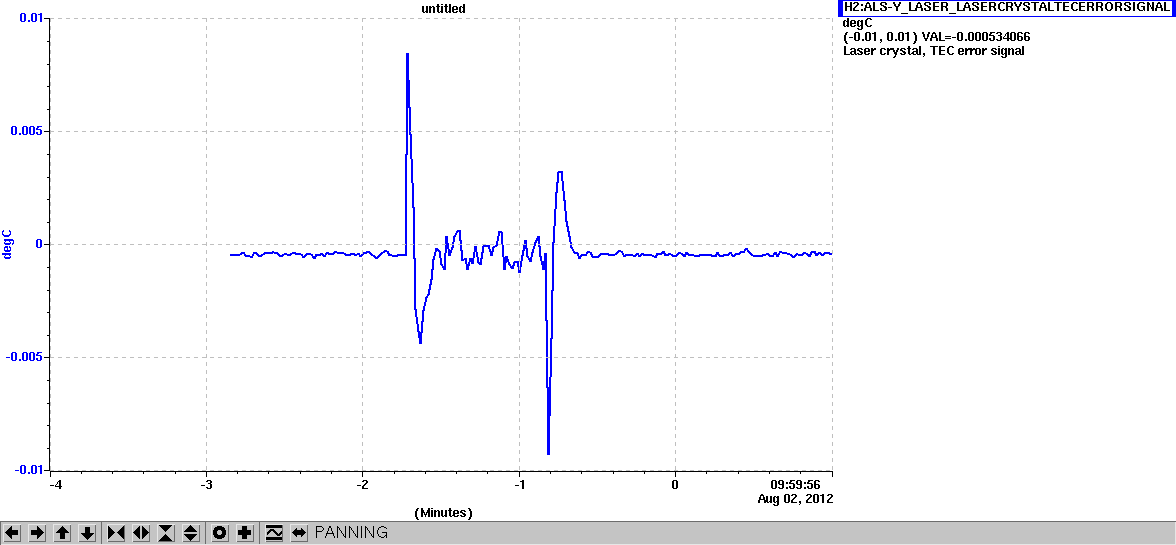
Attached is a plot of the response of the laser crystal TEC when stepping 13mK up and then down at the slow input (assume -1K/V sensitivity). The response shows a spike by about +9mK and then -9mK (not clear how good either calibration is). The response time is roughly 5 sec which would indicate a ~30 mHz pole in the slow input of the laser.

Images attached to this report
H1 SUS
jeffrey.kissel@LIGO.ORG - posted 08:24, Thursday 02 August 2012 (3699)
H1 SUS MC2 Phase 2b Results
B. Bland, J. Kissel

[[ These results are extremely belated, but I want to post them for posterity. ]]

After making adjustments to the static Roll of the optic, we've remeasured (as much as we remembered to of) H1 SUS MC2. Attached are the results.

Several things that these results indicate:

- The alleviation of the DC/static roll in the optic appears to have restored normalcy on the lowest L and T mode, i.e. they're no longer split in frequency. Huh!
- Now all degrees of freedom match well with the model, and other degrees of freedom.
- Spectra compared against in-chamber LLO suspensions indicate that excess noise seen at high-frequency is indeed most likely due to the noisy external environment on the optical tables. However, you'll notice that the noise has significantly reduced from when the SUS was in LHO staging building, so this confirms that the LHO assembly area is simply the noisiest environment where testing takes place, and it's not a problem fundamental to the suspension itself.


As of these results, H1 SUS MC2 has passed Phase 2b testing and is ready for install into HAM3.
Non-image files attached to this report
H2 ISC
alberto.stochino@LIGO.ORG - posted 20:31, Wednesday 01 August 2012 (3698)
Leaving arm locked overnight

I re-locked the arm, after I had unlocked it earlier to take some measuremens with the ALS table PZTs.

I'm leaving it locked overnight.

H2 ISC
alberto.stochino@LIGO.ORG - posted 20:26, Wednesday 01 August 2012 - last comment - 10:29, Thursday 02 August 2012(3697)
ALS QPD loops closed with Cartesian input and output matrices

I replaced the old ALS QPD output matrices (measured empirically by Elli and Thomas several weeks ago) with new ones based on Cartesian coordinates. I obtained these by ray-tracing on the ALS table. Then I measured the input matrices with a Matlab script (/svn/cdsutils/trunk/ALS).

Now the inputs of the IP_POS and IP_ANG filter modules should be calibrated in meters and radians.

These are the matrices:

INPIT =
  -0.001934944012837   0.000295830132597
  -0.000025683755141  -0.000141436038465
INYAW =
   0.001338191005451  -0.000236296533156
  -0.000010597031521   0.000352368394300

OUTPIT =OUTYAW=
   1.0e+07 *
  -0.746993867828206   2.240981603484618
   0.048486940975147  -0.800820822925440

The loops have UGF of about 10 Hz with these gains:

IP_POS_PIT= -8; IP_ANG_PIT=-8; IP_POS_YAW=-8; IP_ANF_YAW=-4

Attached are some spectra measured with the loops either open or closed.

The TMS table relative lateral stability seems to comply with the requirements (=100urad RMS). On the other hand the angular stability seems to be a bit worse than desired (=1urad RMS).

Long term stability (12+ hrs) still has to be evaluated.

Non-image files attached to this report
Comments related to this report
daniel.sigg@LIGO.ORG - 07:51, Thursday 02 August 2012 (3700)
There seems to be a factor 2-3 gain peaking at 20Hz. The gain peaking seems to be responsible for most of the remaining rms. There are also lines at 60Hz and just below that are fairly large in the spectrum. Is this real motion or just sensor noise?

Also: pdf of 2nd file
Non-image files attached to this comment
alberto.stochino@LIGO.ORG - 10:29, Thursday 02 August 2012 (3702)

I multiplied the input matrices by 1e6 so that we read out um and urad at the input of the IP_POS and IP_ANG filter modules.

On all modules I enabled a filter called "cal" that divides that factor out.

LHO General
patrick.thomas@LIGO.ORG - posted 19:14, Wednesday 01 August 2012 (3696)
plots of dust counts
Attached are plots of dust counts > .5 microns in particles per cubic foot.
Non-image files attached to this report
H1 IOO
volker.quetschke@LIGO.ORG - posted 18:33, Wednesday 01 August 2012 (3695)
EOM Amplitude Modulation

[Michael R., Volker Q.]

After installing the new EOM and measuring the PM sidebands, see previous entry, we measured the RFAM on the core modulation frequencies 9.1MHz, 45.5MHz and 24.1MHz. All frequencies were driven with 10Vpp. The measurement was performed using a LZH aLIGO PSL locking PD (D1002163) mounted at the position of IO_AB_PD1.

The AC path of this diode has a 4x amplification with respect to the DC path and 50 ohm output impedance.  The DC path also has 50 ohm output impedance.

The DC value was measured with a TDS 2024 into high impedance, the AC output was measured with an Agilent 4395a into 50 ohm. (Note, this gives another factor of 2 for the DC value.)

The RFAM was calculated using this formula RFAM = (V_AC/4) / (V_DC/2) accounting for AC amplification and DC path impedance.  V_AC denotes the Vrms as measured with the spectrum analyzer and V_DC the voltage read from the oscilloscope. The PM value below is the modulation index as measured previously.  As a sanity check the V_AC measurements were done with the dBv, dBm and Volt settings of the spectrum analyzer to confirm that Vrms is displayed. The following table shows the measurements:

DC value in mV   PM 45.5 ampl. (dBV) 45.5 ampl. (dBm) 45.5 ampl. (uV)   RFAM  Frequency  RFAM/PM
930   0.31 -79.8 -66.8 103        
      1.02E-04 1.02E-04 1.03E-04 Vrms 5.50158E-05 45.5 MHz 1.77E-04
                   
      9.1 ampl. (dBV) 9.1 ampl. (dBm) 9.1 ampl. (uV)        
    0.39 -75.4 -62.4 172        
      1.70E-04 1.70E-04 1.72E-04 Vrms 9.13034E-05 9.1 MHz 2.34E-04
                   
      24.1 ampl. (dBV) 24.1 ampl. (dBm) 24.1 ampl. (uV)        
    0.14 -84.6 -71.5 61        
      5.89E-05 5.95E-05 6.10E-05 Vrms 3.16583E-05 24.1MHz 2.26E-04

The Agilent 4395a was set to BW = 3kHz.

LHO VE
kyle.ryan@LIGO.ORG - posted 17:38, Wednesday 01 August 2012 (3694)
HAM5 and HAM6 gross leak testing
Kyle, Gerardo

7/31/2012 

With the leak detector backing a 50l/sec turbo which was pumping the HAM5 HAM6 annulus and the Vertex Volume being pumped by the Vertex MTP (@ 3.4 x 10⁻⁷ torr), we sprayed (~5sec bursts of audible flow) at each of the test ports of the HAM6 side of the HAM5/HAM6 septum.  No response.  Next, we moved the leak detector over to back the Vertex MTP such that 100% of the exhaust was being sampled and, at some point, noticed that the helium background had risen (from the ~ 2 x 10⁻⁹ torr*l/sec when backing annulus turbo) to 6.5 x 10⁻⁹ torr*L/sec


8/1/2012

The indicated helium background of the leak detector was 6.5 x 10⁻⁹ torr*L/sec when we left yesterday.  It remained unchanged today.  This value falls off rapidly as the 10" gate valve at the MTP inlet is closed and is behaving as if it is a real signal sourced on the VE side of the 10" gate valve.  Any helium introduced via cross talk to a leaking metal joint yesterday would not remain unchanged for this many hours of 2000 l/sec MTP pumping.  It is much more likely to be a reservoir permeated through the annulus viton from the previous days spraying  -> Today we vented, then pumped, then vented, then pumped, then vented then pumped the HAM6 and HAM5 annulus space over the course of the afternoon in hopes that this might expedite the removal of helium permeated into the annulus viton.  We observed during the initial annulus vent that the helium signal increased slightly while the annulus was vented.  

With the helium background too high for acceptance testing of new conflat or feed-through joints we decided to eliminated any gross leaks existing on HAM5 and HAM6.  All conflat joints and electrical feed-throughs were sprayed with 10 second blasts of audible flow.  The helium background rose slowly and steadily from 6.5 x 10⁻⁹ torr*l/sec to 1.3 x 10⁻⁸ torr*l/sec over the 1 hour period we were testing

H1 IOO
volker.quetschke@LIGO.ORG - posted 17:14, Wednesday 01 August 2012 (3693)
Frequency dependent sideband strength in H1 EOM

[Michael R., Volker Q.]

Following the measurements at LLO we measured the frequency dependent sideband generation around the resonant frequencies. See here for the LLO measurements.

The table below shows the sideband height as measured with a OSA on the PSL table.  The frequency is the modulation frequency in MHz.  All three modulator inputs were driven with 10Vpp (in 50ohm).

Carrier (V): 2.15       2.10       2.14  
                     
Frequency SB (mV) m   Frequency SB (mV) m   Frequency SB (mV) m
8.90 21 0.20   23.80 7 0.12   44.80 14 0.16
8.95 28 0.23   23.85 11 0.14   44.90 15 0.17
9.00 37 0.26   23.90 13 0.16   45.00 18 0.18
9.05 55 0.32   23.95 17 0.18   45.10 24 0.21
9.10 82 0.39   24.00 18 0.19   45.20 30 0.24
9.15 99 0.43   24.05 17 0.18   45.30 37 0.26
9.20 90 0.41   24.10 11 0.14   45.40 45 0.29
9.25 66 0.35   24.15 10 0.14   45.50 53 0.31
9.30 44 0.29   24.20 9 0.13   45.60 53 0.31
9.35 28 0.23   24.25 7 0.12   45.70 50 0.31
9.40 19 0.19   24.30 5 0.10   45.80 40 0.27
                45.90 30 0.24
                46.00 22 0.20
                46.10 17 0.18

The sideband strength is well centered around the target frequencies of 9.1MHz and 45.5MHz.  The 24.1MHz modulation is slightly off by 100kHz, but I did not want to risk to change the other two frequencies while trying to change the not so important 24.1MHz frequency.

H1 IOO
volker.quetschke@LIGO.ORG - posted 16:44, Wednesday 01 August 2012 (3691)
Modulator swap and optics re-alignment in the PSL
[Michael R., Cheryl V., Volker Q.]

The H1 modulator has been installed on the PSL table, the temporary H2 modulator
got swapped out.  The H2 modulator will be re-tuned and become the H1 spare.

The beam after the modulator was not parallel to the grid on the optics table
because IO_MB_M2 was not movable far enough to allow for the about 5 degrees
of beam deviation going into the EOM.

At LLO this problem was solved by using a New Focus Pedestal Base with
Clamping Forks and moving mirror to an off-grid position.

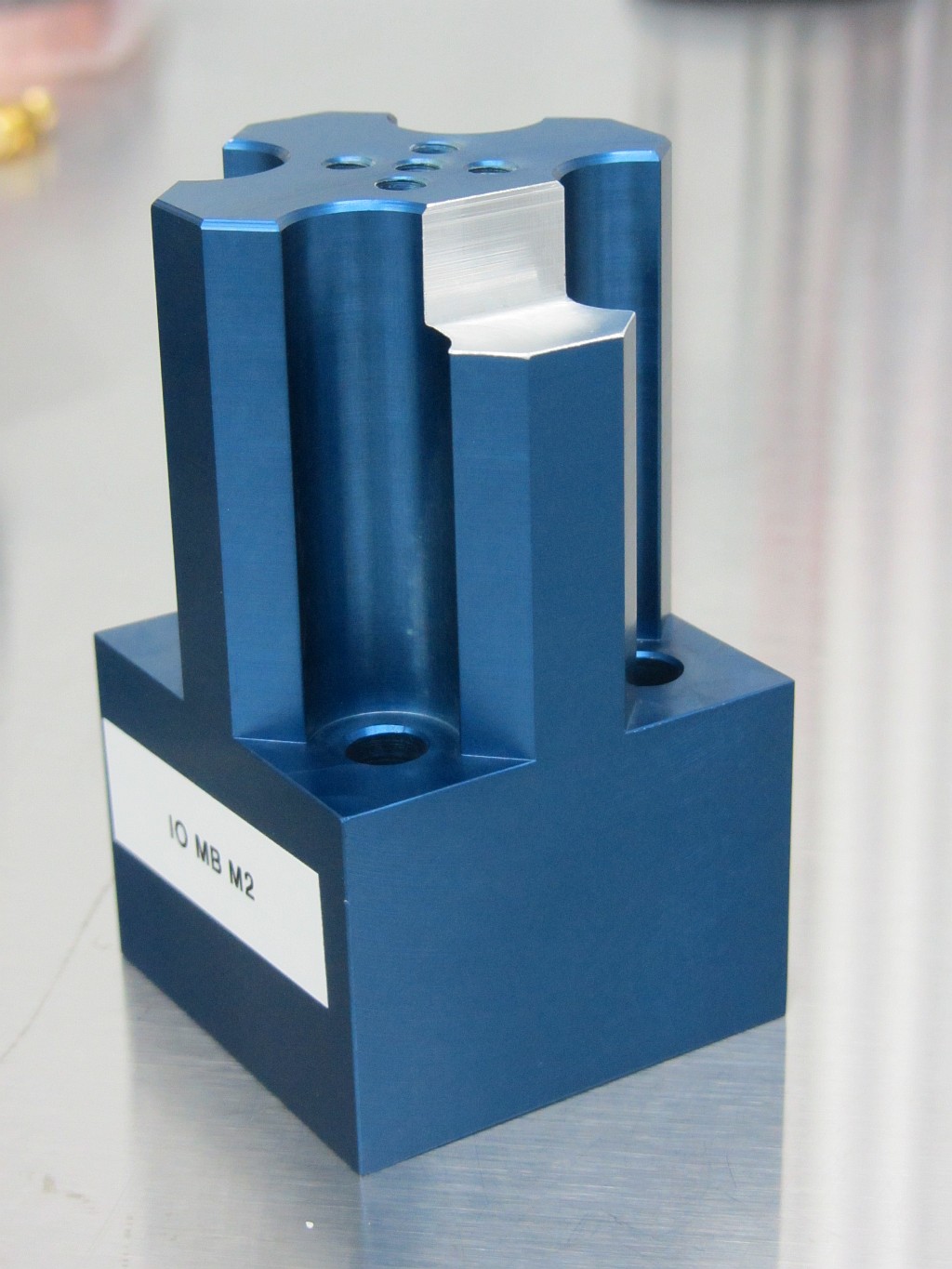
Here we decided to use a mirror mount with three adjustment screws and
a modified blue base to mount IO_MB_M2.  This provided a stable mounting
the mirror mount and the needed flexibility to steer into the EOM.
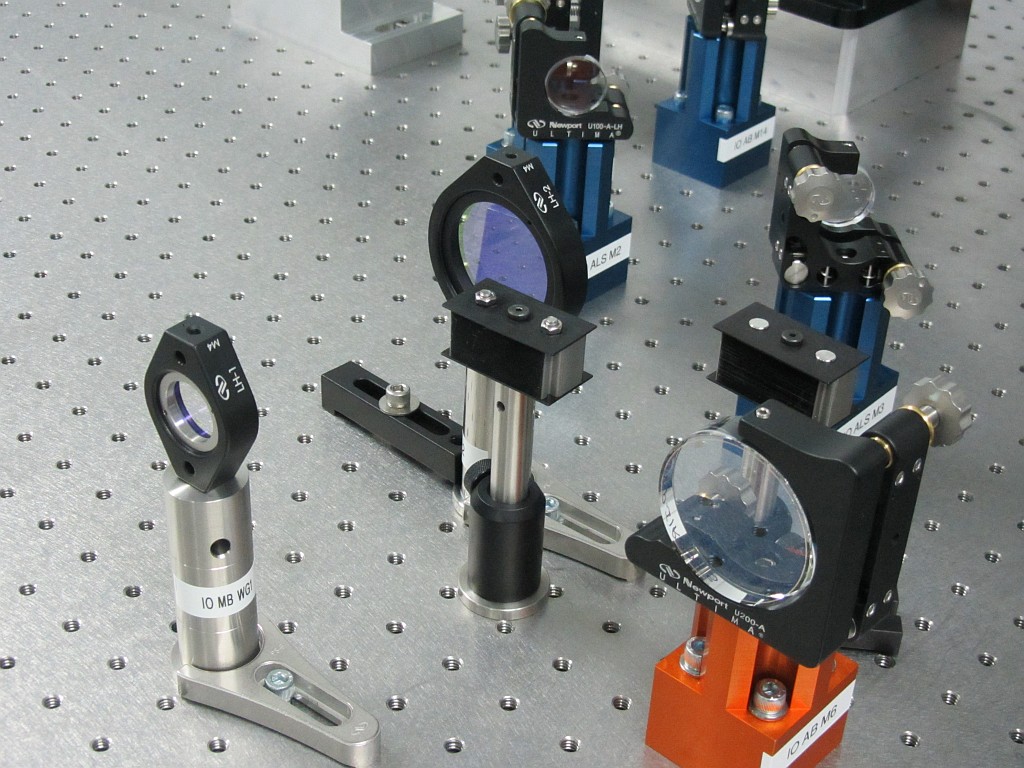
All IO PSL optics were realigned using pinhole 4 inch beam height apertures
to keep the beam on the grid of the optical table.

We also found that the reflections from the AR surfaces of the mode
matching lenses IO_MB_L1 and IO_MB_L2 were surprisingly strong.
(We followed various stray beams with 10W into the EOM)

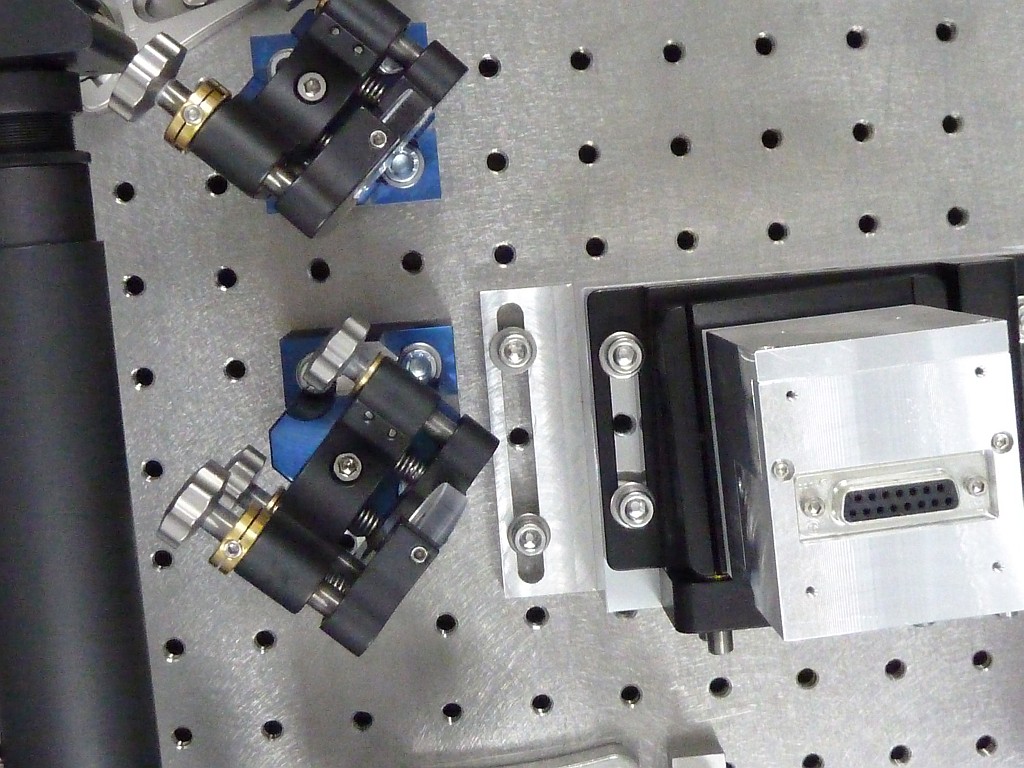
The immediate reflection from IO_AB_L1 hits the brushed aluminum
surface of the modulator housing - the lens is turned slightly to
not reflect the beam back into the modulator.
This creates a wide horizontal "spray" of scattered light because of
the brushed surface.  We worked around this problem by placing a dog
clamp beside the EOM aperture. See picture (dog_clamp_and_beam_dump.jpg),
this works, but is certainly not a permanent solution.

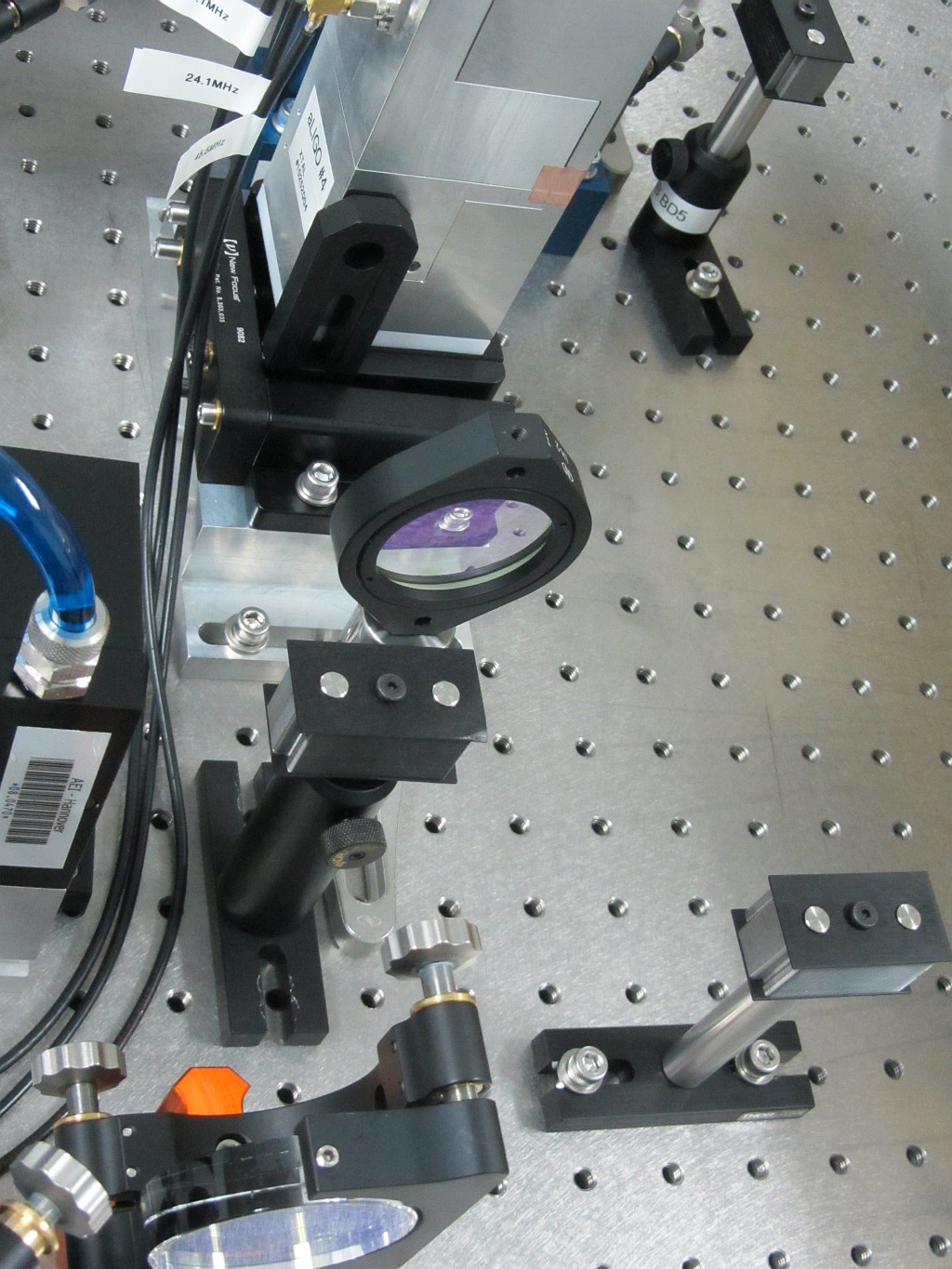
The next beam we blocked was a reflection from IO_MB_L2 partially hitting
the rim of IO_MB_L1 and partially going trough hitting the dog clamp
area.  See the razor blade dump roughly in the center of the dog clamp
picture.

Another beam we blocked was going towards IO_MB_L2, see (L2_dump.jpg).
(At the time of writing this we are not sure anymore if this beam was
already blocked by the dump in front of IO_MB_L1, this needs
verification).

Finally we placed a razor blade dump close to IO_MB_M3 to catch the
wrong polarization in the separated beam coming from the modulator
crystal.  See picture (wrong_pol_bd.jpg)

Sideband strength and RFAM will be reported in a separate log entries.
Images attached to this report
H1 PSL
michael.rodruck@LIGO.ORG - posted 16:22, Wednesday 01 August 2012 (3692)
PSL plots

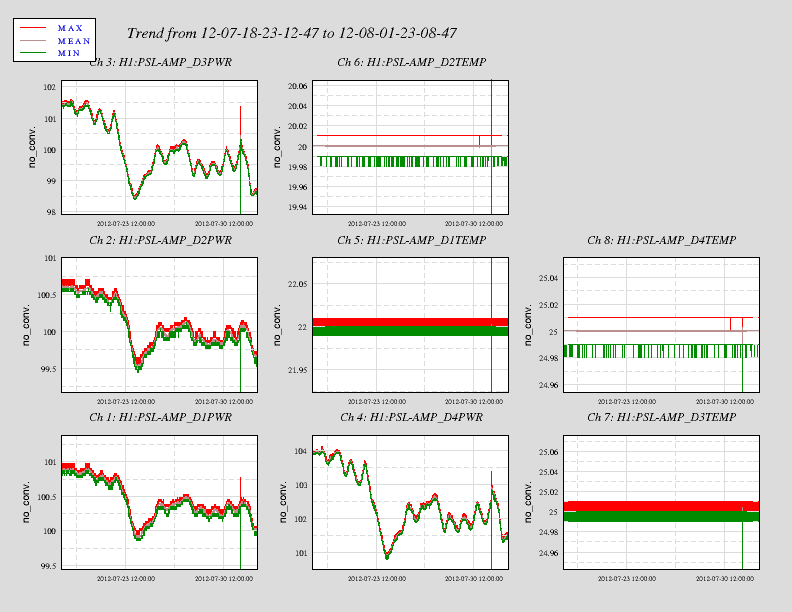
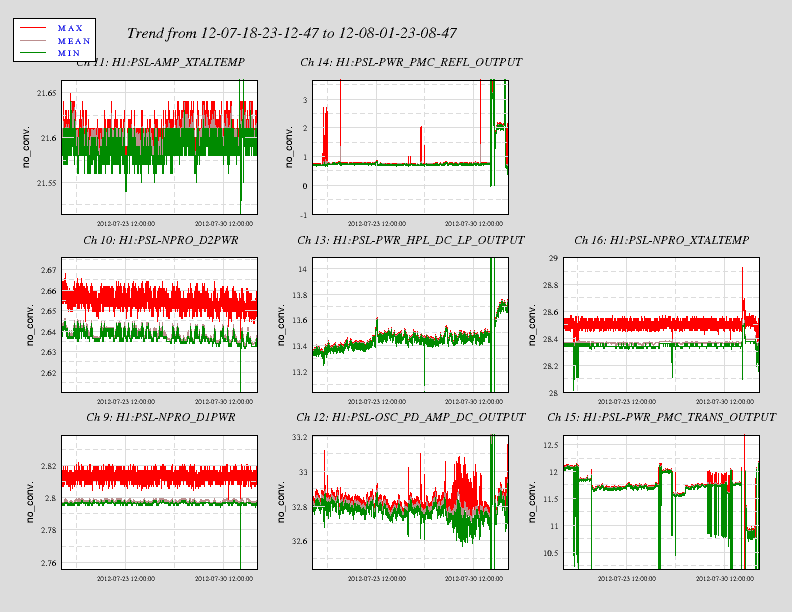
35W beam

We briefly transitioned to high power yesteday for IO work. While transitioning I forgot to turn off the FE watchdog, so when I closed the FE shutter the laser tripped, which is the discontinuity you see.

Images attached to this report
Non-image files attached to this report
LHO General
thomas.vo@LIGO.ORG - posted 15:57, Wednesday 01 August 2012 (3690)
OPS Summary
- HAM 2 alignment - Jason
- HAM ISI transfer functions - Hugo
- Reclean Optics table lab - Terry
- Connecting H2 ITMY Ring Heater Cables - Fil
- HAM 3 : Doug & Jason
- HAM 6 leak checking - Kyle & 2:45 to 2:55
- RFAM measurements - Michael & Volker
H2 TCS
filiberto.clara@LIGO.ORG - posted 15:01, Wednesday 01 August 2012 (3689)
Ring Heater - BSC8
Pulled H2 Ring Heater Cable from BSC8 along Y-Arm to H2 PEM/TCS Rack. Ring Heater Chassis power is connected, but unit was left off. IO Chassis still needs work, missing ADC card. Work was done around 10-11 am. Bram/Hugo/Control room was notified prior to start of work.
Displaying reports 82741-82760 of 86348.Go to page Start 4134 4135 4136 4137 4138 4139 4140 4141 4142 End