Displaying reports 1481-1500 of 88618.Go to page Start 71 72 73 74 75 76 77 78 79 End
Reports until 16:28, Monday 30 March 2026
H1 ISC
sheila.dwyer@LIGO.ORG - posted 16:28, Monday 30 March 2026 (89701)
PRC alignment

Jenne Driggers, Sheila, Keita, Camilla, Jennie Wright, Rahul

We are searching for PRX flashes to use for the POP path work in HAM1.  

We are using a DRMI locked time from March 14th (1:30-2 UTC) as a reference.  Since that time HAM2 hepi has been locked, causing a +3.7urad shift in RZ, which means that PR3 and PRM osems need to be -3.7urad yawed compared to how they where before HEPI was locked to reproduce the alignment (this shift is small compared to the misalignments that we are looking for).  

While trying to restore to this reference time, we see that restoring ITMX sliders restults in optical levers similar to the reference time, and PRM sliders results in PRM osems similar to the reference times.  However, restoring PR3 sliders to the reference time gives top mass osem pitch -20 urad in pitch, and PR2 sliders restored gives a +30 urad shift according to the top mass osems.  

HAM2 CPS RY shows a +1.3 urad shift at the same time as the PR3 osem shift show -24urad (these are opposite directions), HEPI shows -1.5urad RY, at 11 am pacific time Friday, there is no change in the DAC drive at this time.  

PR2's shift seems to have happened right after the DACKill from Friday.  Ibrahim and Oli are running top mass to top mass TFs for health checks on both of those.  

Keita walked aligments to get PRX flashes back.  In the end, PRM and ITMX are back to where they were when DRMI was locked March 14th, as well as PR3 yaw.  PR3 pitch osem is back to where it was on the 14th, but the slider is +11urad.  PR2 pitch slider is -47urad, osem says -29 urad, yaw +45 slider, +55 urad osems.  

We dedicded it was time to move on with the in chamber work, because while these alignment shifts are strange, they probably can't explain the misalingment between the in air and the in vacuum pop paths.  

H1 SUS
oli.patane@LIGO.ORG - posted 15:30, Monday 30 March 2026 - last comment - 15:31, Monday 30 March 2026(89703)
PR3 / PR2 TFs look good

Commissioners wanted health checks run for PR3 and PR2 to check for any suspension issues. I ran TFs for PR3 and Ibrahim ran them for PR2. Results for both suspensions look good. Results for PR3 are below, and then Ibrahim will be commenting on the info for the PR2 measurements.
Settings:
- PR3 in HEALTH_CHECK
- DAMP OFF (including estimator damping)

Data:
/ligo/svncommon/SusSVN/sus/trunk/HLTS/PR3/SAGM1/Data/2026-03-30_2115_H1SUSPR3_M1_WhiteNoise_{L,T,V,R,P,Y}_0p02to50Hz.xml
r12986
Results:
/ligo/svncommon/SusSVN/sus/trunk/HLTS/PR3/SAGM1/Results/2026-03-30_2115_H1SUSPR3_M1_ALL_TFs.pdf
/ligo/svncommon/SusSVN/sus/trunk/HLTS/PR3/SAGM1/Results/2026-03-30_2115_H1SUSPR3_M1.mat
r12987

Non-image files attached to this report
Comments related to this report
ibrahim.abouelfettouh@LIGO.ORG - 15:31, Monday 30 March 2026 (89705)

PR2 TFs

Non-image files attached to this comment
H1 SUS (SUS)
rahul.kumar@LIGO.ORG - posted 15:26, Monday 30 March 2026 - last comment - 15:28, Monday 30 March 2026(89702)
OSEM spectra for SUS PR2 and PR3 - looks healthy

Sheila, Rahul

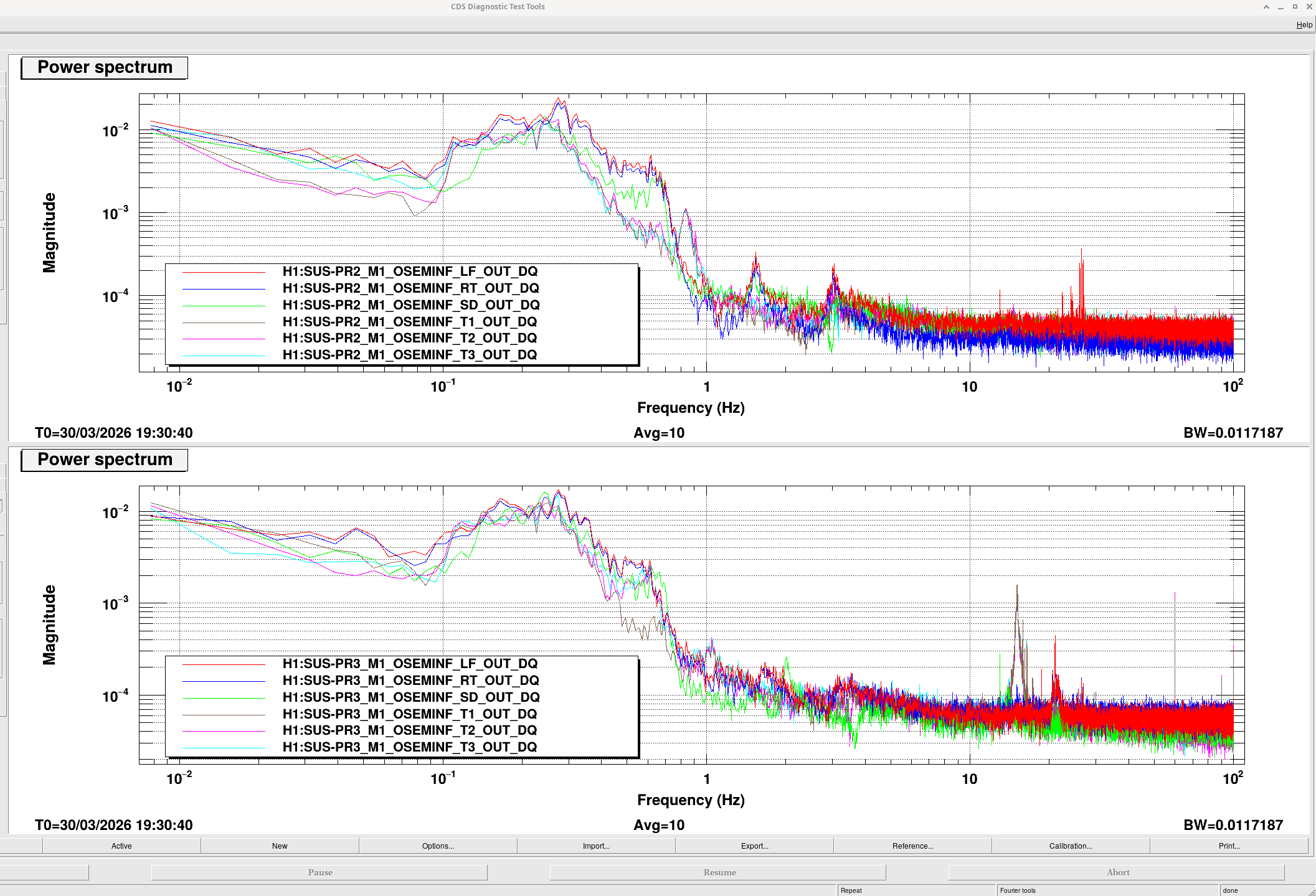
This morning I took top mass osem spectra for both PR2 and PR3 suspension and they looks healthy (the noise level for all bosems are similar and the magnitude is to below 10^-4  above 10Hz - un-calibrated) - plot attached below. There is a 15Hz peak seen on PR3, which is also seen (in both PR2 and PR3) if we go back in time (7 days) compare the spectra results. 

I also looked at the medm screen of both the suspensions (input filters, flag position, damping loops and coil driver settings) and trended bosem channels and did not find anything unusual. 

Images attached to this report
Comments related to this report
rahul.kumar@LIGO.ORG - 15:28, Monday 30 March 2026 (89704)

spectra for PR2 and PR3 from last week (25 March 2026). 

Images attached to this comment
H1 TCS
sophie.muusse@LIGO.ORG - posted 12:13, Monday 30 March 2026 (89698)
CHETA QCL Fused Silica beam dump

Summary: A thermal lens resulting from using 2 Fused Silica windows as attenuators in the CHETA system should not effect the profiled beamsize. 


We are considering using 2 Fused Silica windows at 45 degrees as absorping attenuators at the outputs of the QCL during beam profiling to stop back reflections which we believe are currently damaging the units. We plan on using 2 windows to prevent a beam displacement so the path doesnt have to be altered. During this process we require atleast 7mW on the thermal profiler to accurately profile the beam.

The attenuation through each 1mm window assuming using a loss factor of -28e6dB/km at 4.6um would be as follows:
Power after first window: 0.398W
Power after second window: 0.158W
Power reflected back through both windows: 0.0251W

This shows there will be non-neglible absorption so some quick modelling has been completed to demonstrate that this thermal lens would not have a significant effect on the system. 

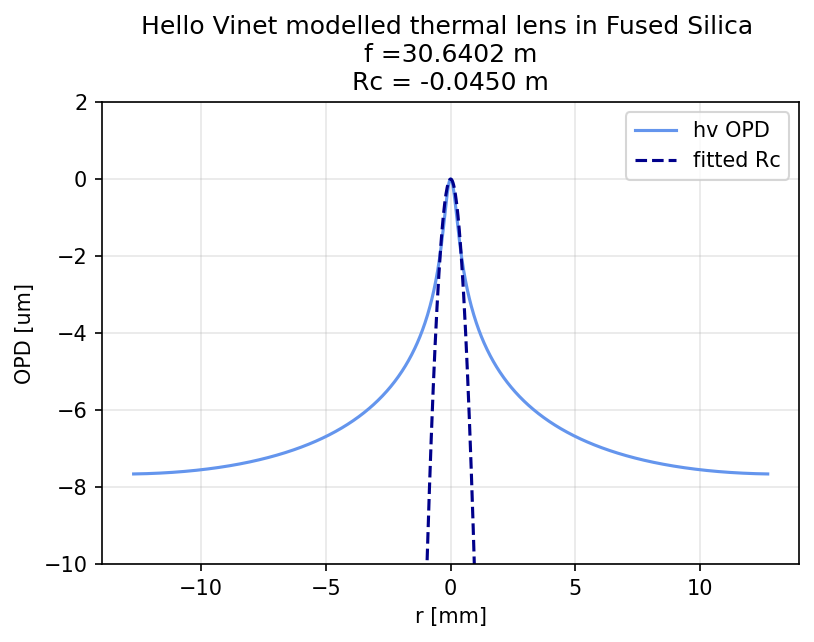
I have used the finesse Hello Vinet implementation to model both the thermo-refrative and thermal expansion induced thermal lenses, assuming 2W of QCL power is absorbed in the substrate. This will be an over estimate as HV assumes that Pin ≈ Pout and that the absorbed power is much smaller than Pin. 
A radius of curvature was found from the HV OPD by completing an overlap interval with 2,0 and 0,2 modes.

Assuming worst case scenario of 2W of absorbed power and an beamsize of 300um (approximately the waist of a nominal QCL unit) there is an induced thermal lens of f =30.5273 m Rc = -0.0451 m. To determine the effect on the q-parameter of the beam I have assumed both glass windows act as a lenses with this focal length and use ABCD matrics determine the change in q.  This change in q is similar to the measurement error of these q factors and when propagated through to the ITM changes the beam size by less than 1%. This calculation for every unit is given in the table below using these yaml files.  

Condition q (x) q (y) w at ITM x (m) w at ITM y (m) q at ITM x q at ITM y
0918
current system −0.234 + 0.113j −0.295 + 0.098j 0.05346 0.05747 35.977 + 0.663j 35.634 + 0.563j
with lens −0.231 + 0.110j −0.290 + 0.094j 0.05426 0.05854 35.994 + 0.644j 35.664 + 0.543j
0920
current system −0.129 + 0.071j −0.155 + 0.059j 0.04794 0.05408 36.818 + 0.866j 36.576 + 0.671j
with lens −0.128 + 0.069j −0.15367 + 0.05782j 0.04828 0.05451 36.830 + 0.854j 36.594 + 0.662j
0919
current system −0.186 + 0.096j −0.227 + 0.072j 0.04737 0.05492 37.546+0.920j 37.221 +0.673j
with lens −0.184+ 0.094j −0.224 + 0.070j 0.04791 0.05566 37.564 + 0.900j 37.251+ 0.656j
0851
current system −0.180 + 0.069j −0.224 + 0.063j 0.04887 0.05462 36.143 + 0.670j 35.772 + 0.545j
with lens −0.178 + 0.067j −0.221 + 0.061j 0.04928 0.05515 36.316 + 0.795j 35.896 + 0.620j

edit: fixed LLO numbers with updated parameters

Images attached to this report
Non-image files attached to this report
H1 SPI
thomas.roocke@LIGO.ORG - posted 12:02, Monday 30 March 2026 (89700)
SPI Amplifier Modification

[Tom, Jeff]

The SPI amplifier chassis' (S2500712, S2500713) were modified to increase their transimpedance gain, based upon testing in the optics lab from Jeff. Resistors R4 were changed to modify the gain, and capacitors C5 were changed to maintain circuit stability and bandwidth. Exact component changes summarised below:

S2500711

CH1: R4 = 1.5kohm, C5 = 2.2nF
CH2: R4 = 1.5kohm, C5 = 2.2nF
CH3: R4 = 1.5kohm, C5 = 2.2nF
CH4: R4 = 1.5kohm, C5 = 2.2nF

S2500712
CH1: R4 = 5kohm, C5 = 560pF
CH2: R4 = 5kohm, C5 = 560pF
CH3: R4 = 3.3kohm, C5 = 1nF
CH4: R4 = 3.3kohm, C5 = 1nF

CH5: R4 = 3.3kohm, C5 = 1nF
CH6: R4 = 3.3kohm, C5 = 1nF
CH7: R4 = 3.3kohm, C5 = 1nF
CH8: R4 = 3.3kohm, C5 = 1nF

S2500713
CH1: R4 = 54kohm, C5 = 56pF
CH2: R4 = 54kohm, C5 = 56pF

LHO FMCS (PEM)
ryan.crouch@LIGO.ORG - posted 12:01, Monday 30 March 2026 (89699)
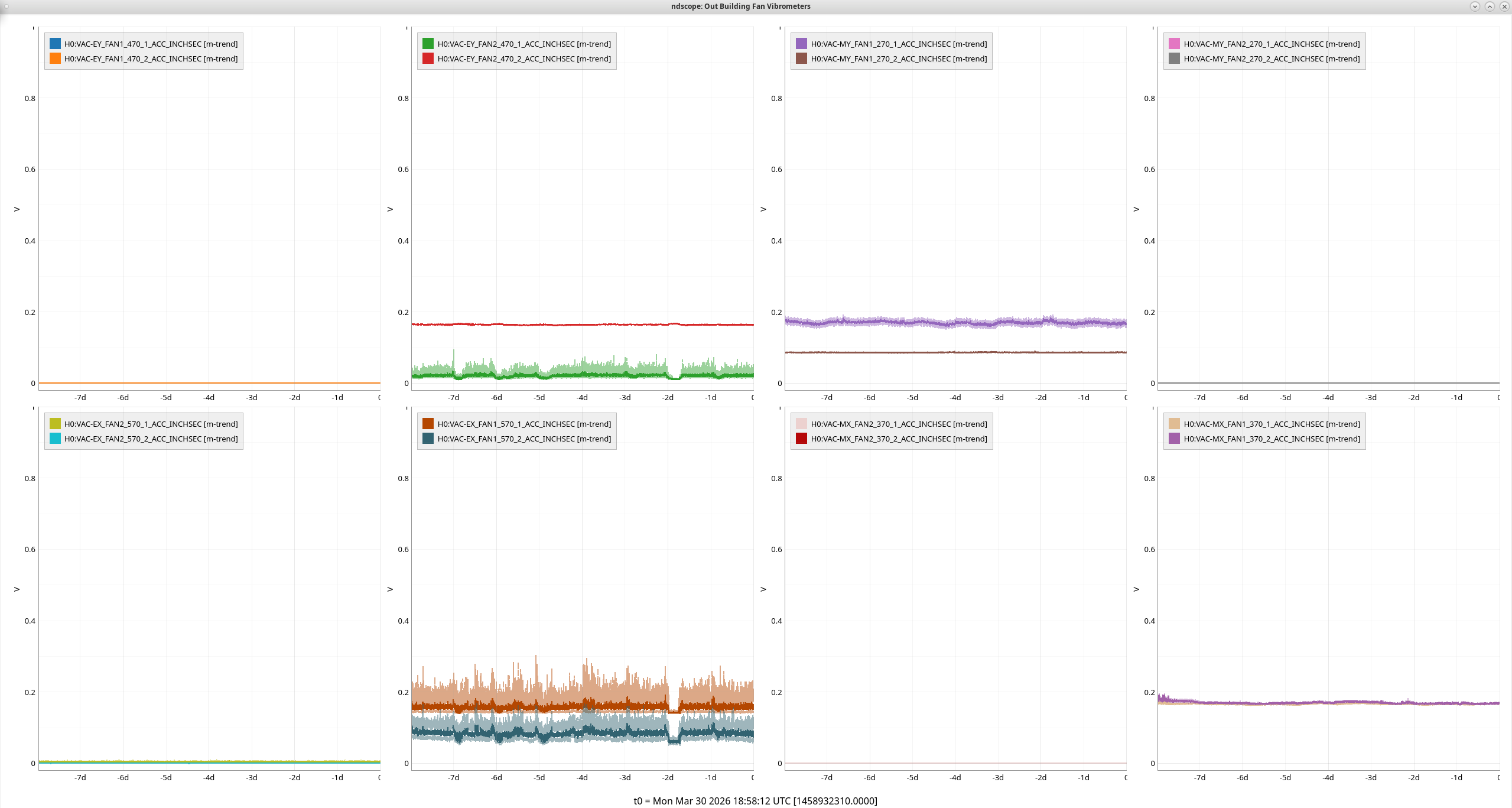
HVAC Fan Vibrometers FAMIS Check (FAMIS 39860)

Closes FAMIS39860, last checked in alog89375

Everything looks as it did during the last check, except MR_FAN4_170_1 looks noisier than during the last check.

Images attached to this report
H1 SEI
ryan.crouch@LIGO.ORG - posted 11:48, Monday 30 March 2026 (89695)
BRS Drift Trends - Monthly FAMIS

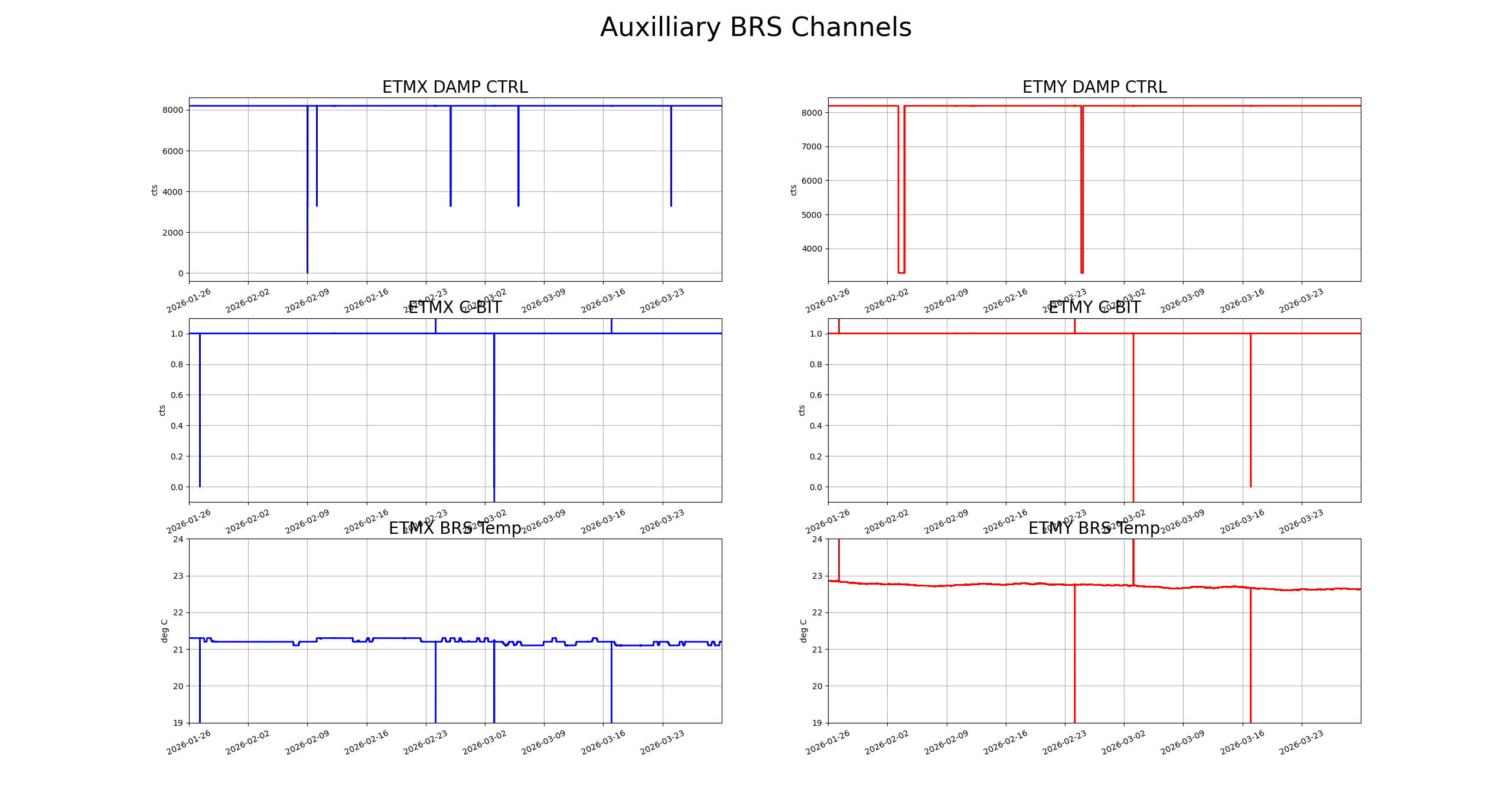
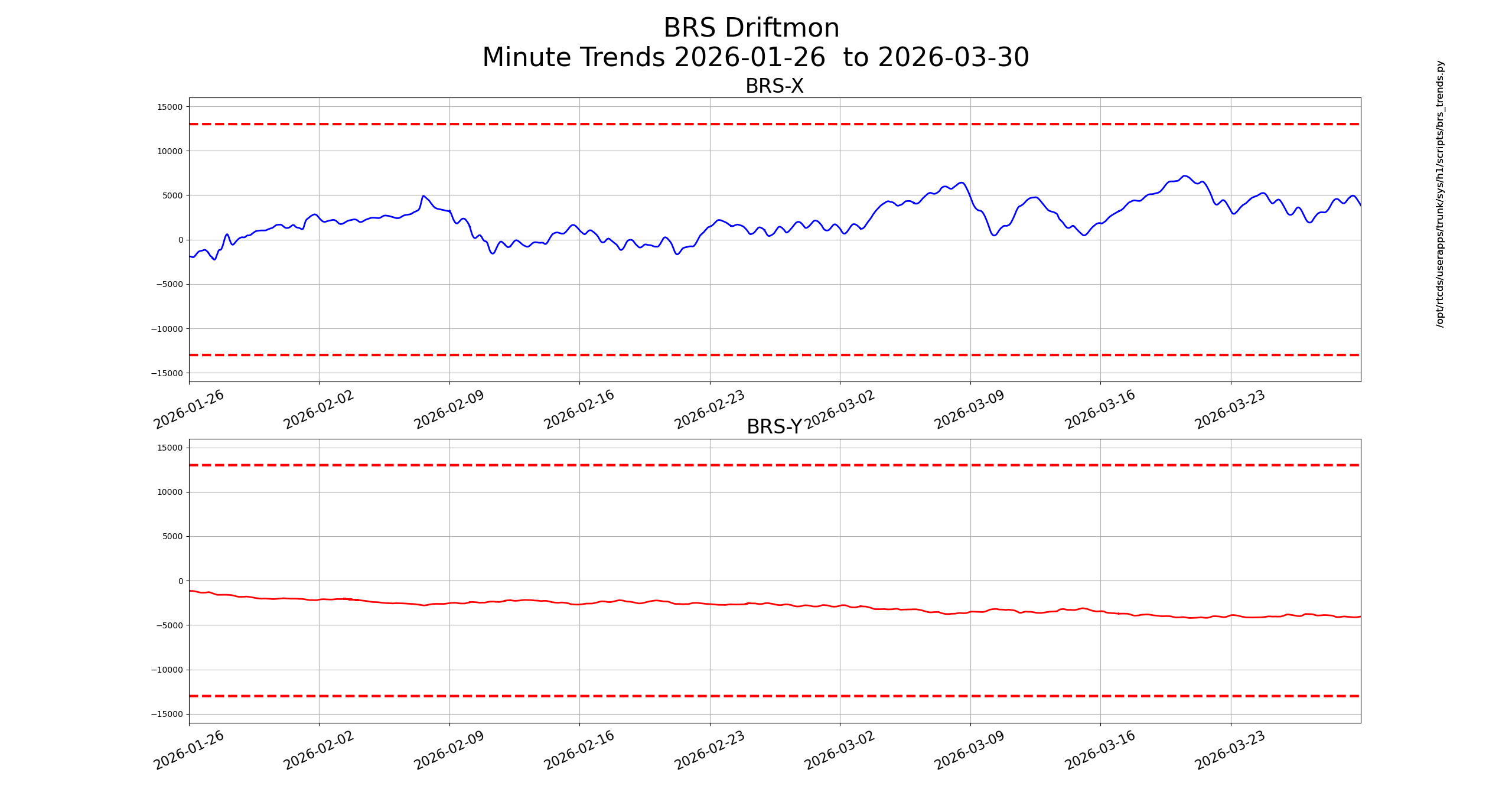
Closes FAMIS38815, last checked in alog89298

BRS_Y looks to be drifting down, over the past two months at least. The aux channels look just as they did before.

Images attached to this report
LHO VE
david.barker@LIGO.ORG - posted 11:47, Monday 30 March 2026 (89697)
Mon CP1 Fill

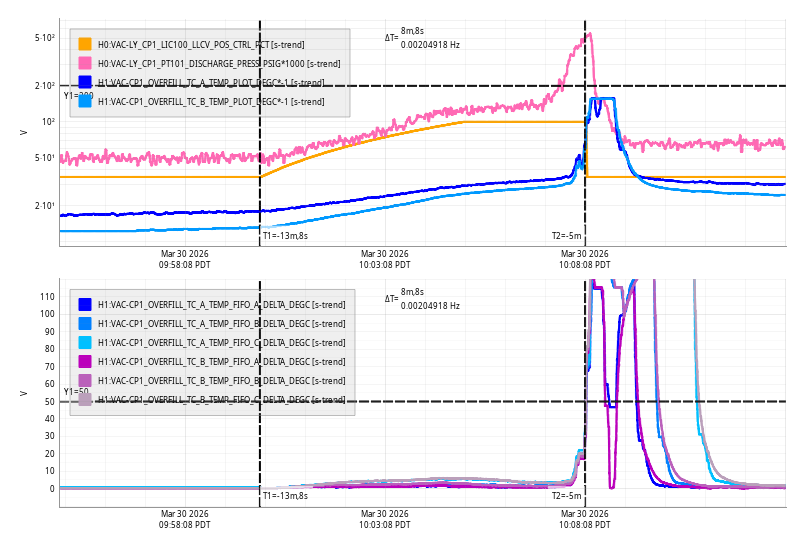
Mon Mar 30 10:08:08 2026 INFO: Fill completed in 8min 5secs


Images attached to this report
H1 General (DetChar)
jane.glanzer@LIGO.ORG - posted 11:35, Monday 30 March 2026 (89696)
Omicron glitch rate comparisons for O4

Attached to this alog are the Omicron glitch rate compariosns between O4a, O4b, and O4c. I am posting just for the record, but this was also presented at the LVK in Pisa (see here). For the comparisons, I used roughly about ~3240 hours of observing time (denoted by the H1:DMT-ANALYSIS_READY:1 flag). The exact GPS times used for the analysis were:

O4a: 1372611618 - 1389484818

O4b: 1397692818 - 1422118818

O4c: 1422118818 - 1447502418

The first attached plot shows the glitch rate across each observing period, which includes glitches with an SNR > 7.5, and frequency between 10 Hz - 1024 Hz. The rate was the highest in O4a, at around ~38 glitches per hour. The subsequent glitch rates for O4b/c were lower and similar levels, coming in at around ~11 glitcher per hour and ~10 glitches per hour. In O4a, the glitch rate was high due to increased non-stationary noise from ~10 Hz - 50 Hz (see alogs 71005 & 71092). The following two plots show the glitch rates as a function of SNR and frequency. Most glitches had an SNR below 50, and frequency below 50 Hz.

Images attached to this report
H1 SUS
thomas.roocke@LIGO.ORG - posted 09:53, Monday 30 March 2026 - last comment - 16:29, Tuesday 07 April 2026(89692)
QOSEM In-Vac Cable Assembly
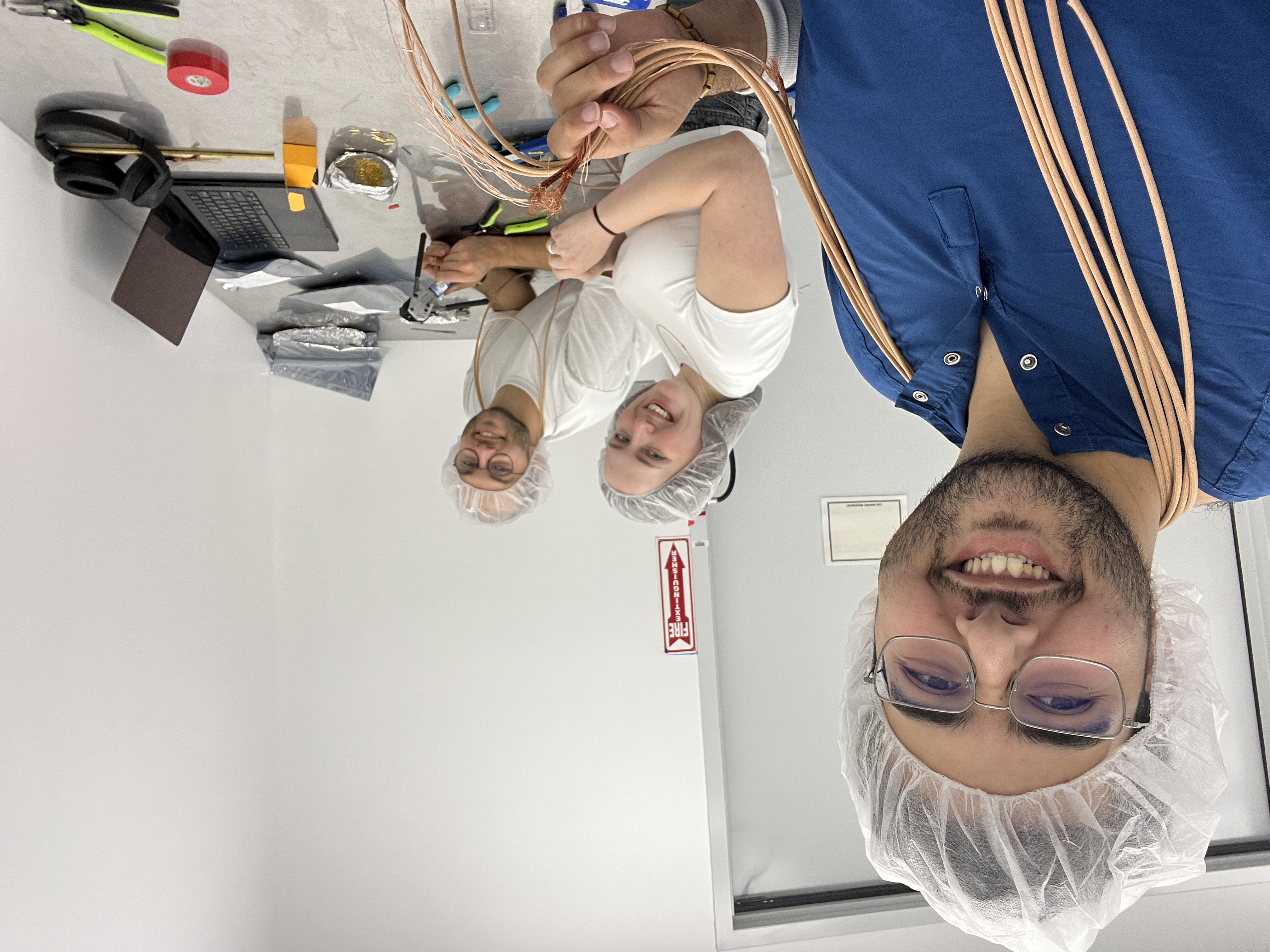
[Tom, Sophie, Ibrahim, Betsy]

Thursday, Friday and Saturday of last week we assembled a batch of 4 QOSEM In-Vac cables (D2500311) for use at LLO on the BBSS. All cables have passed electrical testing.

On Sunday, Betsy cleaned and began an airbake on the cables, and they have now begun there vacuum bake, which should finish Wednesday evening.
Images attached to this report
Comments related to this report
corey.gray@LIGO.ORG - 16:29, Tuesday 07 April 2026 (89813)EPO

Tagging for EPO.

LHO General
ibrahim.abouelfettouh@LIGO.ORG - posted 07:39, Monday 30 March 2026 (89689)
OPS Day Shift Start

TITLE: 03/30 Day Shift: 1430-2330 UTC (0730-1630 PST), all times posted in UTC
STATE of H1: Planned Engineering
OUTGOING OPERATOR: None
CURRENT ENVIRONMENT:
    SEI_ENV state: MAINTENANCE
    Wind: 14mph Gusts, 10mph 3min avg
    Primary useism: 0.03 μm/s
    Secondary useism: 0.13 μm/s 
QUICK SUMMARY:

IFO is in IDLE for PLANNED MAINTENANCE

An earthquake tripped some watchdogs - untripped now.

Plans this week prep BHSS and SPI in Optics lab and continue BSC2 platform install.


LHO VE
david.barker@LIGO.ORG - posted 10:27, Sunday 29 March 2026 (89688)
Sun CP1 Fill

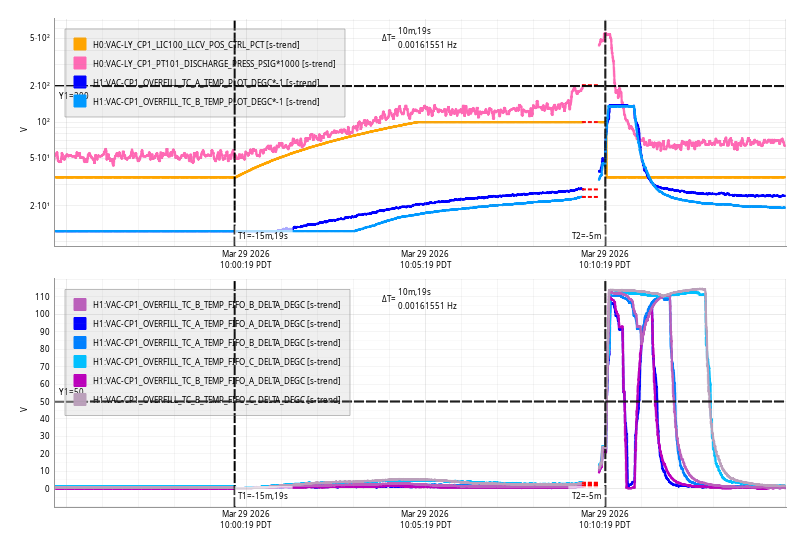
Sun Mar 29 10:10:19 2026 INFO: Fill completed in 10min 16secs


Images attached to this report
H1 ISC (INS, IOO, ISC)
keita.kawabe@LIGO.ORG - posted 13:49, Saturday 28 March 2026 - last comment - 09:08, Monday 30 March 2026(89685)
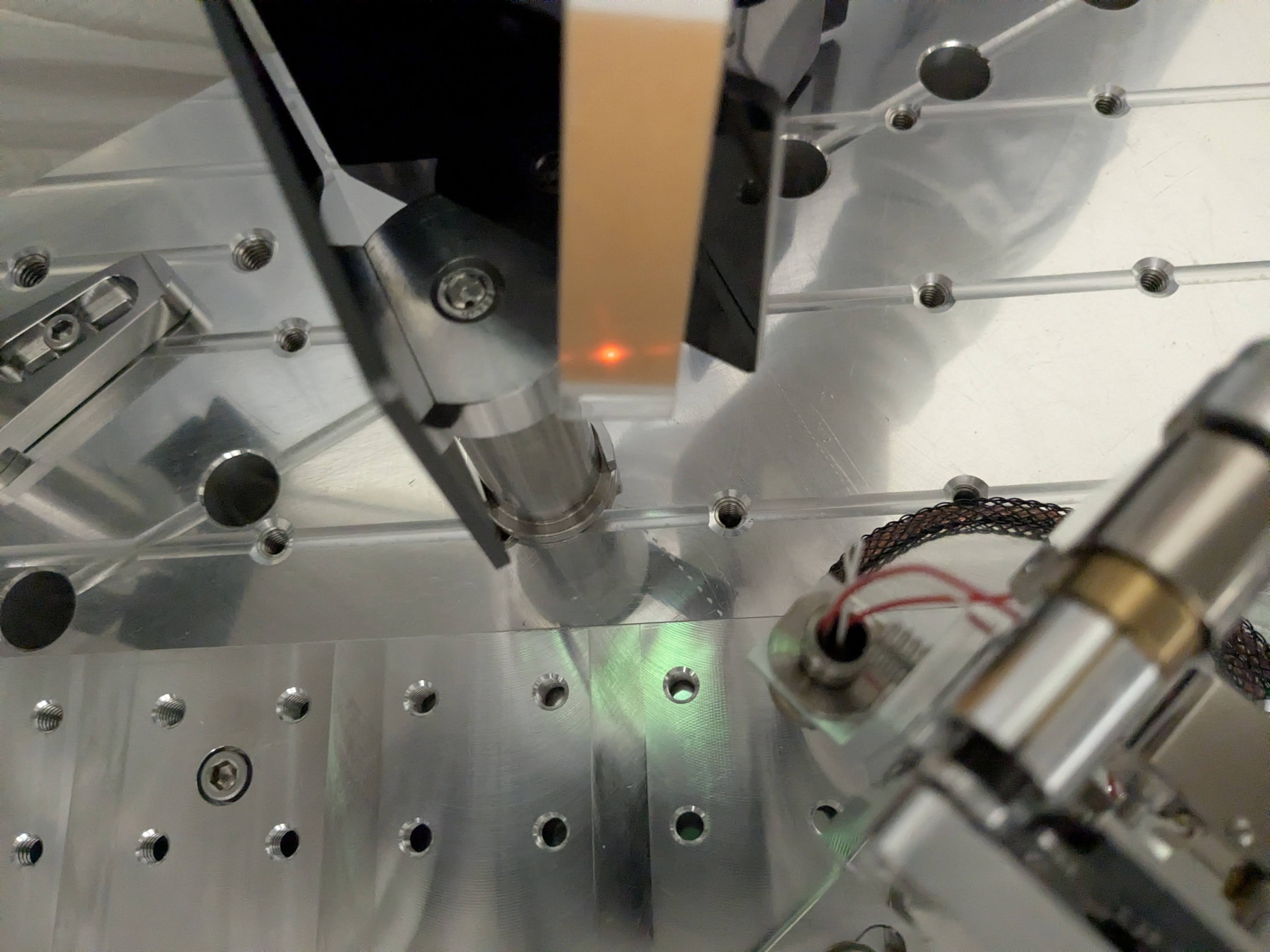
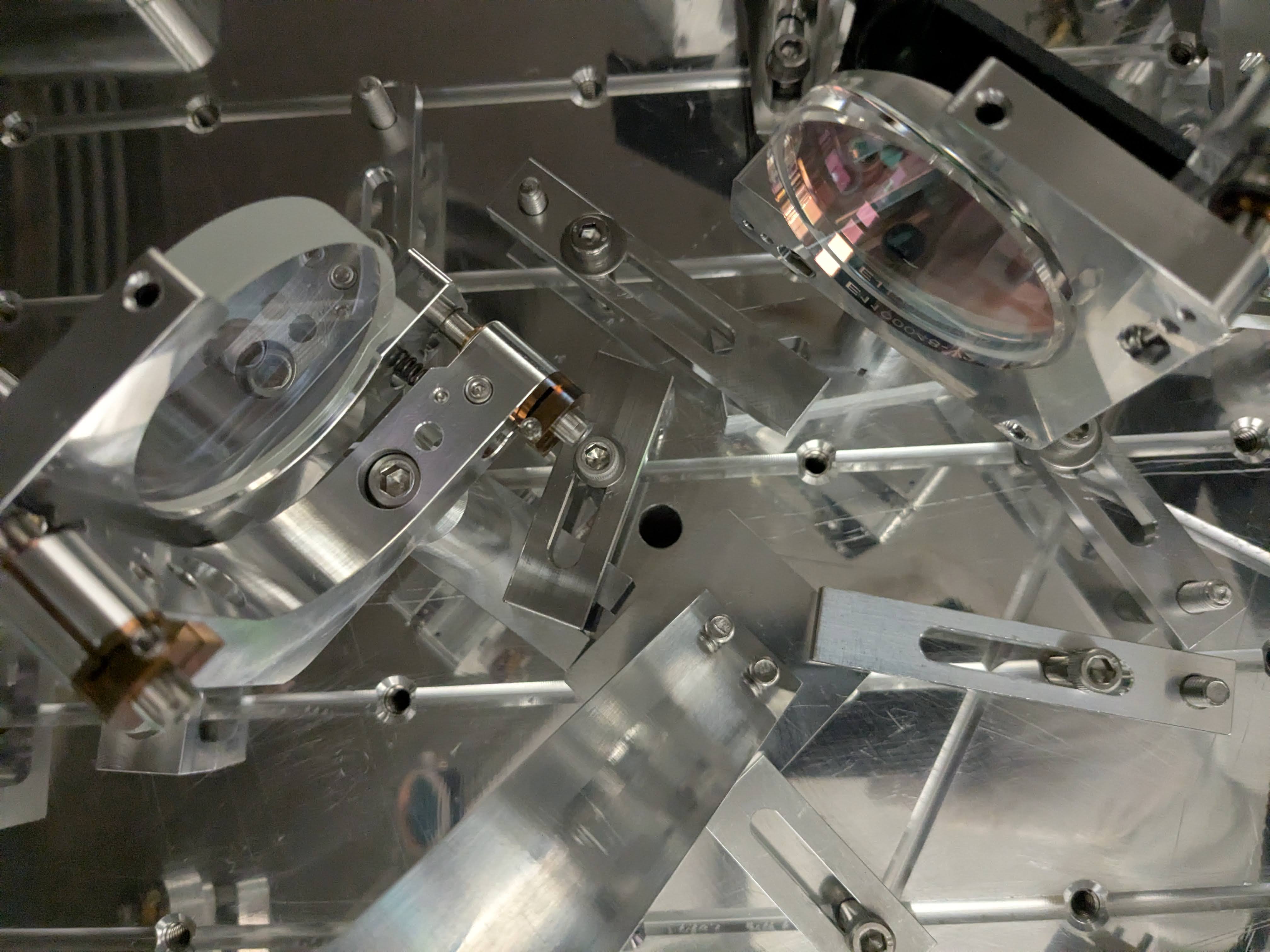
Saturday morning: pico holder on the WFS sled for 50:50 splitter was loose (JennieW, Jason, Keita)

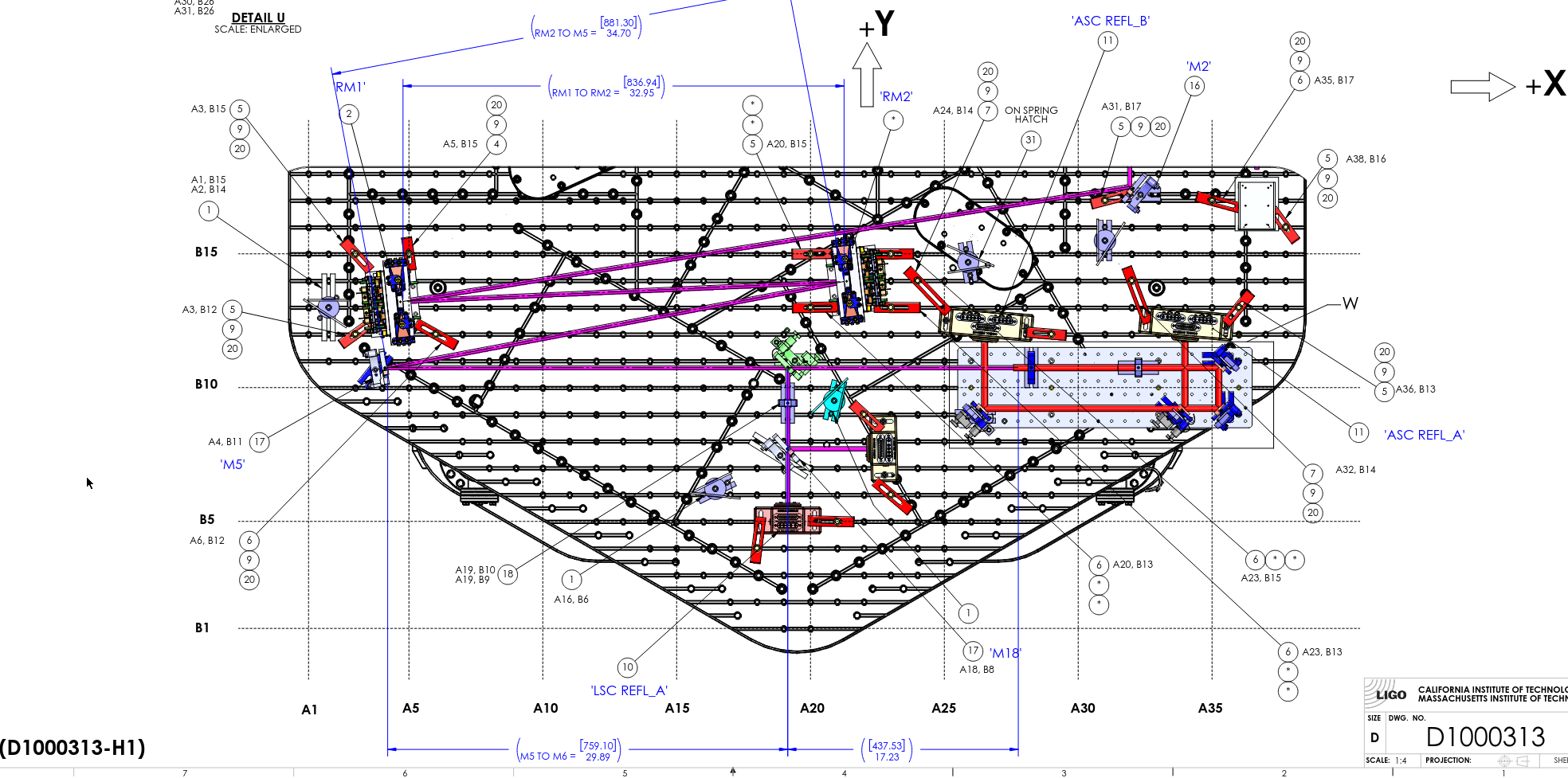
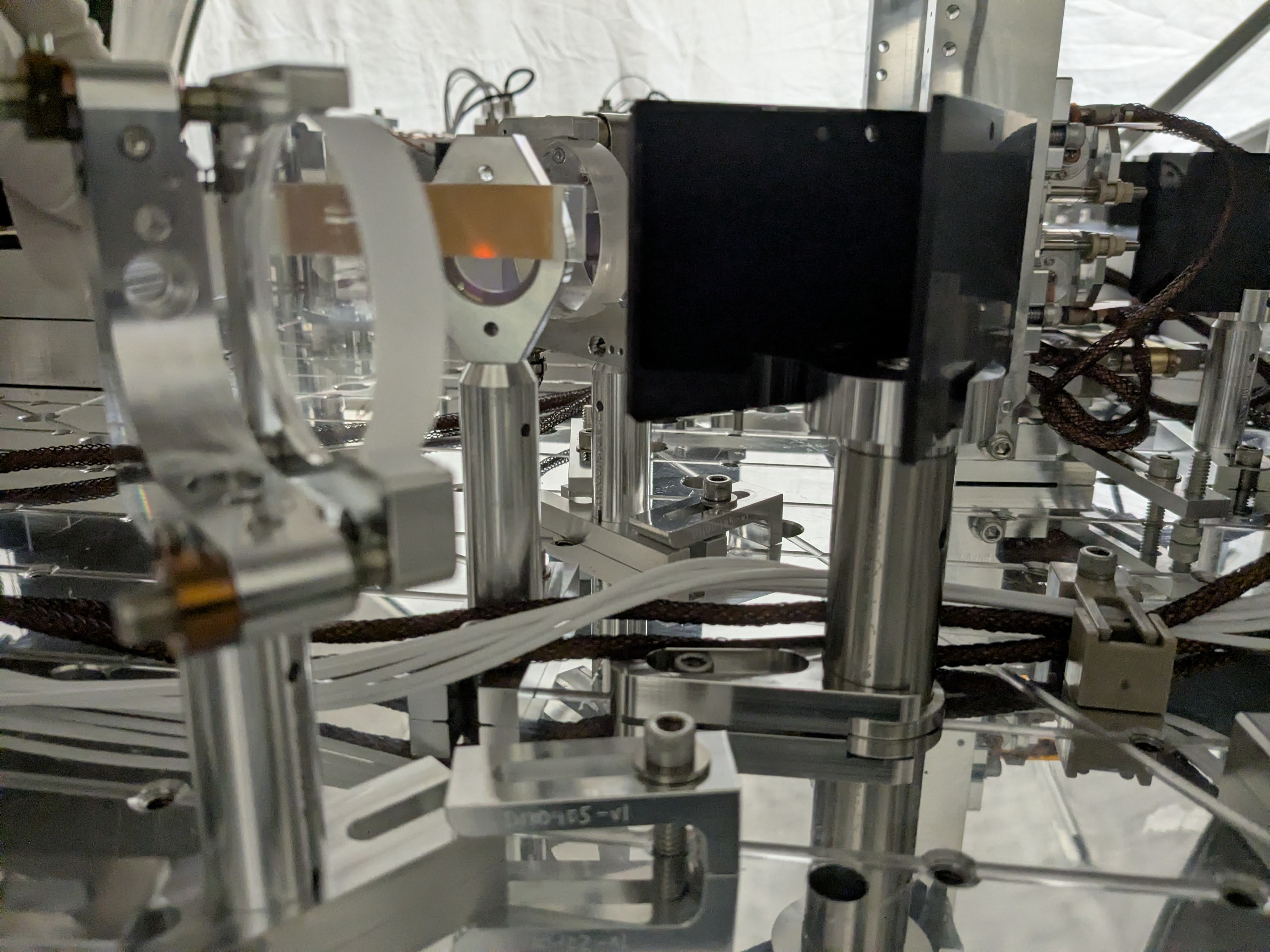
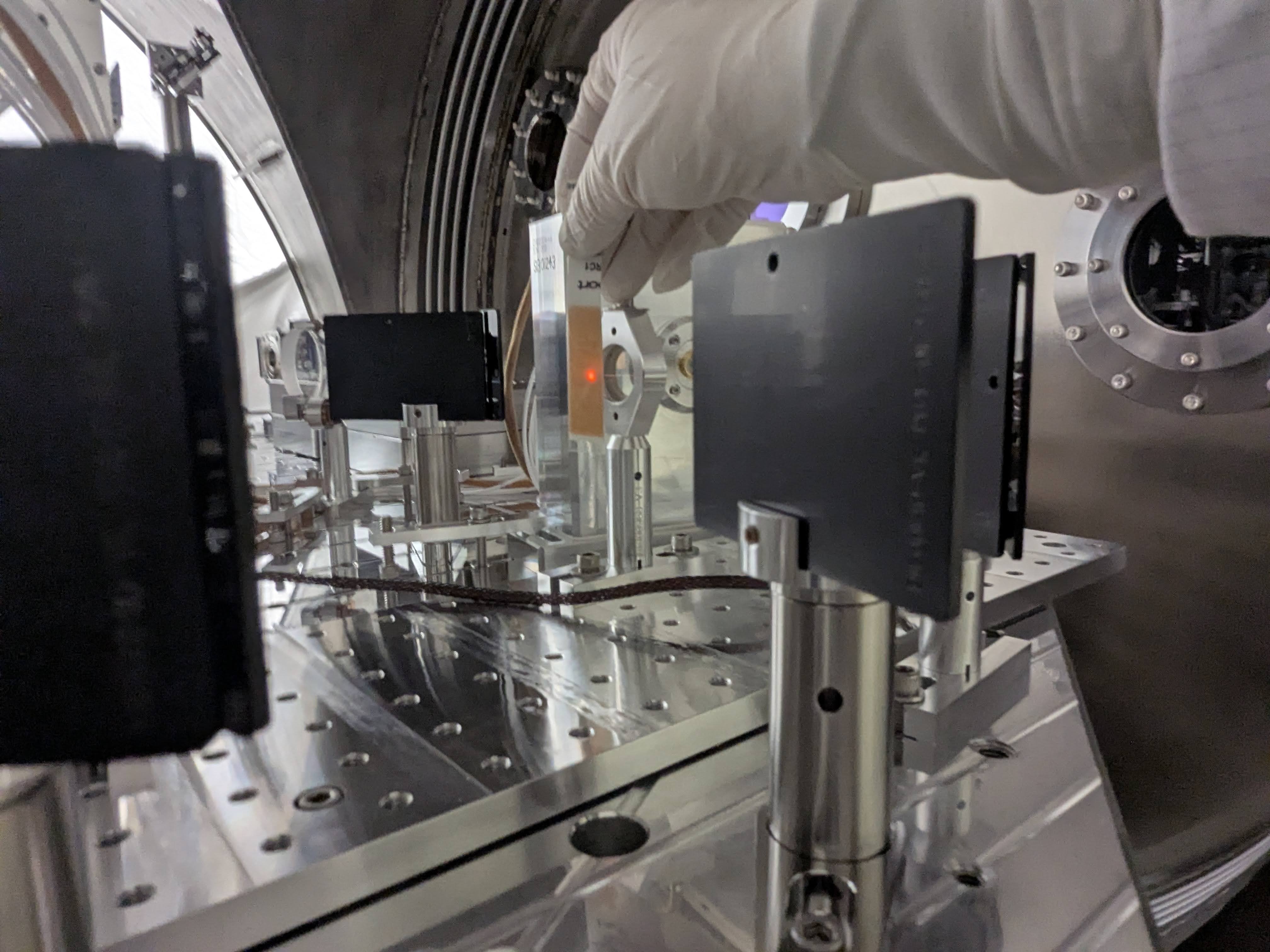
I've found that the pico mount for 50:50 BS on the REFL WFS sled in front of ASC REFL_A was loose and rotated counter-clockwise seen from the top by a huge amount (1st attachment, orange arrows show the direction of rotation). Our guess is that the BS mount was bumped when we were leaning into HAM1 from -Y door to work on the JAC output periscope. In general, it's hard to rotate the mount clockwise seen from the top even if the screw is not super tight (because the screw tends to be tightened), but it's easier to go counter-clockwise.

When this was found, the beam was hitting the +X-Y edge of the mirror, there was no clear reflection beam found so no beam on WFSA, but somehow the ugly transmission beam with lots of diffraction patterns was making it to WFSB.

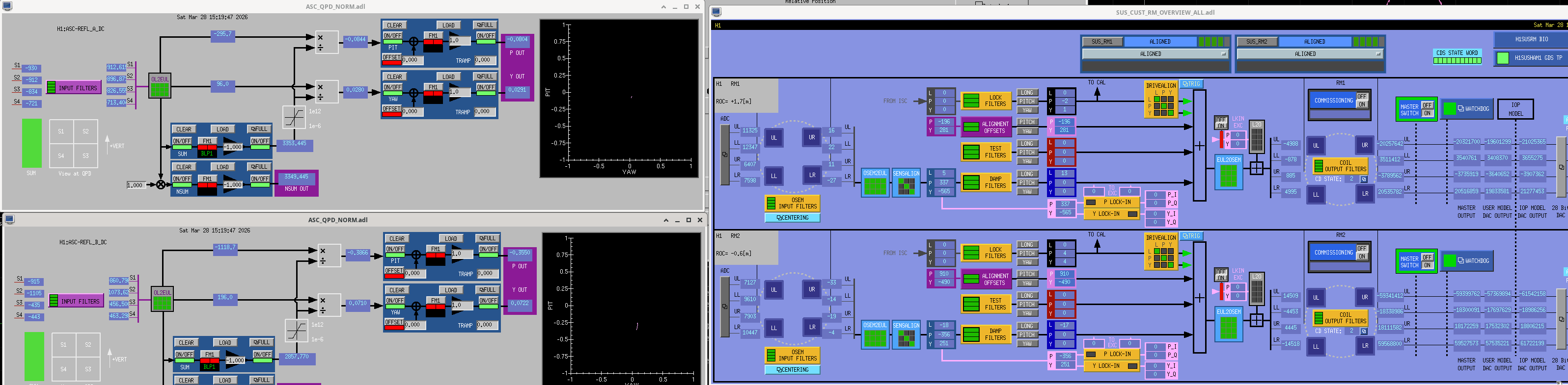
We reverted the RM1 and RM2 bias sliders back to O4 level (RM1 PIT=-180, YAW=-57, RM2 PIT=890, YAW=-530) and I confirmed that the centering on the 2" lens was good. WFSA mount was screwed down tight to the post.

RM1 bias was adjusted further (RM1 PIT=-190, YAW=263) to roughly center the beam on WFSB.

At this point I looked at the beam on WFSA and it was still off mostly in YAW but there was also a large PIT offset. These were taken care of by adjusting the picos I've just screwed down.

I enabled the REFL WFS centering which worked right away. LSC REFL diodes are receiving almost equal amount of light. We'll have to make sure that the beam is not clipped on LSC diodes. Anyway, I relieved the ASC using RM sliders and ended up these numbers: RM1 PIT=-192, YAW=274, RM2 PIT=910, YAW=-532.

Images attached to this report
Non-image files attached to this report
Comments related to this report
keita.kawabe@LIGO.ORG - 17:08, Saturday 28 March 2026 (89686)

Afternoon: Done with the REFL path

Making sure that the beam is centered-ish on the LSC sensors

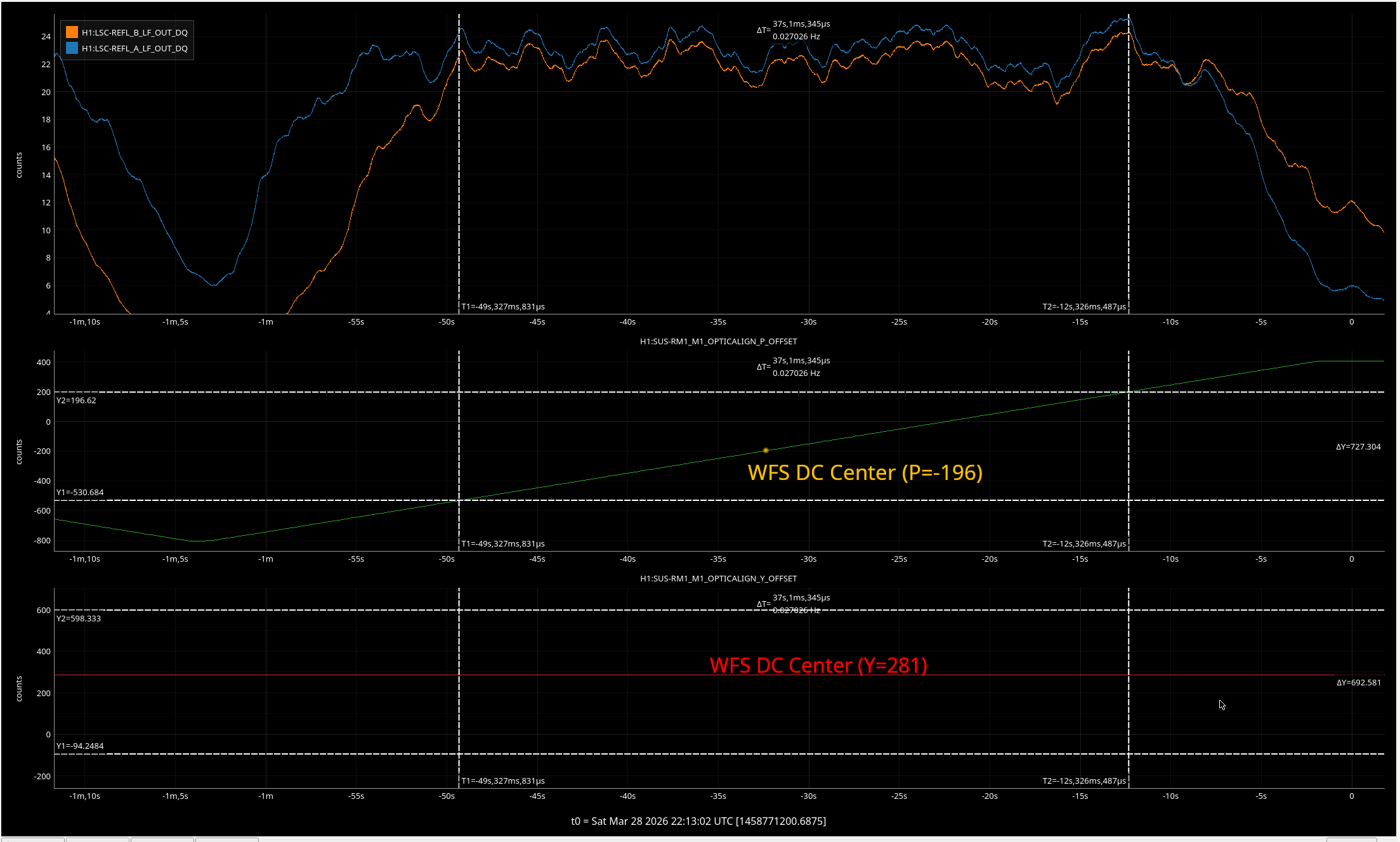
We enabled the WFS DC centering, relieved the WFS output by RM sliders, disabled the WFS centering. Then scanned RM1 in PIT to find out where the LSC REFL A and B DC starts to fall off, and make an average position in terms of RM1 PIT offset ("plateau center"). In general the plateau center is not the same as WFS DC center.

Use the common pico for the REFL LSC sensors to make the plateau center come closer to the WFS DC center. See the 1st attachment.

Repeat the same thing for YAW. We noticed that LSC REFL B is not exactly the mirror image of REFL A, mostly horizontally, as you can see from the 2nd attachment. If they are, we expect both to start falling at the same time but they don't. To fix that we need to touch up the non-pico 50:50 splitter that steer half of the beam to REFL B, but we chose not to do it because the scan range you see here is huge, and beam will totally fall off of WFSB before LSC REFL A and B starts falling.

After all of these and minor tweaks here and there, we ended up with: RM1 P = -196, Y=281, RM2 P=910, Y=-490.

Tilting WFSA in YAW

I checked the beam position along the REFL path and unfortunately the reflection from WFSA was hitting the mirror mount. I tilted the WFS clockwise, paying attention NOT to change the optical path length significantly. After this, Jason and Jennie used pico to steer the beam back to the center of WFS. I confirmed that the WFSA reflection goes into the beam dump.

Final check

I rechecked the beam position along the REFL path. Nothing was grossly off-centered except for 1" mirrors and BS on the WFS sled (this was always the case).

On M2, RM1 and M5, the beam position looked OK though it was hard to say anything quantitatively. No picture for these.

1" lens for the LSC censors, 2" lens on the WFS sled as well as 1" lens on the WFS sled looked good.

Reflection of all LSC and ASC REFL sensors fall on the beam dumps.

Pictures will follow.

No POP check yet

I looked at the POP path too but it wasn't flashing and it was already 4PM so we gave up. We'll continue on Monday.

Images attached to this comment
keita.kawabe@LIGO.ORG - 22:17, Saturday 28 March 2026 (89687)
New_ASC_REFL_A_angle.jpg: After I rotated the ASC-REFL_A angle clockwise seen from the top by about 10 degrees or so.
 
1inLSC_vert.jpg shows the centering on the 1" lens for the LSC REFL. You cannot judge horizontal centering from this picture due to parallax but it looked OK to me.
 
2inOnSled_hor.jpg: Centering on the 2" lens on the REFL WFS sled. Horizontally it's somewhat to the left (+Y) but not too bad. You cannot judge vertical centering due to parallax but it looked OK. See the 1" lens on the sled.
 
1inchOnSled_hor.jpg and 1inchOnSled_vert.jpg: Centering on the 1" lens on the sled. Vertically it's quite good. Cannot tell much horizontally due to parallax, but it looked a bit off to +Y direction to me. Not too bad.
 
LSC_REFL_A_ghost.jpgLSC_REFL_B_ghost.jpgWFSA_ghost.jpgWFSB_ghost.jpg show that reflections from all REFL sensors go to corresponding beam dump.
 
(The last picture (POP_stiffener_base_touching_.jpg) shows how the POP periscope stiffener base touches the base of the REFL path BS that splits the beam to the in-vac and air path. So, this could have made a very minor change mostly in YAW. But anyway it's without doubt that the loose mount on the REFL WFS sled was the main cause of the trouble.)
Images attached to this comment
keita.kawabe@LIGO.ORG - 09:08, Monday 30 March 2026 (89690)

Correction: In the above alog text, "LSC_REFL_B_ghost.jpg" points to the picture for REFL_A ghost beam. This is the correct one: LSC_REFL_B_ghost.jpg.

H1 CDS (CDS, OpsInfo)
keita.kawabe@LIGO.ORG - posted 09:23, Saturday 28 March 2026 - last comment - 09:21, Monday 30 March 2026(89682)
alarm handler is beeping about H1:PEM-CS_DUST_LAB2_300NM

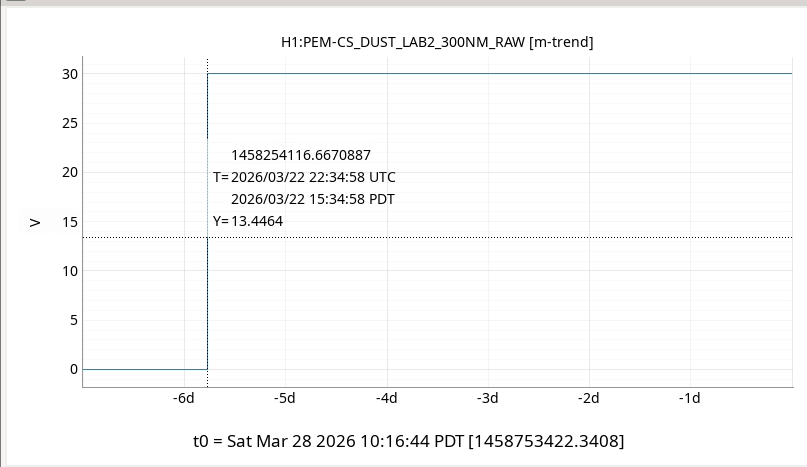
We're getting <HIHI, MAJOR> alarm about H1:PEM-CS_DUST_LAB2_300NM_PCF, which I cannot trend using NDSCOPE, but I can plot H1:PEM-CS_DUST_LAB2_300NM_RAW and that number has been 30[V?] for the past 6 days.

I've silenced it but could somebody check?

Images attached to this report
Comments related to this report
david.barker@LIGO.ORG - 10:21, Saturday 28 March 2026 (89684)

Not sure why this would be alarming today, it has been invalid for many weeks. The 0.3um raw counts went from 0 to 30 last Sunday 15:34 22mar2026, but it looks like the calibrated counts-per-cubic-foot has been NAN or INF for a very long time, which is why it cannot be trended with ndscope.

Perhaps the alarms system was recently restarted and DUST2 is regularly acknowledged on startup?

Images attached to this comment
ryan.crouch@LIGO.ORG - 09:21, Monday 30 March 2026 (89691)

This station (PCAL lab/LAB2) doesn't even have a device connected currently. There have been connections issues here for the past few months that I haven't tracked down yet. I'm not sure why it would have restarted to alarm, but I'll comment this station out of the ioc startup for now.

H1 SPI (CDS, PSL)
jeffrey.kissel@LIGO.ORG - posted 12:56, Wednesday 25 March 2026 - last comment - 10:15, Monday 30 March 2026(89642)
SPI Fiber Patch Cable from PSL to SUS-R2 Installed; Verified Excellent Transmission
F. Clara, J. Kissel, S. Koehlenbeck, J. Oberling, M. Pirello
D2400110

Today we picked up where we left off with the install of SPI into H1. 
Where we last left things, we'd installed a new SPI pick-off of ALS/SQZ beam in Apr 2025 (see ECR E2400083 and results in LHO aLOGs 83989, 83996, 83978). Back then, we had ended the work with the input to the fiber collimator within the PSL dumped.

With Jason and Sina in the PSL, we confirmed that the SPI path was still blocked. 

However, we also realized/remembered/confirmed that the entire ALS/SQZ/SPI path had 25% less power -- We've been running the PSL at lower power allocation downstream of the PMC since Sep 2025 to prevent issues we'd found with the currently installed EOM after a power outage triggered a dust monitor to spew out dust into the PSL (see that saga in e.g. LHO:87109 LHO:86966). They found the power at the SPI pick-off was 140 [mW] instead of the 188 [mW] we left in Apr 2025 (see LHO:83996).

(Using labels in the half-up-to-date drawing D1300348)
Jason and Sina rotated ALS-HWP2 upstream of ALSPBS01 to restore the nominal 50 [mW] into the ALS/SQZ pick-off and ~200 [mW] (190 [mW] measured). This means there's ~50 [mW] less out to ALS / ISCT1 than before today.

Then with the SPI pickoff still dumped, we installed a 30 [m] patch cord*** from the PSL optical table, out the mouse hole between the +X wall of the PSL enclosure and HAM1, then up running along the upper racks to waterfall down at SUS-H2. The fiber sits within the typical orange tubing. Per D2400110, this is SPI_PSL_001, and it's labeled as such on both ends.

After install, I connected the SUS-R2 end to a Thorlabs S121C power meter with S120-APC2 fiber adapter. 
With this installed (making the system laser safe at SUS-R2 end), Jason/Sina unblocked the SPI pickoff input. 
With 190 [mW] in, we measure 187 [mW] out on the other end. 98% transmission, pretty excellent. Almost unbelievably excellent but we weren't rigorous with our uncertainty and systematics.

Happy with this result, we then blocked the SPI path again, and re-capped the SUS-R2 end for final dressing in the racks.
We'll unblock again when we're read to connect it to the Laser Prep Chassis.

***Patch cord details:
Manufacturer DIAMOND
DIAMOND Part Number: ENS/1094388
Customer Part Number: 9711228
Patchcord SM L=30 PM
2xFC 2mm APC (i.e. 2mm narrow key FC/APC on both ends)
tran 6,6/125/245 PAND 980nm


Comments related to this report
jeffrey.kissel@LIGO.ORG - 10:15, Monday 30 March 2026 (89693)SPI
J. Oberling, S. Koehlenbeck
2026-03-27
#BelatedaLOG

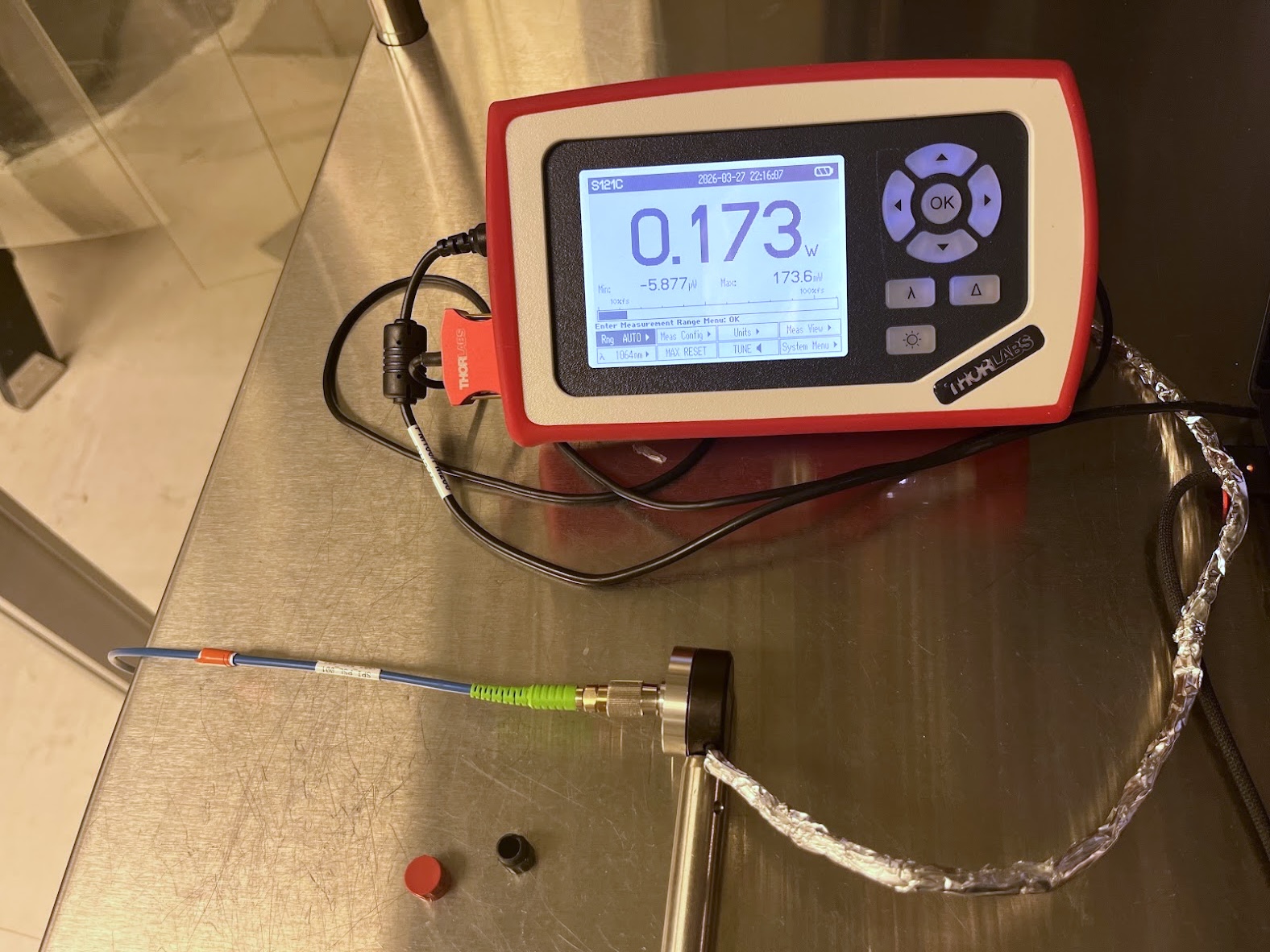
During this power measurement, I made the rookie mistake of overlooking the PM100D power meter console's laser wavelength setting -- and not taking a picture of the display during the measurement.

Today, we both 
(a) retook the measurement at 1064 [nm] with 189.3 [mW] input, and found 173 [mW] output.
(b) confirmed that at 532 [nm] the output read as 188 [mW].
 
For now we set the nominal power into the laser prep chassis as 173 [mW].

After this measurement, we took this same power meter (S121C) and fiber adapter (S120-APC2) into the optics lab and instead used the fiber-coupled NPRO we'd been using to test ISIK in there. We measured the power out of the fiber
    (i) with it fiber-coupled in the same way as the SPI_PSL_001 measurement, and
    (ii) using an addition PAF2-5C collimator to project the beam into free space on to the power meter.

We set the FC-NPRO's power to 177 [mW] in the (i) configuration, but then measured 140 [mW] in the (ii) configuration.
This leads us to suspect that the S120-APC2 + S121C system -- a reflective Si diode, with a shiny metal adapter -- is errantly reporting more power than there really is. We'll repeat the measurement of SPI_PSL_001 another day with a thermal power meter to arrive at our final number.

Images attached to this comment
Displaying reports 1481-1500 of 88618.Go to page Start 71 72 73 74 75 76 77 78 79 End