Routine site inspection revealed that water is accumulating at the LN2 LLCV actuator bowl drain (point-of-use) for CP1 and CP2 -> Found that the corner station instrument air drying tower was working but that the tower regeneration purge rate valve was adjusted to ~15 psi (should be ~65 psi) -> adjusted and opened bowl drains, let air flow until dry. Will check tomorrow.
I torque the ITMY dog clamp bolts to 25 FtLb, as per D0901140.
We noise tested the 24 untested AOSEMs returned from LLO. Seven AOSEMs had lose circuit boards (positioning setscrews were backed off), which were corrected and tuned to >25k open light counts. The remaining 17 AOSEMs have open light counts over 20k counts. These will be tuned to >25k open light counts over the next few days. The open light tuning results will be sent to Stuart Aston at LLO. The noise testing results are posted on the DCC under E1101030, with the individual plots found in S1203453 through S1203476.
Thomas and I started a 2-day measurement at EY to evaluate the drift of the optical levers. For this long measurement, HEPI and ISI are controlled (no sensor correction) and SUS is damped.
If you plan to work at EY, please stop by the control room to inform the operator of the day. Your activity might trip the ISI-HEPI watchdogs and ruin the long measurement.
WP3414 WP3396
The IOP watchdog system between SUS HAM2a, SUS HAM34 and SEI HAM23 was partially re-enabled.
In the new scheme, HAM2A SUS cannot trip SEI HAM23, but SUS HAM34 (actually only the HAM3 SUS of MC2,PR2) can trip SEI HAM23.
Note that if MC2 or PR2 trip SEI HAM23, then all HAM2 suspensions lose their HPI/ISI drives.
This work required restart of h1sush34, h1seih23 and H1 DAQ. For testing I WD tripped MC2, PR2 and MC1 (to prove HAM2 will not trip SEI).
WD MEDM screen was changed to show the new layout.
All tests passed. This closes out the two workpermits.
WP3493
The IOP SUS watchdog system between FMY,ITMY and SEI BSC8 was disabled. This prevents a SUS test on one test stand from tripping the ISI test on the other test stand. This is a transition workpermit which was closed. If in the future an ISI/SUS stack is constructed on the test stand the watchdog can be re-activated.
Re-energized the following devices at the Y end station which were turned off on Friday, Oct. 5, 2012 for software debugging: H2-SEI-C1 rack - (3) coil drivers, reset overtemp condition after powerup. H2-TCS-C1 rack - Ring heater driver, A/I filter box. H2-SUS-C1 rack - (3) A/I filter boxes.
Attached are plots of dust counts > .3 microns and > .5 microns in particles per cubic foot. The data was taken from approximately 6 AM to 7 PM.
Andres R, Gerardo2 M. and Jeff B. Today we moved the ITMY from its H2 one arm test position to its H1-BSC1 position. No problems were encountered during the move or with mounting the QUAD to the BSC.
During any spare moments last week, whilst waiting for test results to come in, I spent time configuring the digital system for the remaining suspension models that are already up and running. - Infrastructure created for BURT snapshot files at, for example, "opt/rtcds/userapps/release/sus/h1/burtfiles/sr2". - BURT infrastructure put under SUS svn control. - Set-up for M1, M2 and M3 stages nominal Watchdog limits, i.e. sensor DC monitors of -30000 to +30000, sensor AC rms monitors of +8000, actuator AC rms monitors of +25000. Also, switched in required "dcBandLim" and "acBandLim" filter banks. - Configured OSEM INPUT FILTERS with default gains (+1) and offsets (-15000), for M1, M2 and M3 stages. Also, switched in required "deWhite" filter banks. - Populated OSEM2EUL matrix with values generated with "make_sushsts_projections.m" and written using "fill_matrix_values.m" scripts (see LLO aLOG entry 2508 for an example). - Populated EUL2OSEM matrix with values generated as above, for M1, M2 and M3 stages. - Verified correct sign convention used in both OSEM2EUL and EUL2OSEM matrices (as detailed in LHO aLOG entry 4350). - Populated SENSALIGN matrix using Matlab blkdiag(1,1,1,1,1,1) function and "fill_matrix_values.m" script, for M1, M2 and M3 stages. - Configured DAMP filter gains using default values for SR2 + PRM (HSTSs), and PR3 (HLTS). Also, switched in required filter banks. - Configured DRIVEALIGN matrix, manually turning off non-diagonal elements, for M1, M2 and M3 stages. - Configured COIL OUTPUT FILTERS gains (signs) for M1, M2 and M3 stages. n.b. the M1-SD BOSEM gain is switched to (+1) for PR3 (HLTS). Also, switched in required filter banks. n.b. updated compensation filters have already installed for all HSTS and HLTS suspensions (see LHO aLOG entry 4359). - Turned ON damping loops for each DOF, but turned OFF M1, M2, and M3 Master Switches, so that new SAFE BURT snapshot could be taken for SR2, PR3 and PRM. - Moved BURT snapshots from "target" directory, to "userapps" directory i.e. from "opt/rtcds/lho/h1/target/h1sussr2/h1sussr2epics/" to directory under sus svn control "opt/rtcds/userapps/release/sus/h1/burtfiles/sr2". - Committed new BURT snapshots to sus svn, "h1sussr2_safe.snap", "h1suspr3_safe.snap" and "h1susprm_safe.snap". These digital systems are now ready to receive the next suspensions for Phase 2a testing chamber-side, most likely this will be PR3 (HLTS). The final piece of the puzzle will be to input/transfer OSEM gains and offsets.
While H2 DAQ was down today I copied the complete set of slow controls PEM minute trend data from H2 DAQ to H1 DAQ using the same procedure followed yesterday for VE and FMCS data.
The H1 DAQ was restarted, it is now serving the full look back of DUST and WEATHER data.
I put all the H1 and H2 DAQ hand edited configuration files into the cds_user_apps SVN repository under trunk/cds/h[1,2]/daqfiles
Files put under SVN
Attached are plots of dust counts > .3 microns and > .5 microns in particles per cubic foot. The data was taken from approximately 6 AM to 6 PM. Also attached are plots of the modes to help show when the data was valid. The large gap is from when the H2 DAQ was down.
Ref WP#3489
Prior to this work, EY H2 Coil drivers were disabled to prevent any damage occuring to ETMY and TMSY (Vern Sandberg and Jim Batch).
Various H2 front ends were rebooted by Alex. The failure of all front end data as detected by the DAQ data concentrator was eventually reproduced, along with the spontaneous crash of h2dc0 when the front end recovered.
Alex spent most of the day with the H2 DAQ down while he tried various upgrades to the MX_STREAMS drivers and code on the concentrator.
By 4pm the H2 DAQ was returned to operational. At around the same time the H1 DAQ was restarted with a complete set of VACUUM and FMCS channels, so that when the H2 DAQ is taken down over the weekend these channels will continue to be trended.
Alex will continue this work through to Monday. The aim is that the bug whereby a single front end restart/reboot invalidates all front ends data for many minutes at a time will be resolved.
Ref WP#3492
Due to today's H2 DAQ work, I reconfigured H1 DAQ to also acquire the VACUUM and FMCS EPICS channels. The process was:
h2ldasgw0 and h2ldasgw1; stop acquiring data, tar up the raw minute files for all the VE and FMCS channels. These tar files were 62GB and 48GB respectively, and have 277 and 382 number of channels respectively.
compess the VE and FMCS tar files, size reduced to 18GB and 8GB respectively.
copy the h2ldasgw0 files to h1ldasgw0, copy the h2ldasgw1 files to h1ldasgw1. Uncompress and install the VE and FMCS files into the minute_raw trends dirctory on h1ldasgw[0,1]
Reconfigure h1fw0 and h1fw1 to acquire VE and FMCS files. The H0EDCU_VE.ini and H0EDCU_FMCS.ini files were copied from H2 DAQ to H1 DAQ.
The H1 DAQ was restarted. VE and FMCS data in full frames, second frames and minute frames started from scratch. The raw minute trend frames were then appended with the latest data, and all previous minute trends are available back to the VE and FMCS epoch.
In addition, the H1 TIMING EPICS channels from the h1ecatc0 IOC were added to the frame. These channels cover the status of the H1 Timing Master in the MSR. The new channels have the prefix H1:CDS-TIMING_
The new ini file is called H1EDCU_TIMING.ini
Patrick reminded me that a trend of this weekend's dust monitors would be also valuable to preserve, so I have just added the H0EDCU_PEM.ini to the H1 DAQ (dust and weather station data). In this case I did not have time to copy the raw minute trend files, so these channels are starting from scratch at 18:30 Friday.
In prep for a possible move next week, we've installed the cookie cutter, cleared a path on the ISI table, removed a bunch of the QUAD dog clamps, and disconnected all of the QUAD cables such that the ITMy is ready to swing 90deg into it's new position.
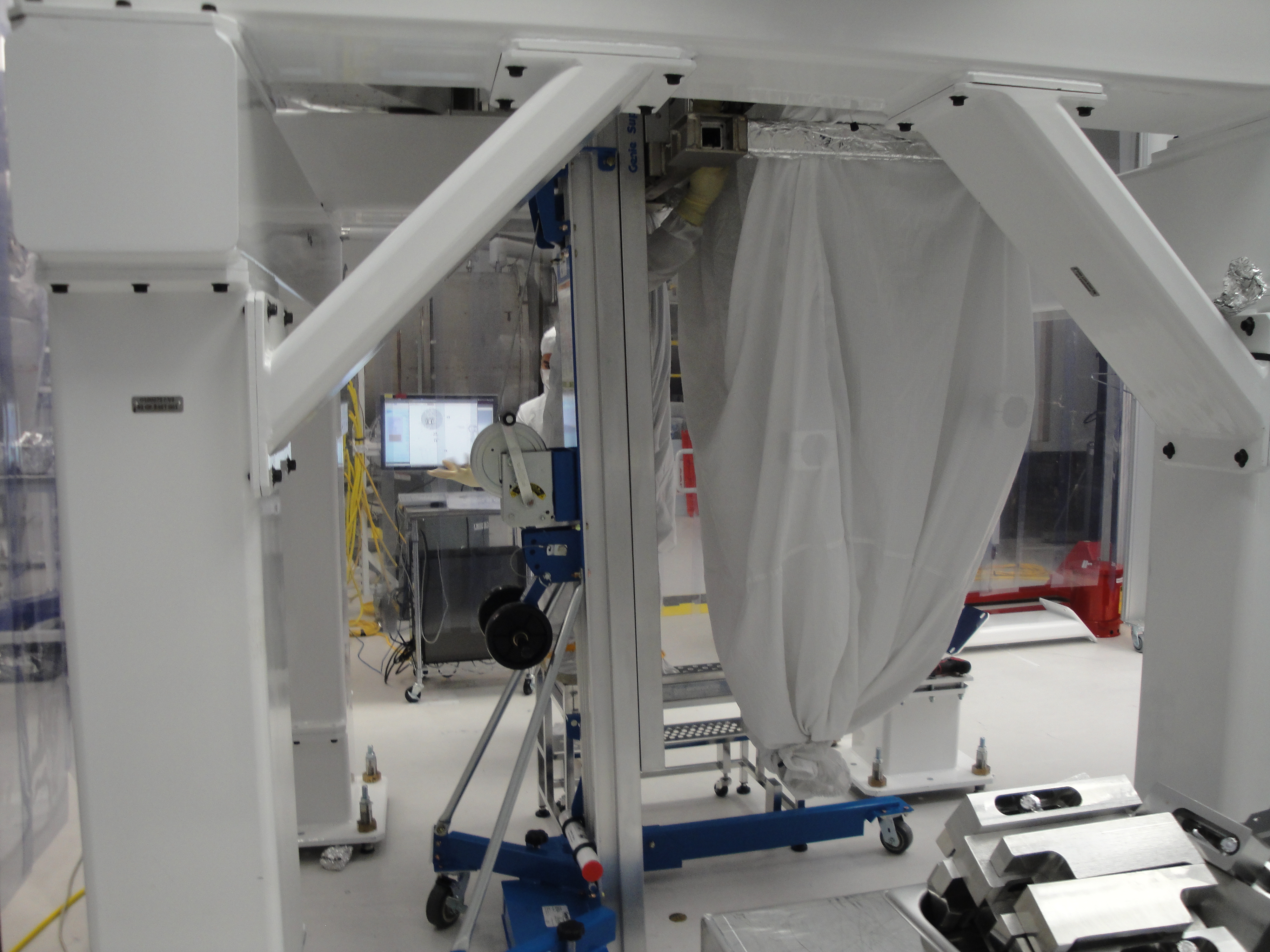
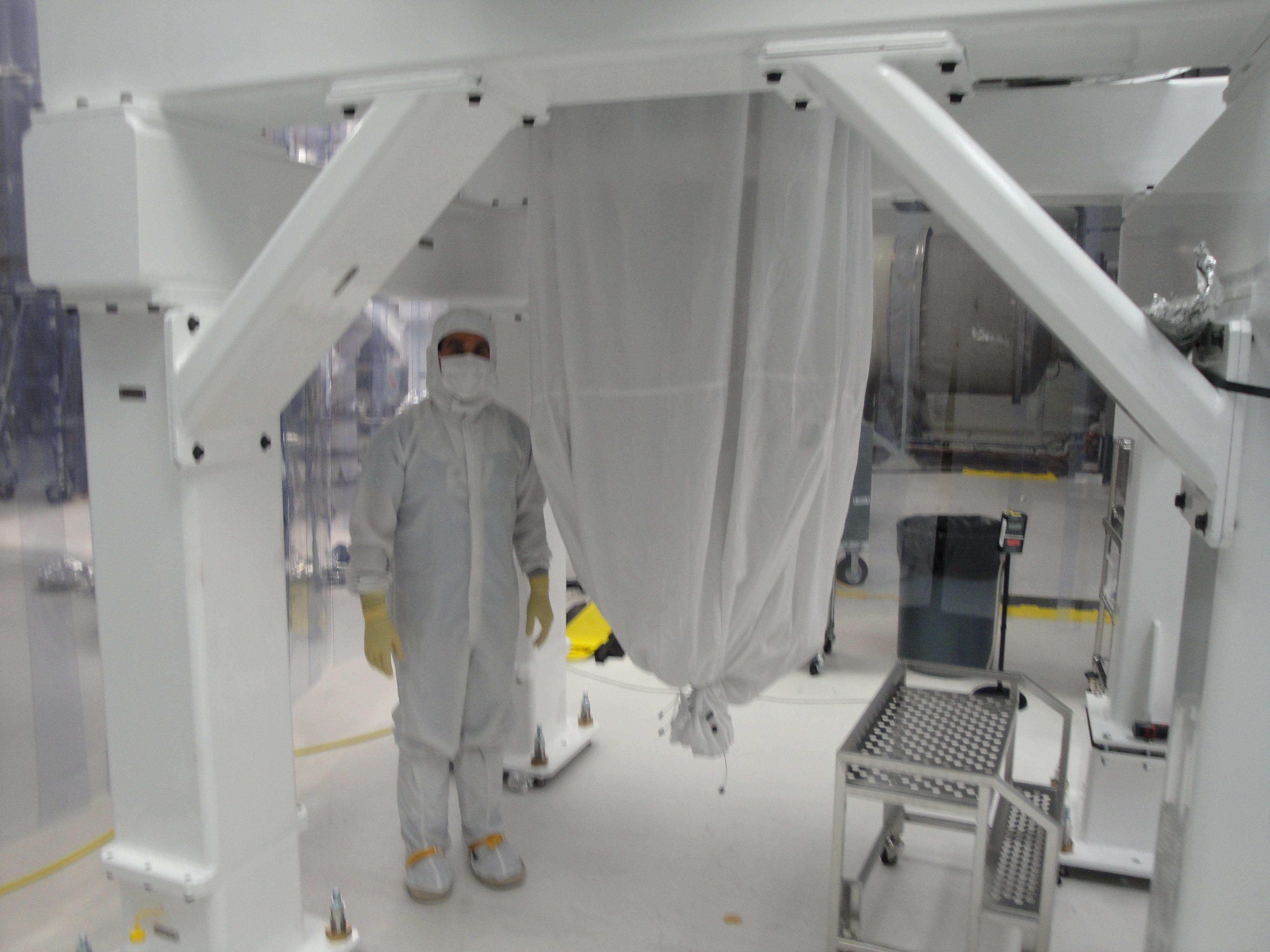
After 2 days and some heroic efforts by a few guys, whose identities shall remain incognito, the formerly-known-as-FMy full suspension has been removed from under the test stand and parked just outside of it. It is strapped to a leg of the test stand now and will be relocated to the BSC2 ISI in another week or after the ISI finishes a few rounds of testing. The maneuver was particularly difficult since the QUAD was still under the ISI, taking up a lot of real estate.
HughR, GregG, JimW Between yesterday afternoon and today, the stage 2 of this assembly had its cap sensors aligned, gapped, then the stage was floated and leveled. After more cps fine tuning, a first pass at cable routing and a round of locker tuning I think stage 2 is pretty well dialed. On Monday we will do more of the same on stage 1, then one more pass at cabling. After that, this ISI should be ready for its first round of testing.
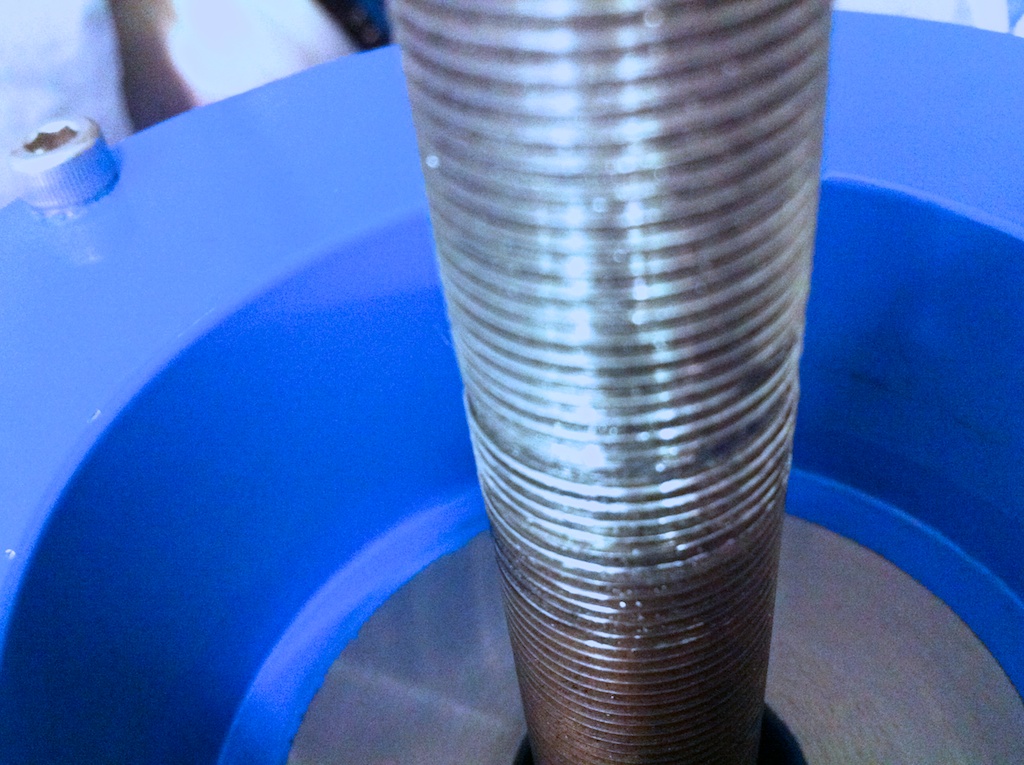
After HAM1 needed a large movement to rectify some measurement issues the springs had come into hard contact with the side of the housing collar. I re-centered the springs and loaded the weight back to the previous values. This brought the support tubes to +- 25 thousandths of an inch. During the process of bringing the support tubes to nominal one of the springs started to bind, and after removing the nut one could see several demolished threads. Tyler G. expertly repaired them and I replaced the spring. The support tubes are now sitting within +- 5 thousandths although with the amount of activity around the dial indicators some of those values may be adulterated. After I locked the HEPI feet down I re-zeroed the dial indicators and hopefully placed them in better positions for when IAS can shoot the table.
There was some concern about the threads of the spring. The threads were cleaned up on the lathe knocking out the material that had been deposited in the root of the thread. This added a bit of slop where some crests had been lost but I flipped the spring in the housing so the areas supporting the tension of the spring are on good threads.
Mark B. Resuming work on BSFM02. Will take damped and undamped TFs and damped and undamped spectra.
Mark B. Done for the day. Undamped TF data is 2012-09-26_1900_X1SUSBSFM02_M1_*_WhiteNoise.xml, and damped TF data is 2012-09-26_2000_X1SUSBSFM02_M1_*_WhiteNoise.xml . Plots for these data set are appended. I've added the appropriate lines to plotallbsfm_tfs.m and committed it but I haven't run it - I want to check that it does the right thing with data taken on H2 but filed as X1. Spectra time segment starts are startTimeRef.gps = 1032753893; % GPS Start Time Damping OFF startTimeRes.gps = 1032752625; % GPS Start Time Damping ON I still need to generate plots for these and the ones earlier today, but as mentioned previously, first I have to modify plotbsfm_spectraBSFM02.m to accept X1 data (the script it's based on was hard-wired to L1/H1/H2).
Mark B. Here the comparison plot with all the BSFM02 data plus some for the real H2 FMY and X2 BSFM06. The noise in the BSFM02 data sets is rather worse than X2 BSFM06 (but comparable to H2 FMY), so it looks like we don't have the best drive parameters. However it does look like noise and there don't seem to be any significant features common to the noisy bits of 2012-09-25_1100 and 2012-09-26_0900.
Mark B. After some discussion with Stuart, I processed the spectrum data from 7/26/12 morning and evening two ways. First I used a custom plotbsfm_spectraBSFM02.m to process it as X1/BSFM02/BUILD01 with tags of 2012-09-26_0900 (morning) and 2012-09-26_1900 (evening) with names like ^/trunk/BSFM/X1/BSFM02/BUILD01/SAGM*/Results/2012-09-26_*900_X1SUSBSFM02BUILD01H2:SUS-FMY_*.pdf So if anyone is looking for the data by following the directory structure in the usual fashion for a Phase 1b test, appropriate plots will be there. The captions in these plots also specify X1 BSFM02 primarily and H2 FMY secondarily. We also used the stock plotbsfm_spectra.m to process the data purely as H2:FMy with names like ^trunk/BSFM/H2/FMY/SAGM*/Results/2012-09-26_1900_H2SUSFMY_*.pdf This is so that it can be found by the stock version of plotallbsfm_spectra.m, which Stuart felt was too much hassle to customize. We added two new lines to the measList section with comments to the effect that the suspension in each case was really BSFM02. Attached is a set of comparison plots with the morning and afternoon's data. Unfortunately we couldn't include the 'L1','BS','2012-09-24_1200' dataset because it doesn't seem to have been committed from LLO.
In preparation for the Acceptance review, I redid the TF plots with up-to-date comparisons.
Red: 3IFO Phase 1b undamped (2012-09-26_1900)
Pink: 3IFO Phase 1b damped (2012-09-26_2000)
Black: H1 BS Phase 3b undamped (2013-07-30_1059269030)
Orange: L1 BS Phase 3b undamped (2013-08-29_0900)
Because the data was taken on a mechanical test stand in the LVEA with other work going on around, it is somewhat noisy (especially up to about 0.6 Hz in most DOFs and throughout in P) and the damping is a bit strong, but the peaks in the undamped TFs are very clean and in exactly the right positions.
I also redid the spectra with comparisons.
Green: 3IFO BS 2012-09-26_0900
Red: 3IFO BS 2012-09-26_1900 (later the same day)
Cyan: H1 BS 2013-02-25_1000 (on BSTST test stand)
Purple: H1 BS 2013-07-24_1400
Blue: L1 BS 2013-11-27_0930