Displaying reports 82201-82220 of 86139.Go to page Start 4107 4108 4109 4110 4111 4112 4113 4114 4115 End
Reports until 11:22, Friday 31 August 2012
X1 SEI
corey.gray@LIGO.ORG - posted 11:22, Friday 31 August 2012 (4052)
Final LHO-Built HAM Boxed Up

(corey, greg, jim, justin, mitchell)

This morning we boxed up HAMISI#7 (destined for HAM#4).  This took about 2-2.5hrs.

H1 AOS
thomas.vo@LIGO.ORG - posted 09:54, Friday 31 August 2012 (4051)
H1 Optical Levers Drilling
Eric J, Thomas V, Apollo


The holes to set pylons and giraffes are drilled on the input side of H1, this includes the HAM2 and HAM3 optical lever transceivers as well as the PR3 transmitter and receiver(giraffe).  We also set the dwarf pylons down on the anchor bolts and are currently looking to have viewports placed in before installing more delicate components.

The H1 output side is being laid out and drilled today as well.

H1 SEI
corey.gray@LIGO.ORG - posted 09:00, Friday 31 August 2012 (4049)
Another Early Morning Quake Trips A Few SEI Watchdogs

Mag 7.6 earthquake (or an aftershock) in the Phillipines tripped the BSC8 HEPI & ISI and BSC6 HEPI.

H1 SEI
greg.grabeel@LIGO.ORG - posted 08:42, Friday 31 August 2012 (4048)
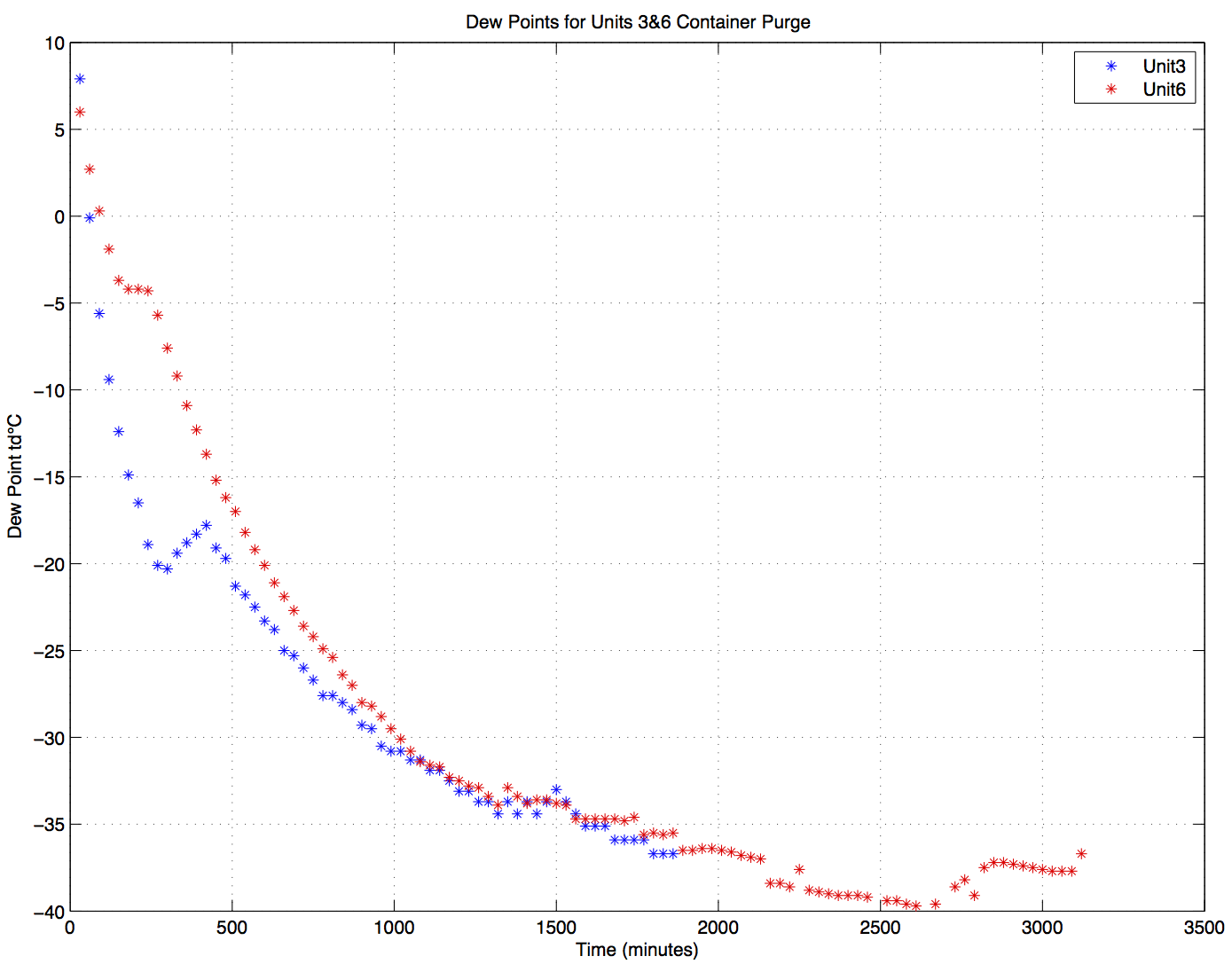
Unit 3 HAM purge
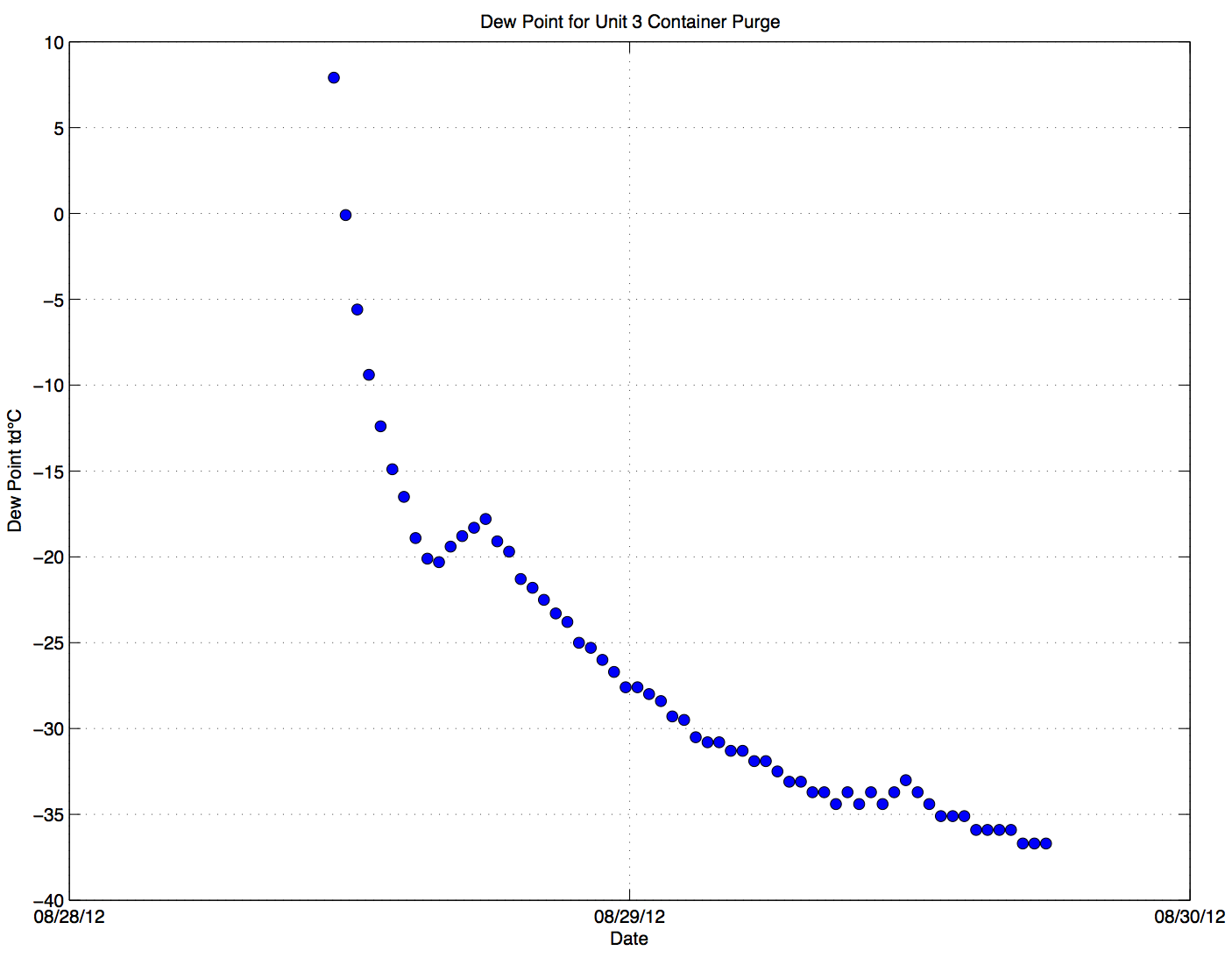
Unit 3 HAM had its cabling and pods removed on the 28th and was resealed in a storage container. A purge was started shortly thereafter. Interestingly the time it took to drop below -25 td°C was very similar to Unit 6 which had cabling and viton. 
Images attached to this report
LHO General
patrick.thomas@LIGO.ORG - posted 18:41, Thursday 30 August 2012 (4046)
plots of dust counts
Attached are plots of dust counts > .5 microns in particles per cubic foot.
Non-image files attached to this report
LHO VE
kyle.ryan@LIGO.ORG - posted 17:01, Thursday 30 August 2012 (4045)
West Crane out-of-service -> postponing BSC1 16.5" feedthrough flange work


H2 ISC
alberto.stochino@LIGO.ORG - posted 16:42, Thursday 30 August 2012 (4044)
WFS sensing matrix still not good

With the arm cavity locked I tried to measure again the WFS sensing matrix. It still looks almost degenerate in both PIT and YAW.

These are the measurements:

sensP =
   1.0e-03 *
   -0.2374    0.2929
   -0.1506    0.1611
sensY =
   1.0e-03 *
    0.0133   -0.1897
    0.0177   -0.2023

And these are inverted matrices:

iP =
   1.0e+04 *
    2.7373   -4.9782
    2.5596   -4.0341
iY =
   1.0e+05 *
   -2.9772    2.7915
   -0.2610    0.1953

The measuremetns are at about 4 Hz.

They look quite bad. I won't even try to impelment them.

H2 ISC
alberto.stochino@LIGO.ORG - posted 16:38, Thursday 30 August 2012 (4043)
Arm cavity stably locked

The arm cavity is stably locked since 23:15 UTC.

There is only damping enabled on the ISI. We turned the isolation off because it was causing the oscilaltions at few tens of mHz on the reflected power.

H1 PSL
michael.rodruck@LIGO.ORG - posted 16:15, Thursday 30 August 2012 (4040)
PMC mode matching

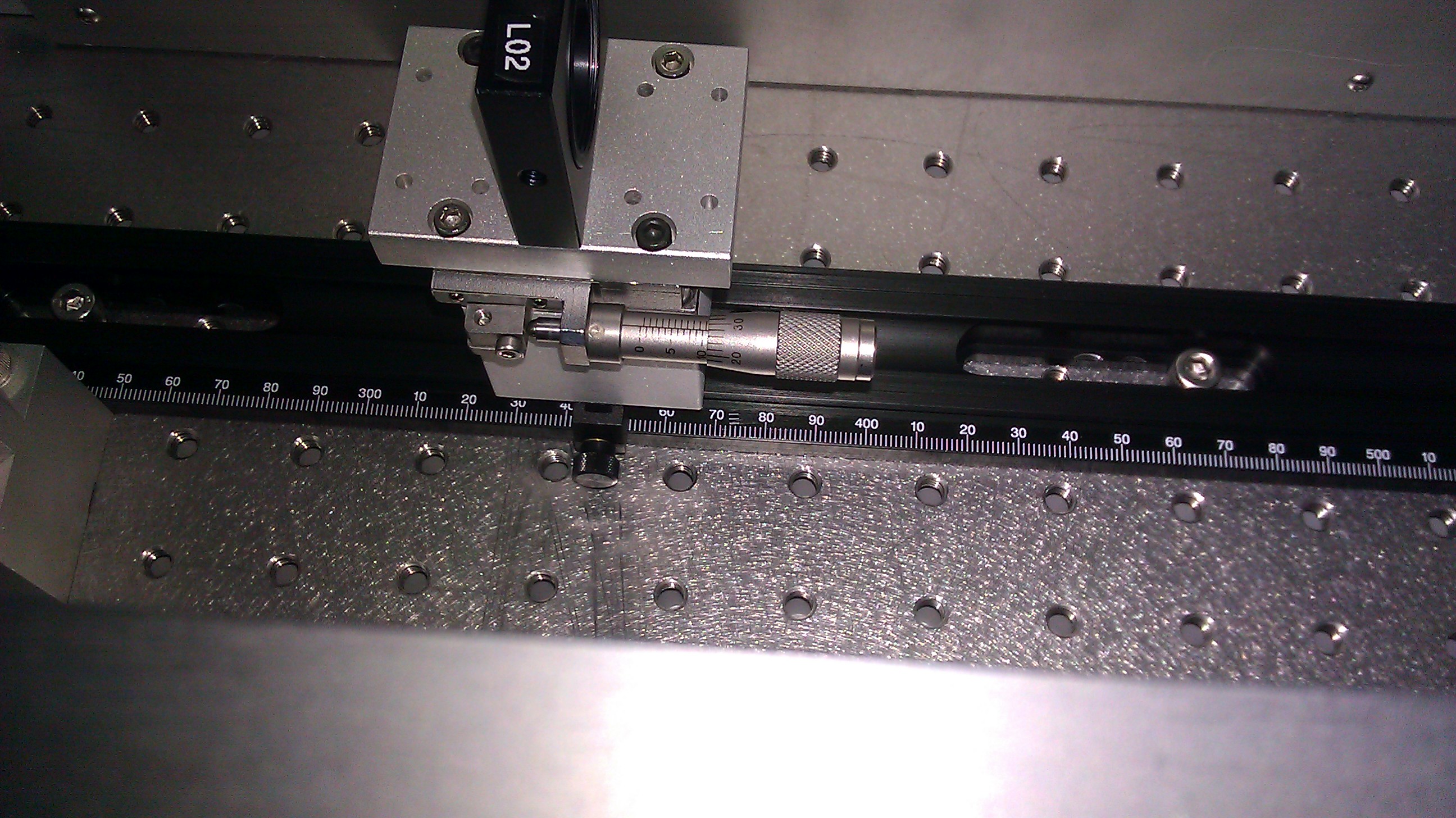
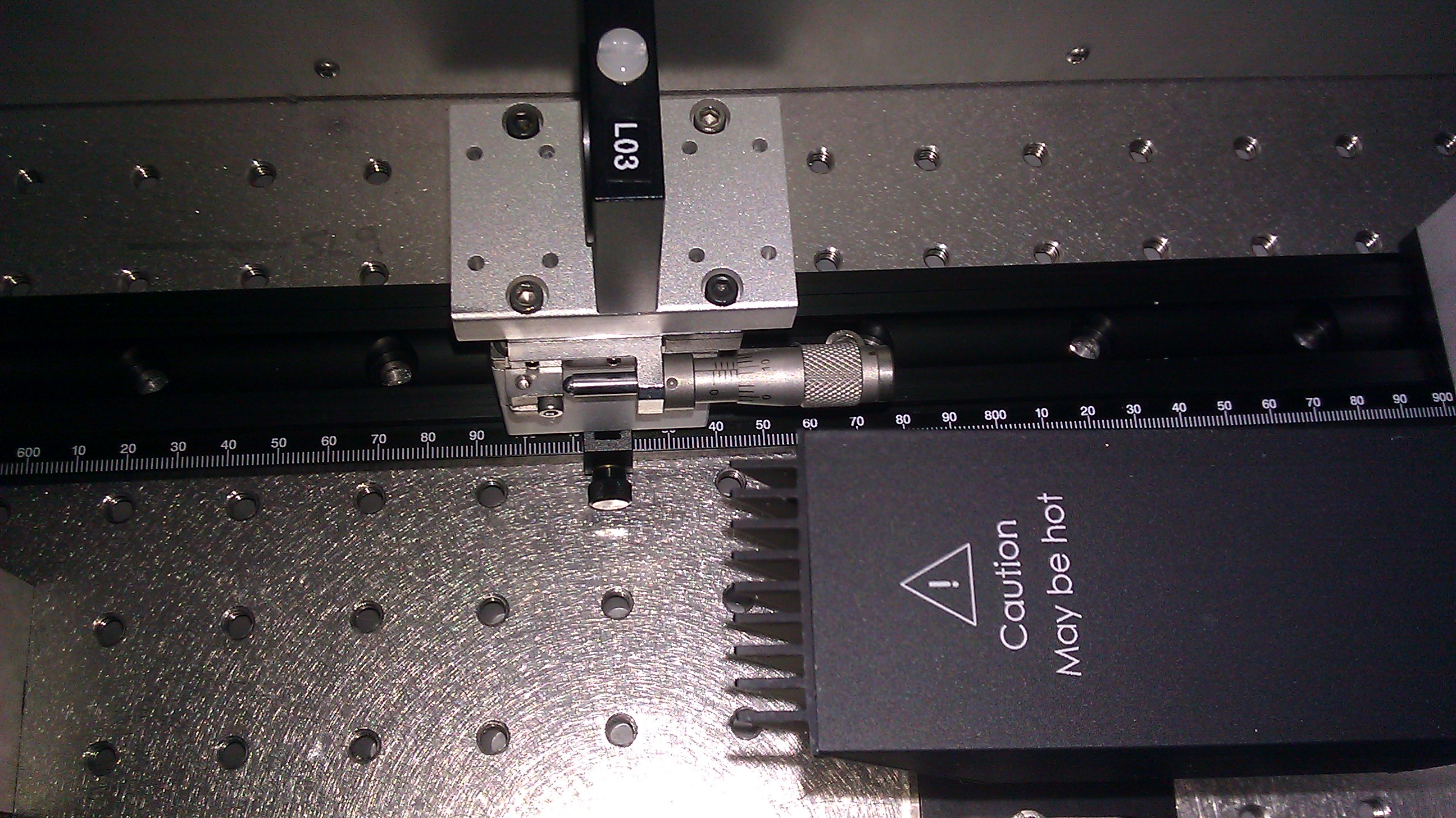
This is a summary of fine tuning the mode matching into the PMC for the 35W laser. The attached spreadsheet lists the power of each mode looking at ISS_PDA_DC hooked into an oscilloscope. The position of the lenses L2 and L3 is measured from the lens's block's edge facing HAM1. After moving a lens the alignment peak was minimized to below 10mV and was not included in this spreadsheet. Mode power is measured in mV and going to the 'right' of the 00 mode. The strongest peak is the last one (first to the 'left') and looks similar to a 11 Laguerre-gaussian mode. I believe the second mode listed is the 02 mode, however most are too faint to see clearly.

The best position appears to be

L2: 368mm

L3: 738mm

Note that this is very different for the 200W laser. For the 200W laser, the lenses are at:

L2: 310mm

L3: 728mm

I do not have other numbers for the 200W laser.

Images attached to this report
Non-image files attached to this report
LHO General
corey.gray@LIGO.ORG - posted 16:14, Thursday 30 August 2012 (4032)
Morning OPS Summary

One-Arm Test yielded morning to "noisy" activities; goal was to have some cavity locking & Wavefront Sensor work later.

Apollo drilling for oplev piers in morning (and a little in the afternoon)

Giacamo/Cheryl:  SUS AUX assembly work in LVEA (after lunch)

Hugh going to check BSC6 to look at HEPI (morning)

Alex going to EY optics lab to inventory TMS (morning)

Bubba squaring up main crane by hitting bumpers, but this activity ended up tripping/deactivating the crane.  Will be investigated in the morning (manlift required)

Scotty doing some quick drilling (1:50-2:10)

Eric doing feedthru protection work (avoiding HAM3 due to OAT)

Keita at EY lab (left at 3:30)

H2 ISC
alberto.stochino@LIGO.ORG - posted 11:32, Thursday 30 August 2012 (4039)
Reference cavity healed?

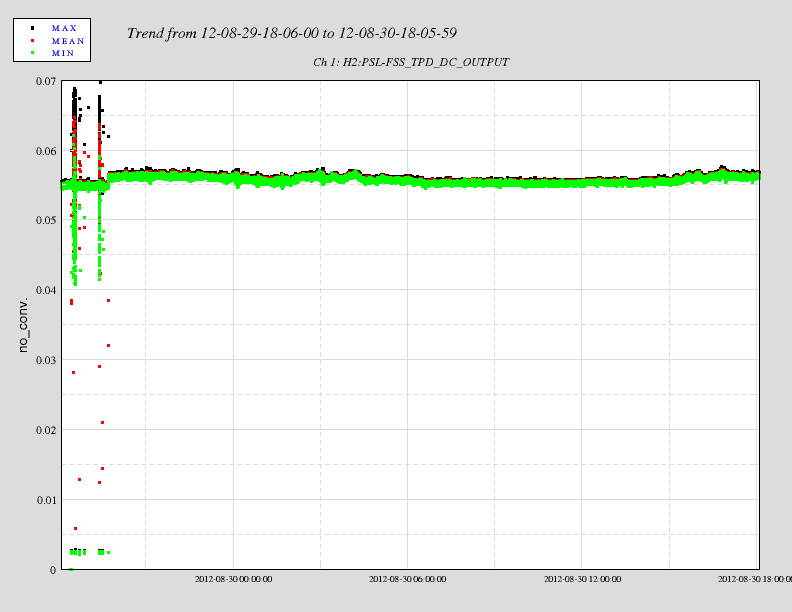
The reference cavity has been locked continusously, with no glitches for about 24 hours. It's not clear why, since yesterday no one even touched the FSS.

Anyways, we're happy about that and we hope it'll last.

Attached is a 24 hr trend of the cavity transmitted power. On the left end you can see the glitches that we were having before.

Images attached to this report
H1 PSL
michael.rodruck@LIGO.ORG - posted 10:45, Thursday 30 August 2012 (4038)
PSL plots

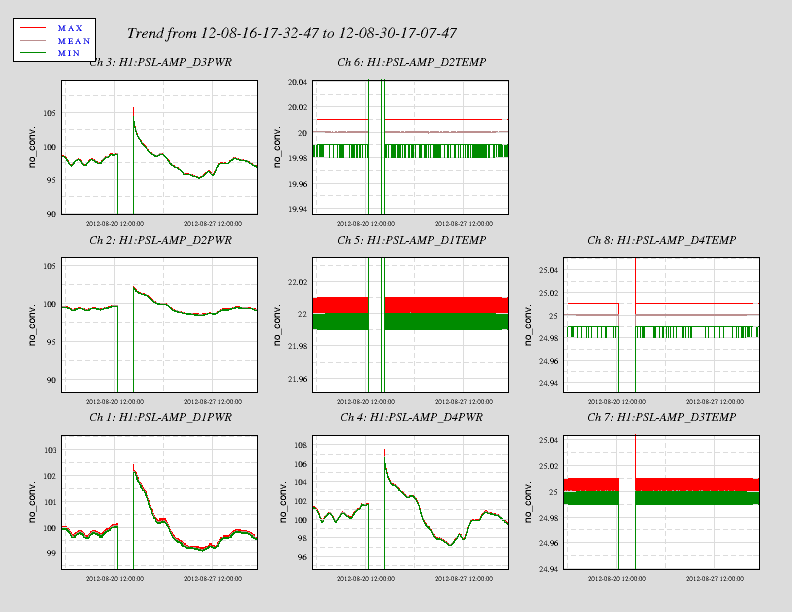
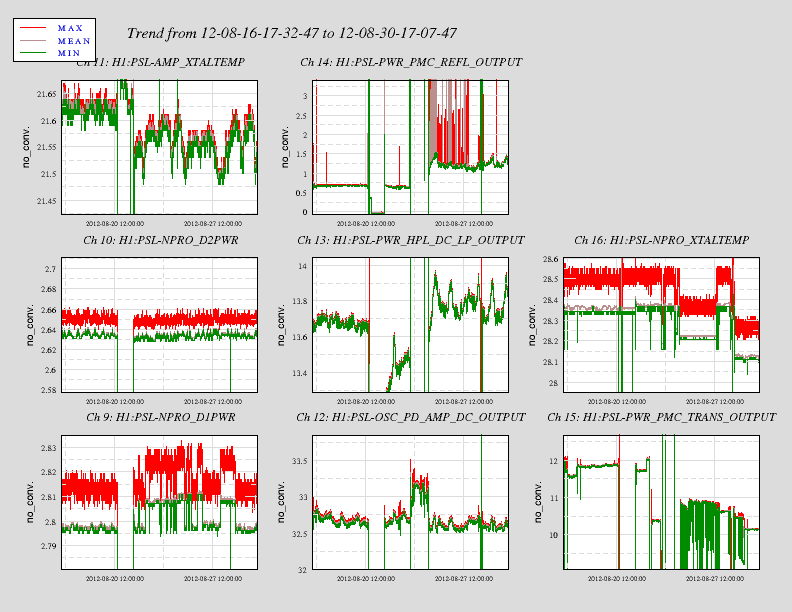
35W beam

Images attached to this report
Non-image files attached to this report
H1 SUS
jeffrey.bartlett@LIGO.ORG - posted 10:28, Thursday 30 August 2012 (4037)
H1-PRM First TFs
Andres and I ran the first set of transfer functions on H1-PRM yesterday. The results are posted in the attached files. There is a problem with P, R, and V. We are checking the suspension for EQ stops rubbing, OSEM alignment, and Flag positioning and will rerun the transfer functions after taking corrective action. 

The first set of transfer functions were taken in the afternoon with no one in the Triples Lab (where the suspension is located) and only light assembly work (no forklifts, moving BSC plates, etc) underway on the ground floor.  As a test, I repeated taking the transfer functions last night after everyone had left the staging building for the night. There was no difference between the TFs taken during the day and at night. Conclusion: As long as the Triples Lab is empty and there is limited activity in the rest of the staging building, we should be able to test suspensions during normal working hours.      
Non-image files attached to this report
H1 SEI
corey.gray@LIGO.ORG - posted 10:22, Thursday 30 August 2012 (4036)
6.8 Greenland Earthquake Trips SEI Watchdogs

This morning at 14:11utc (7:11am Pacific time) a couple of earthquakes reached us.  This tripped both BSC8 & BSC6 ISI & HEPI.  The initial quake was a 6.8 (13:43utc) & the aftershock was 5.2 (13:51utc).  Attached is a trace of one of the SEI Watchdogs (i.e. BSC8 ISI Stage1).

Non-image files attached to this report
H2 General
jaclyn.sanders@LIGO.ORG - posted 09:42, Thursday 30 August 2012 (4033)
Cavity scan methodology

During a cavity scan, a second modulation is applied to the laser frequency. The response of a Fabry-Perot cavity to laser frequency modulation contains information about the cavity parameters, including cavity length, free spectral range, modal spacing, and the radius of curvature of the cavity optics. The goal of cavity scans is to measure cavity characteristics and characterize their time evolution in response to heating of the optics.

While the 532 nm ALS laser is locked to the arm cavity, laser frequency modulations are injected into the Innolight Prometheus frequency-doubled laser through the laser frequency servo (Common Mode A) with an SR785 signal analyzer. These frequency modulations are transmitted into the 1064 nm beam used for PSL phase locking and the 532 nm beam used for arm cavity locking. The PSL phase locking beam does not interact with the arm cavity, and the signal from the RF photodiode is used as a proxy for the signal injected into the arm cavity. The arm cavity reflection photodiode gives the output signal, which the SR785 divides by the input signal to produce a transfer function.

Automation of SR785 measurements is necessary to perform and store transfer functions in quick succession over a period of hours. A Prologix GPIB-Ethernet controller is used for remote control and retrieval of data from the SR785. Scripts for performing transfer functions and retrieving data using the GPIB-Ethernet interface were created for use at the 40m interferometer, and were used for cavity scan transfer functions here. The Python script exttt{TFSR785.py} performs a single transfer function.

A bash script, exttt{autoTF}, was used to repeatedly call this Python script. This script was originally set to perform one scan from 30kHz to 80kHz, alternate smaller scans around the first-order modes (from 46-47 kHz and from 65.75-66.75 kHz) three times, then repeat until 12 hours elapses or the script is terminated. During the scan, it was found that the first-order peaks moved further than anticipated, so the script was altered to scan from 45-46 kHz and 66.75-67.75 kHz. In future scans, the smaller scans will be run from 45-47 kHz and 65.75-67.75 kHz for the duration. For all scans, the amplitude of the excitation was 10 mV, and 10 averages were used.

The ALS laser output power is 100 mW, and the SR785 excitation output current is 100 mA. Therefore, the modulation depth for these cavity scans is 0.1, or 1% of power in the modulation sidebands.

The attachment cavity_characterization.pdf contains a more thorough explanation of the motivation behind cavity scans, and some preliminary results. The attachment cavityshift.pdf plots a cold cavity scan and a cavity scan after 2.5 hours of heating on the same axes, showing the shift in modal spacing with ITM heating.

Non-image files attached to this report
H1 AOS
giacomo.ciani@LIGO.ORG - posted 08:57, Wednesday 29 August 2012 - last comment - 12:46, Thursday 30 August 2012(4023)
HAUX: small progress towards testing
[Alex, Deepak, Cheryl, Giacomo]

Yesterday we finished alignment of the remaining 2 HAUX. All 4 are aligned and hooked up.
The optical lever setup is in place, but no pitch balancing has been done yet.

Electronics is up and running, the model has been restored to a clean working state after reboot, and BURT saved:
- all OSEMs offsets and gains set
- Damping filter set to (what I think are) reasonable values (no much though on this as of now: they just work to damp the optic) and set to the off state
- Hardware LP filter set to ON (but see later)
- Coils TEST enable flag set to 1.
- Master switches are off

Note that although the hardware for binary IO is on, apparently there is no state change when we change the flags in the software. It is not clear if status is not changed, or if is changed but not reported. This will need to be investigated this morning.
Comments related to this report
filiberto.clara@LIGO.ORG - 12:46, Thursday 30 August 2012 (4031)
Added missing (Binary) cables in rack SUS-C3, from IO chassis (FE IO Chassis 2 HAM-A Controls) to Binary Input and Output Chassis. This only solved part of the issue, since the Enable and Disable bits were not switching. Opened up HAM A Coil Drivers and removed jumpers for Disable / Enable. With the jumpers in place, the state would not change regardless of input. No jumpers should be installed in P3 and P4. 

All four HAM-A Coil Drivers had the jumpers removed. 
S1201163
S1201160
S1201158
S1201161
H2 CDS
david.barker@LIGO.ORG - posted 17:42, Tuesday 28 August 2012 - last comment - 12:40, Friday 31 August 2012(4019)
H2 maintenance day

About 50% of the H2 front ends were upgraded to RCG 2.5.1 last week, this week I cleanly rebuilt and restarted all H2 frontends against 2.5.1 in conjuction with the timing change.

All of H2's timing signals were moved from the old h2 timing master to the new h1 timing master. The old h2 timing master is being decommissioned.

errors in the burt restore of the safe.snap files were seen on h2peml0, h2tcsitmy and h2pemey (my problem, I'll fix these).

Problems with a large ADC input on h2hpietmy is being tracked to a HEPI pump issue at EY.

The 24MHz RF amplifier at EY is showing a timing problem on the fanout, and its fpga led is blinking red sometimes.

Comments related to this report
daniel.sigg@LIGO.ORG - 12:40, Friday 31 August 2012 (4056)
Fixed timing synchronization of the EY RF source by power cycling the unit.
H2 SUS
keita.kawabe@LIGO.ORG - posted 13:25, Tuesday 28 August 2012 - last comment - 12:00, Friday 31 August 2012(4007)
ETMY POS to cavity length and oplev measurements from yesterday

We measured the transfer functions to the cavity length from M0 POS, L1 POS and L2 POS, when the cavity was locked and only M0 was damped.

At the same time we also measured the transfer functions from the same actuation points to the OPLEV signals.

Two main goals of this were:

1. To see if L2 stage (penultimate mass) drive was working fine. There has been speculations but no definitive answer.

2. To provide a set of measured data for SUS so hierarchical control effort could be accelerated.


Anyway, if you're only interested in the plots see attached. Frequency points are kind of sparse and not even (the former is constrained by time, the latter is by the fact that I'm throwing away low coherence data).

Plots as well as data files etc. are all under /ligo/home/controls/keita.kawabe/OAT_2012/ETM_M0_L1_and_L2_POS_to_L3

Everything was checked into svn: /ligo/svncommon/SusSVN/sus/trunk/QUAD/H2/ETMY/Common/Data/2012-08-27_H2SUSETMY_M0_L1_L2_POS_to_L3

[Update 13:30-ish 28/Aug/2012]

The plots are now normalized by the L2L element of the drivealign matrix, as that was 1 for M0 and L2 (as it should be) but 10 for L1 for whatever reason.

Non-image files attached to this report
Comments related to this report
keita.kawabe@LIGO.ORG - 13:30, Tuesday 28 August 2012 (4009)

Two things that are obvious from the plots:

(Updated 13:30-ish Pacific, 28/Aug/2012) 1. L2 drive is working. It is about a factor of 120 or so weaker than L1, and L1 is about a factor of 6 weaker than M0 (see page 1).

1. L2 drive is working. It is about a factor of 12 or so weaker than L1, and L1 is about a factor of 60 weaker than M0 (see page 1).

2. Cavity length to angle coupling could be problematic at resonances (see page 4). At DC for M0, it seems to be 0.1rad/m in a ball park, and and even if we feed back 1um RMS this is 0.1urad RMS, which sounds OK.

keita.kawabe@LIGO.ORG - 10:59, Tuesday 28 August 2012 (4010)

One thing that is not obvious from the plot:

For L2 drive, I had to use a ridiculously large excitation (+-120000 counts, half about a quarter of the range of 18bit DAC considering the output matrix of 0.25) with ridiculously long integration time (e.g. 160 seconds) to get a good coherence for f>1Hz. The background noise is too large.

This practically means that, as others pointed out, L2 is going to be railing if the ALS signal is fed back to L2 with a UGF of 1 Hz.

0.1Hz might be possible, but 1Hz, not likely.

keita.kawabe@LIGO.ORG - 13:32, Tuesday 28 August 2012 (4012)

Other things:

When the measurement was done, L2 stage driver FM2/3/5/6/7 were on while FM1 was off.

EUL2OSEM output matrix elements for M0 (for two lower face coils F2 and F3) were (0.5, 0.5).

EUL2OSEM output matrix elements for L1 and L2 (for all four coils) were both 0.25*(1, 1, 1, 1).

keita.kawabe@LIGO.ORG - 06:57, Friday 31 August 2012 (4047)

Update Aug/31/2012

In the above entry,

"When the measurement was done, L2 stage driver FM2/3/5/6/7 were on while FM1 was off."

this was  incorrect but I cannot edit it any more, it seems. It should read


" L2 stage driver FM2/3/6/7/8 were on while FM1 was off." 

jeffrey.kissel@LIGO.ORG - 12:00, Friday 31 August 2012 (4053)
J. Kissel, B. Shapiro

I attached plots comparing Keita's transfer functions to what I expect from the model. Executive summary: 5 of the 9 transfer functions measured match my model exquisitely -- All L to L TFs, and the TOP to TST, and PUM to TST L to P TFs. Of the remaining TFs: I don't expect the model to predict the L to Y coupling well at all, but I'm still baffled as to why the UIM to TST L to P transfer function doesn't match up. 

Comments / questions / concerns welcome. I really haven't yet been able to get a warm and fuzzy feeling about a lot of this data. So, take it with a grain of salt.

You'll notice that among the series of plots is the predicted maximum range for each stage. Please don't read too much into these numbers, I haven't yet verified them against Norna's numbers (see T1100595), taking into to account the differences between her numbers and mine (mostly the maximum range of the coil driver, updated to use the real, recently measured, transconductance of the coil drivers times the 10 [V] DAC range.) BUT I know that frequency response is accurate, because it uses the latest and greatest measured responses. 

Notes / Details:
- There are fudge factors that I don't yet understand. They're explicitly called out in the legend, but they're summarized here:

                  %L  P  Y
driveAlignGain = [-1 -1 -1;... % M0
                  -5 -5 -5;... % L1
                   1  1  1];   % L2
meas(iStage,iDOF).tf = meas(iStage,iDOF).tf / driveAlignGain(iStage,iDOF);
 
As Keita mentions, I expect the L1/UIM fudge factor to be 10 not 5, from the driveAlign gain. 
I'm NOT really that surprised that we got the sign wrong on M0 and L1, but I don't know yet where it lies.

- The modeled M0-only damping loops are not *exactly* representative of what Matt tuned a month or 3 ago, but they should be close enough. I expect the overall gain to be different, and I expect the low frequency bump filters to be different, but otherwise they should match pretty well.
Non-image files attached to this comment
H2 ISC
matthew.evans@LIGO.ORG - posted 00:16, Thursday 19 July 2012 - last comment - 15:17, Thursday 30 August 2012(3490)
OAT - first dither alignment

It is a long way from being robust, and it is quite slow, but the cavity dither alignment worked this evening.  The commands are:

YAW
./tdsdither 1.9 30 4 0 300 H2:SUS-ITMY_M0_TEST_Y_EXC H2:ISC-ALS_EY_REFL_PWR_MON_OUT H2:SUS-ITMY_M0_OFFSET_Y 10 5
./tdsdither 2.3 50 5 0 300 H2:SUS-ETMY_M0_TEST_Y_EXC H2:ISC-ALS_EY_REFL_PWR_MON_OUT H2:SUS-ETMY_M0_OFFSET_Y 10 5

PIT
./tdsdither 1.9 30 4 90 300 H2:SUS-ITMY_M0_TEST_P_EXC H2:ISC-ALS_EY_REFL_PWR_MON_OUT H2:SUS-ITMY_M0_OFFSET_P 10 5
./tdsdither 2.3 50 5 30 300 H2:SUS-ETMY_M0_TEST_P_EXC H2:ISC-ALS_EY_REFL_PWR_MON_OUT H2:SUS-ETMY_M0_OFFSET_P -10 5
 

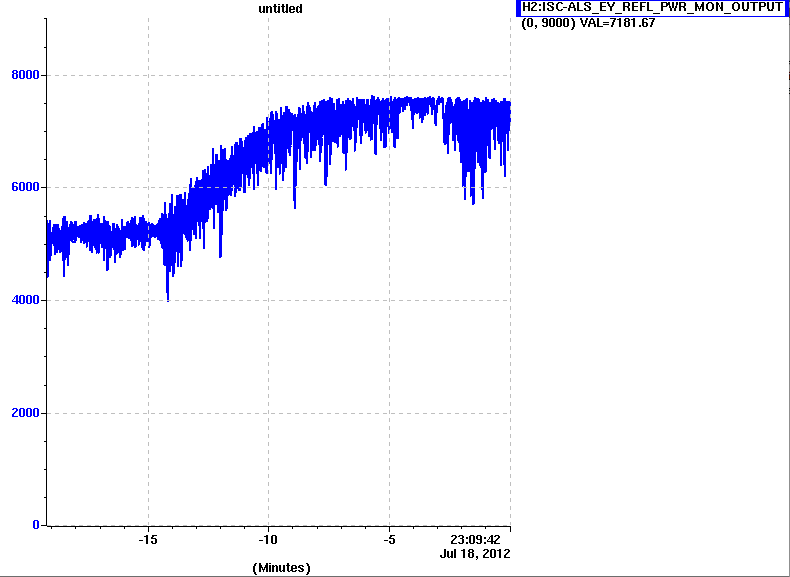
The new tdsdither is a perl script replacement for the malfunctioning ezcademod which currently lives in userapps/trunk/isc/common/scripts.  The attached image shows the power increase as the ITM and ETM alignment are dithered.

Images attached to this report
Comments related to this report
alberto.stochino@LIGO.ORG - 15:17, Thursday 30 August 2012 (4042)

With the new channels names the commands are:

PIT

./tdsdither 1.9 30 4 90 300 H2:SUS-ITMY_M0_TEST_P_EXC H2:ALS-Y_REFL_B_PWR_OUT H2:SUS-ITMY_M0_OFFSET_P 10 5

./tdsdither 1.9 30 4 90 300 H2:SUS-ETMY_M0_TEST_P_EXC H2:ALS-Y_REFL_B_PWR_OUT H2:SUS-ETMY_M0_OFFSET_P -10 5


YAW

./tdsdither 1.9 30 4 90 300 H2:SUS-ITMY_M0_TEST_Y_EXC H2:ALS-Y_REFL_B_PWR_OUT H2:SUS-ITMY_M0_OFFSET_Y 10 5
./tdsdither 1.9 30 4 90 300 H2:SUS-ETMY_M0_TEST_Y_EXC H2:ALS-Y_REFL_B_PWR_OUT H2:SUS-ETMY_M0_OFFSET_Y 10 5

Displaying reports 82201-82220 of 86139.Go to page Start 4107 4108 4109 4110 4111 4112 4113 4114 4115 End